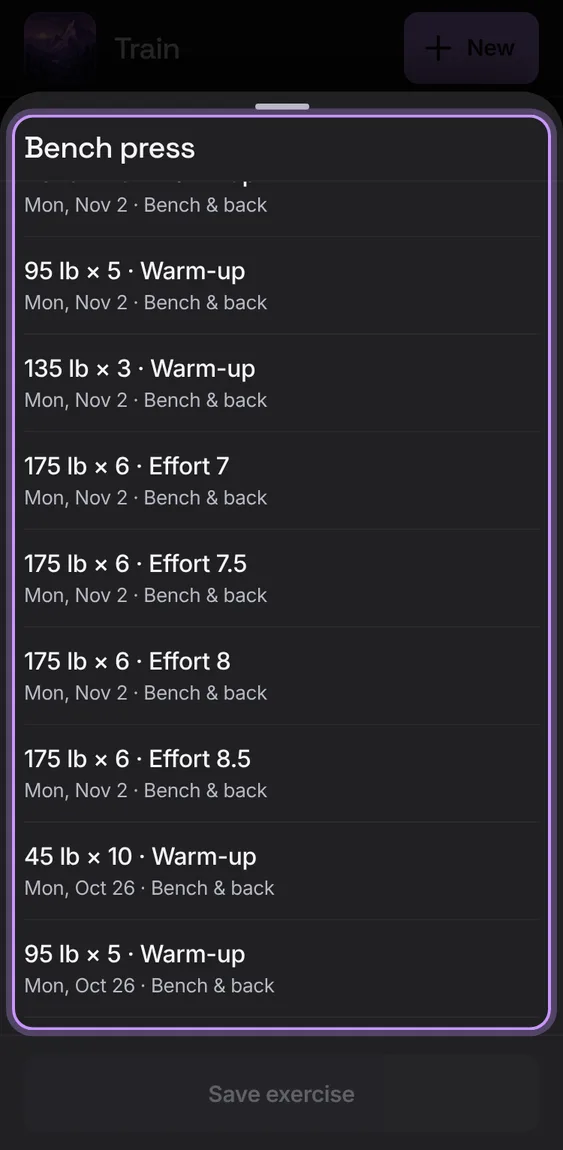
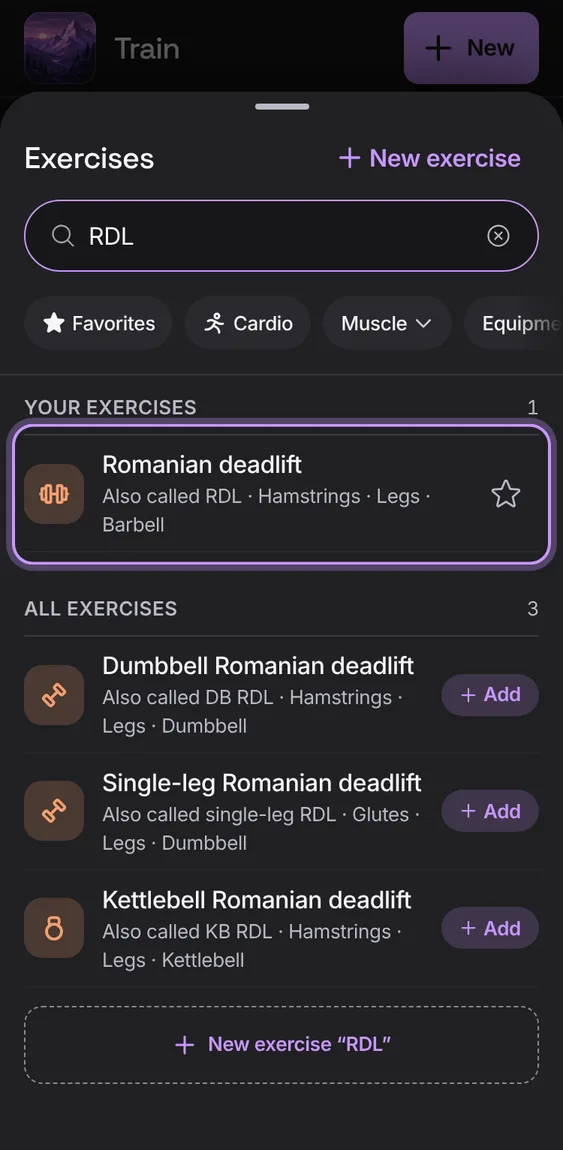
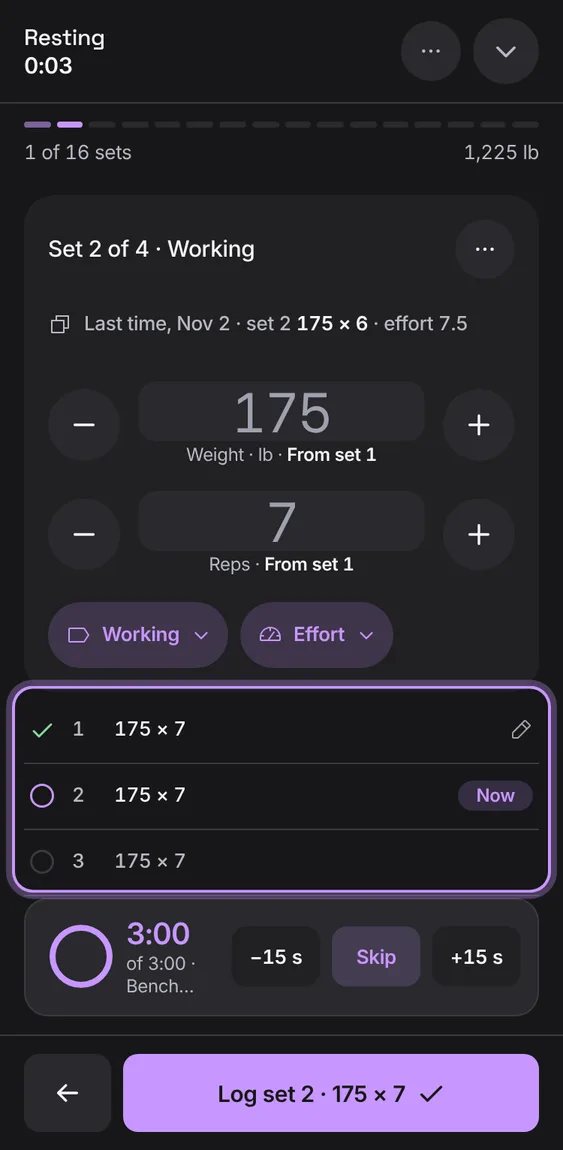
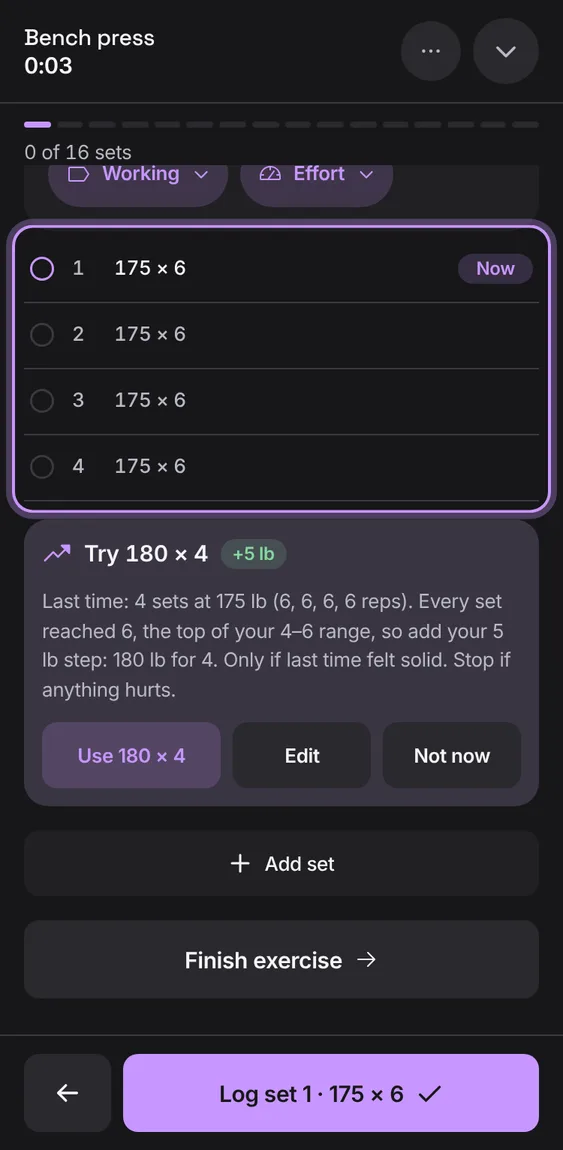
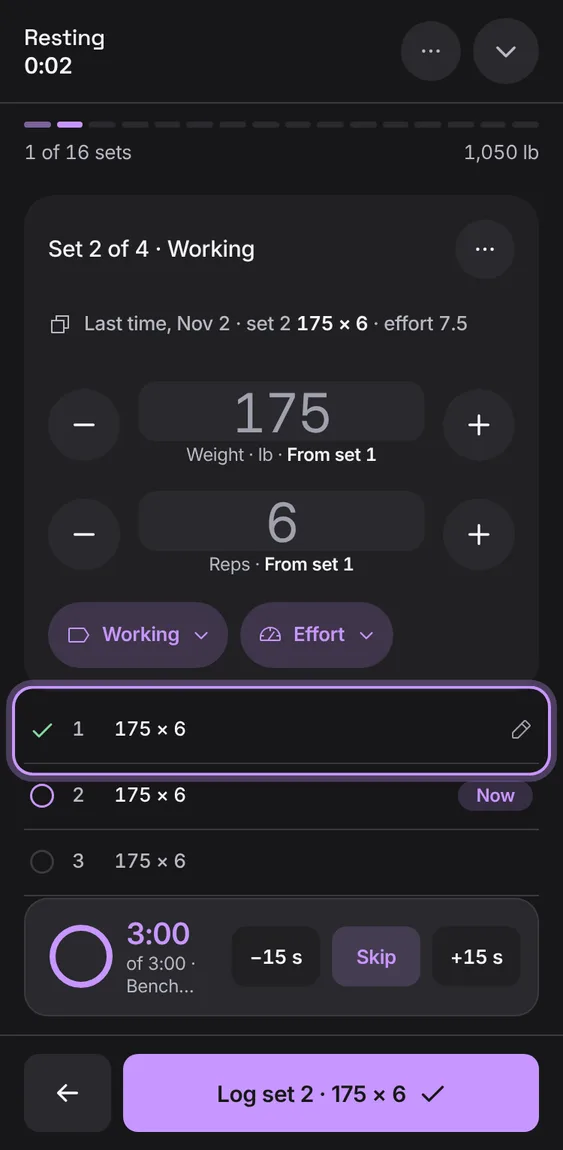
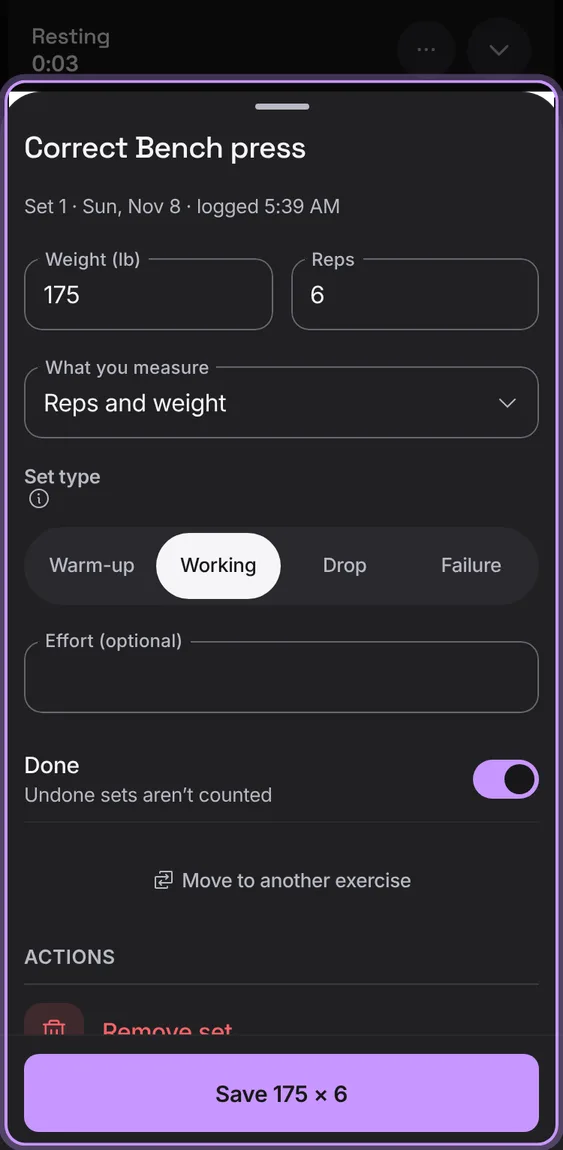
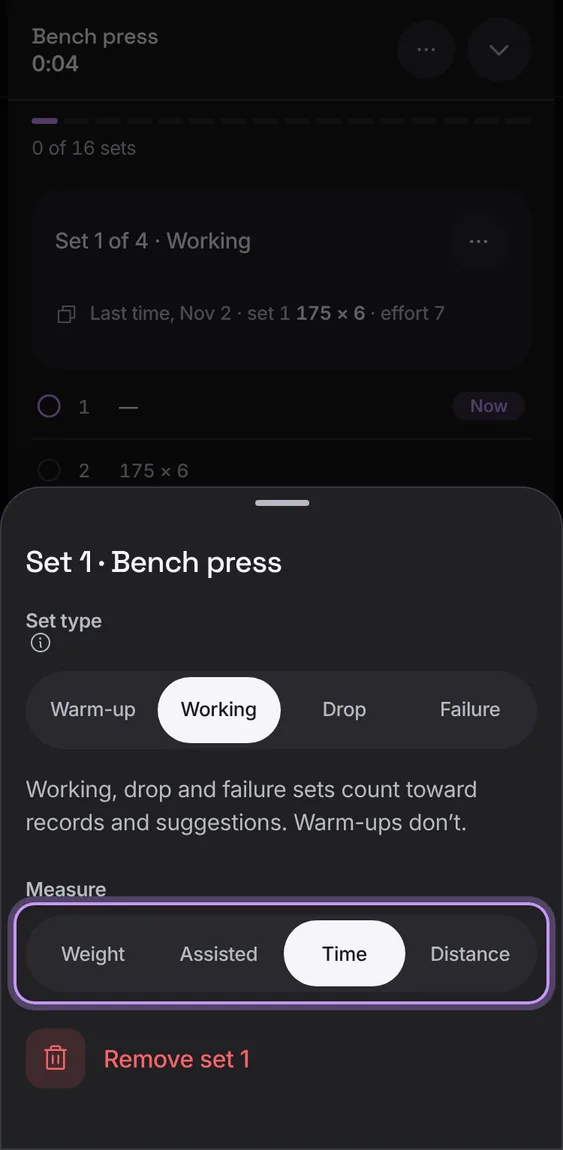
Move a logged set within its exercise: drag its handle, use the arrow keys, or Move up and Move down in its options.
In Review workout, drag a set by its handle.
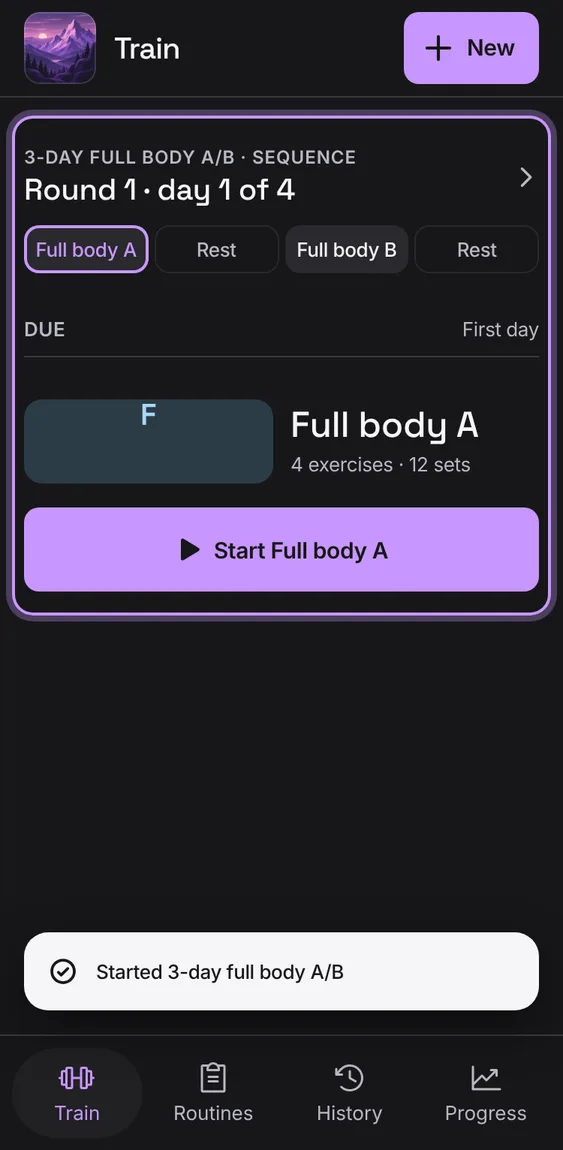
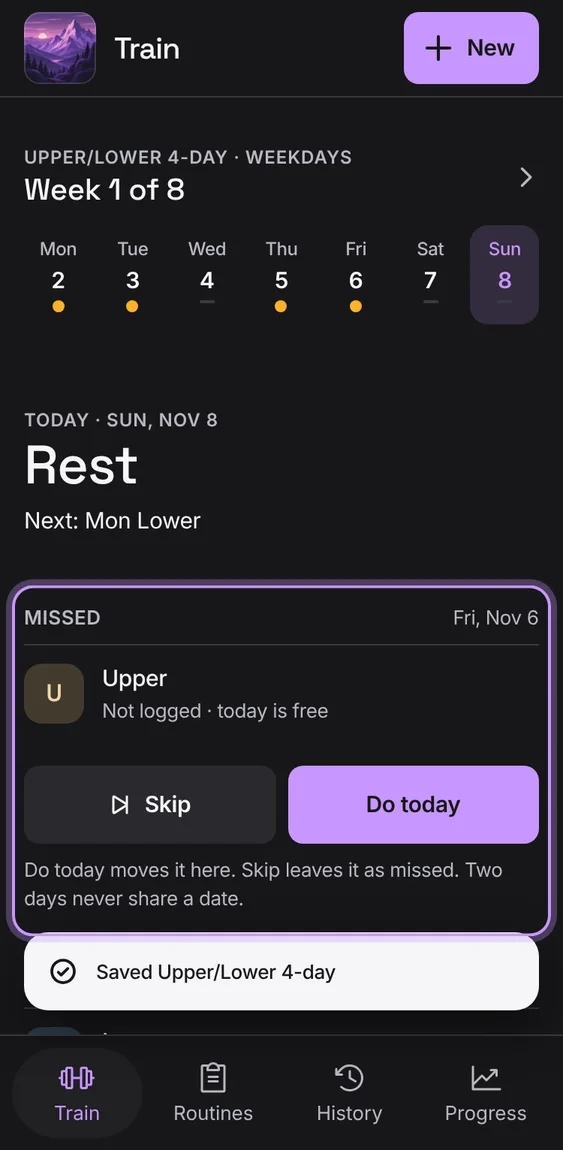
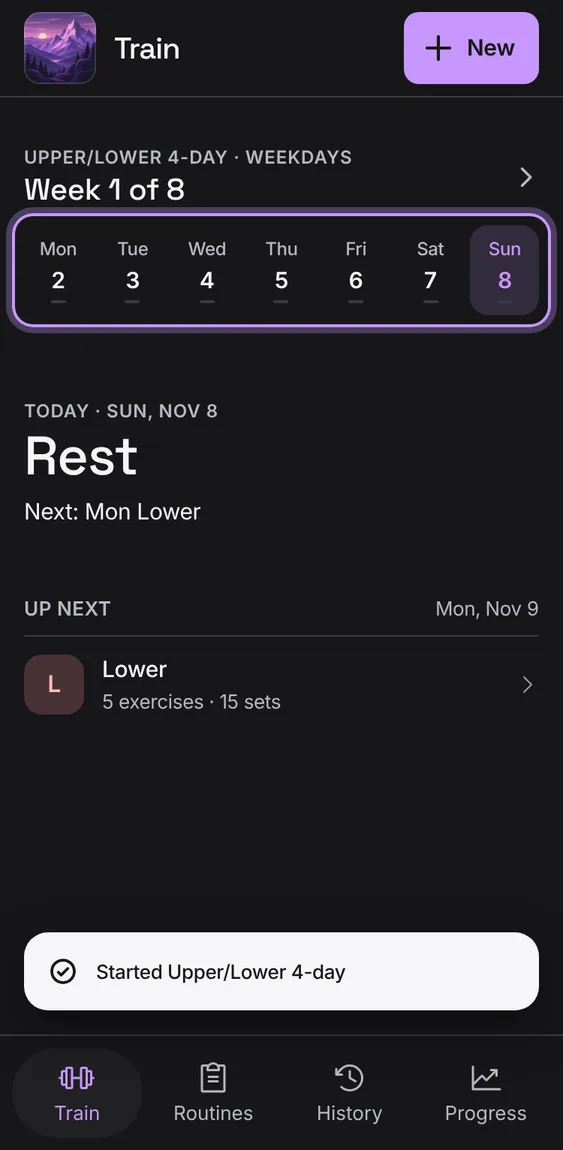
With a program running, Train shows the program's day: what to do today, the week or the rotation, and what's next. Every figure comes from your own workouts.
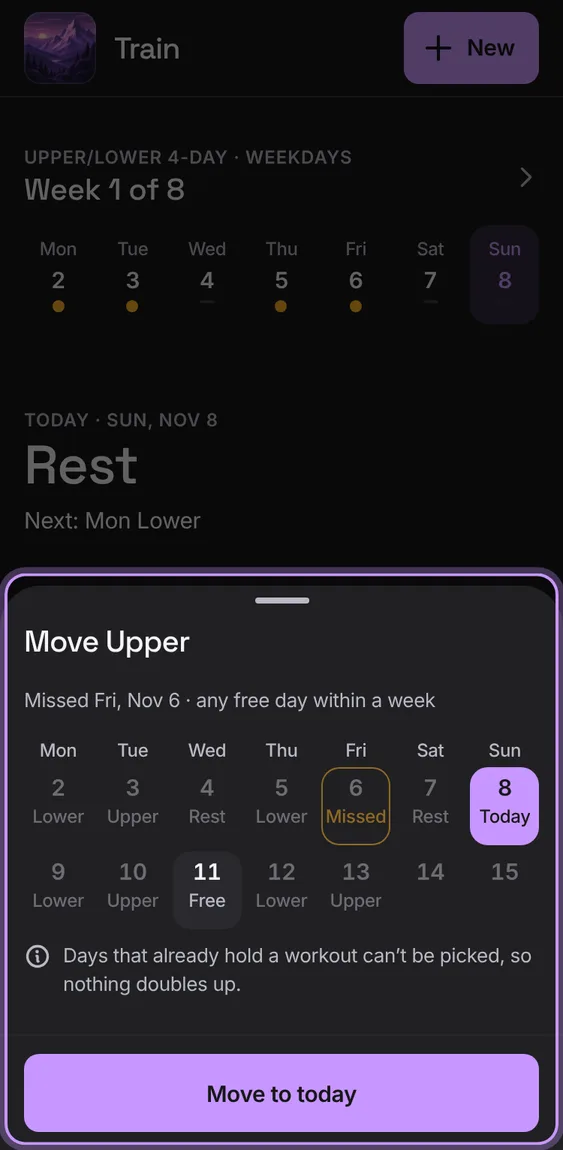
Choose any free day within a week of the missed one. Days that already hold a workout can't be picked, so nothing doubles up.
Tap Move day, pick a day, then Move to that day.
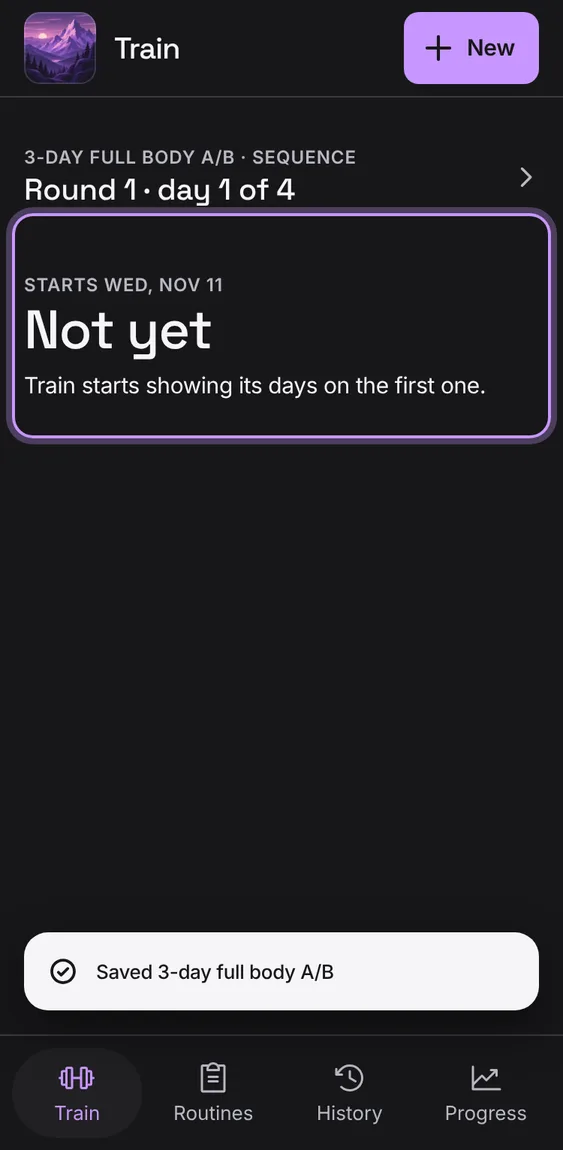
A program that starts later says when; a finished one says Well done and how to repeat it.
Open Train before the start date, or after the last week.
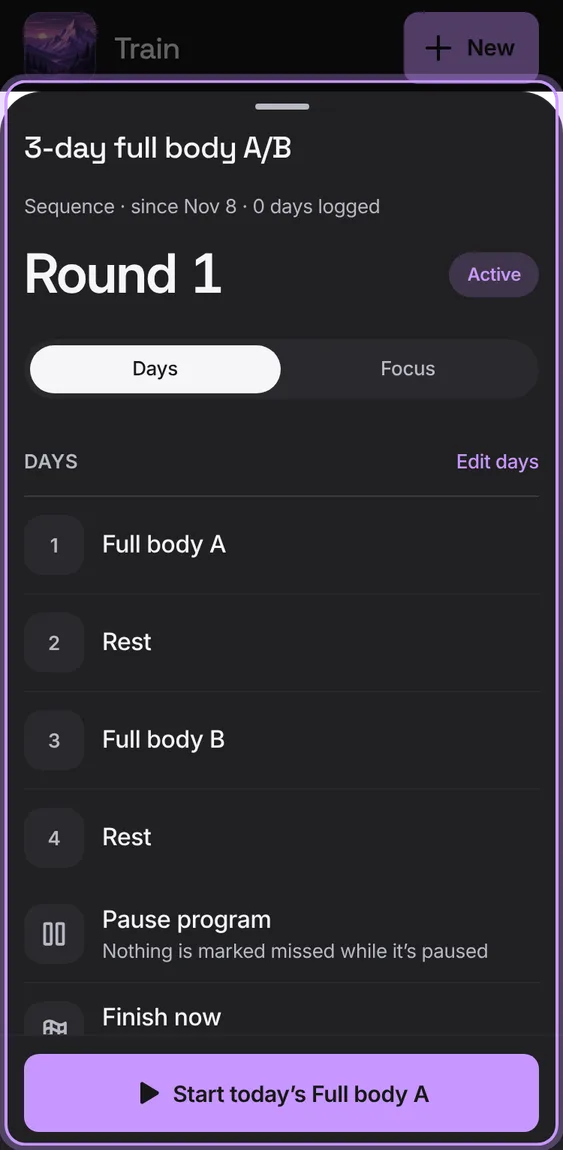
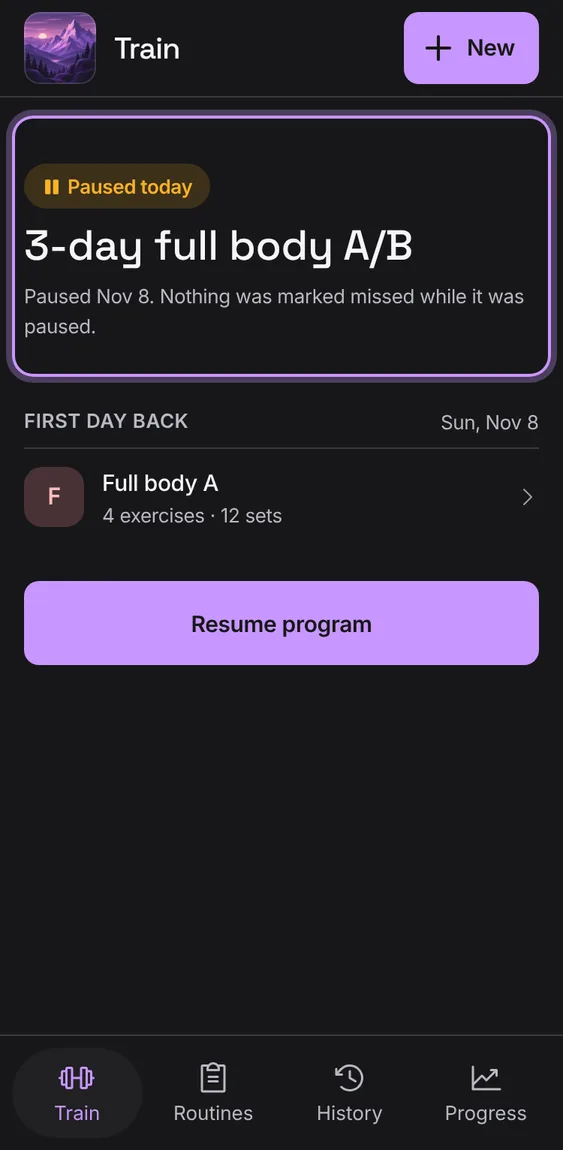
A paused program waits: nothing is marked missed. Coming back, choose Extend (keep your place and move the end) or Continue (keep the end date).
Tap Extend or Continue, then Extend and resume or Continue and resume.
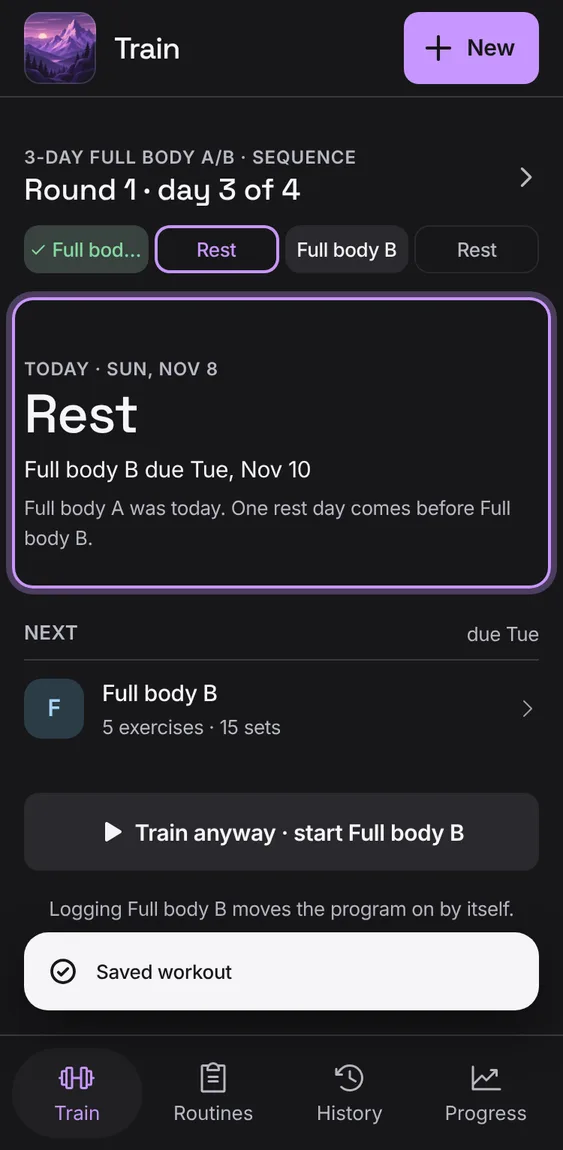
On a rest day Train says Rest and names the next day; Up next lists the next planned day's routines.
Open Train on a day with nothing planned.
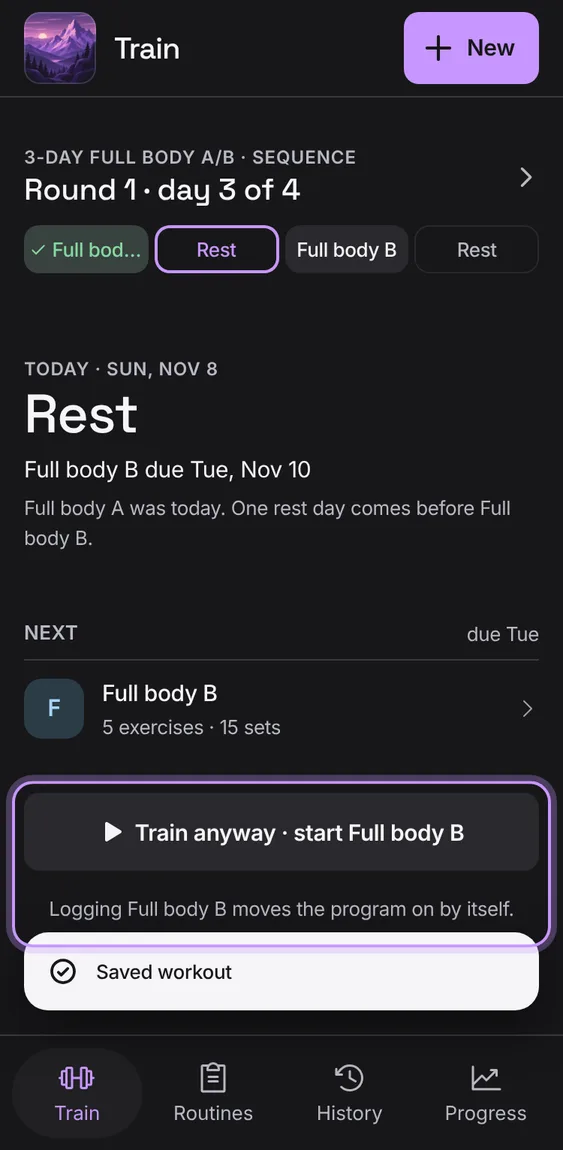
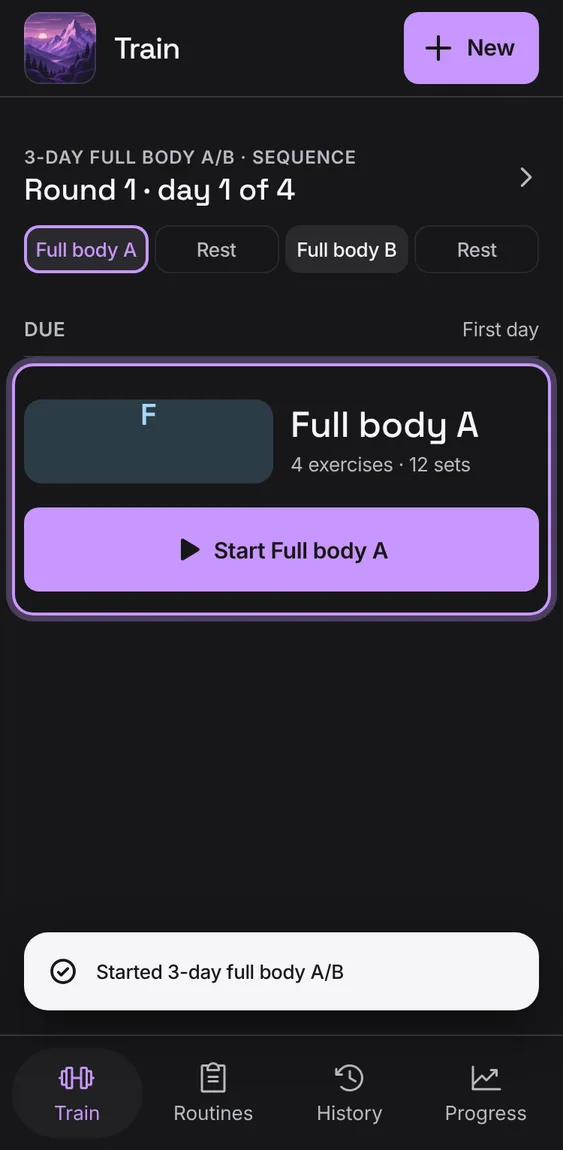
A sequence moves on when you log its day: the rotation shows what's done this round, what's due and how long since the last one. On a rest you can still Train anyway.
Log the day that's due; the next one follows.
On a rest, tap Train anyway to start the next routine early.
Today's first routine large, with when you last did it, its volume and working sets, and Start; any other routine of the day under it. Done ones get a Done pill.
Tap Start and the routine's name.
Once every routine is logged, Today says Done for today.
A strip of the week, Monday first: each day done, today, rest, missed or planned.
Shown under the program's name for a weekdays program.
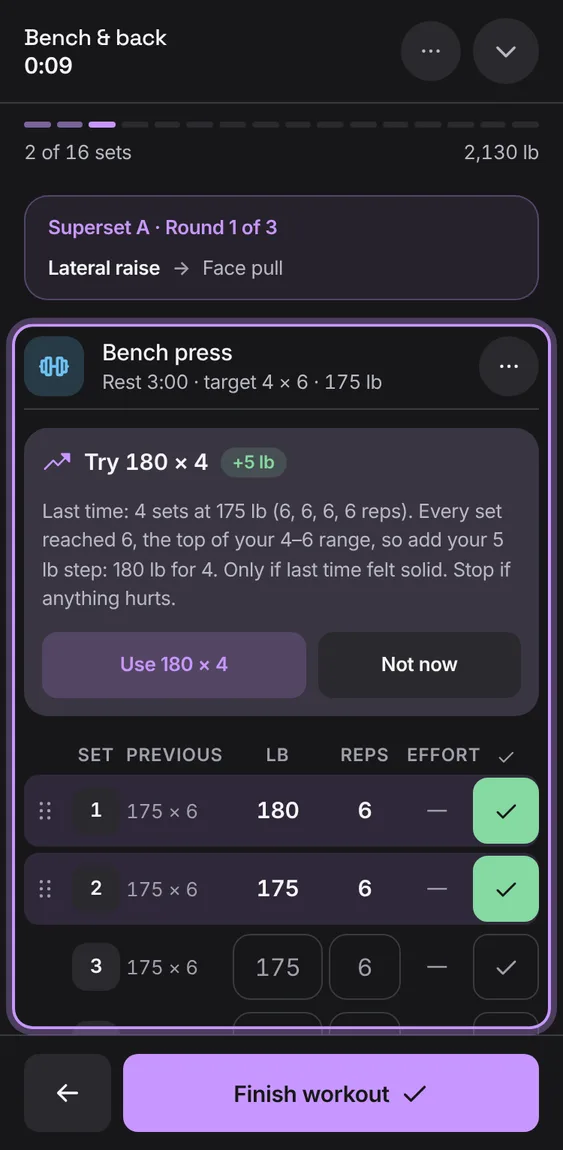
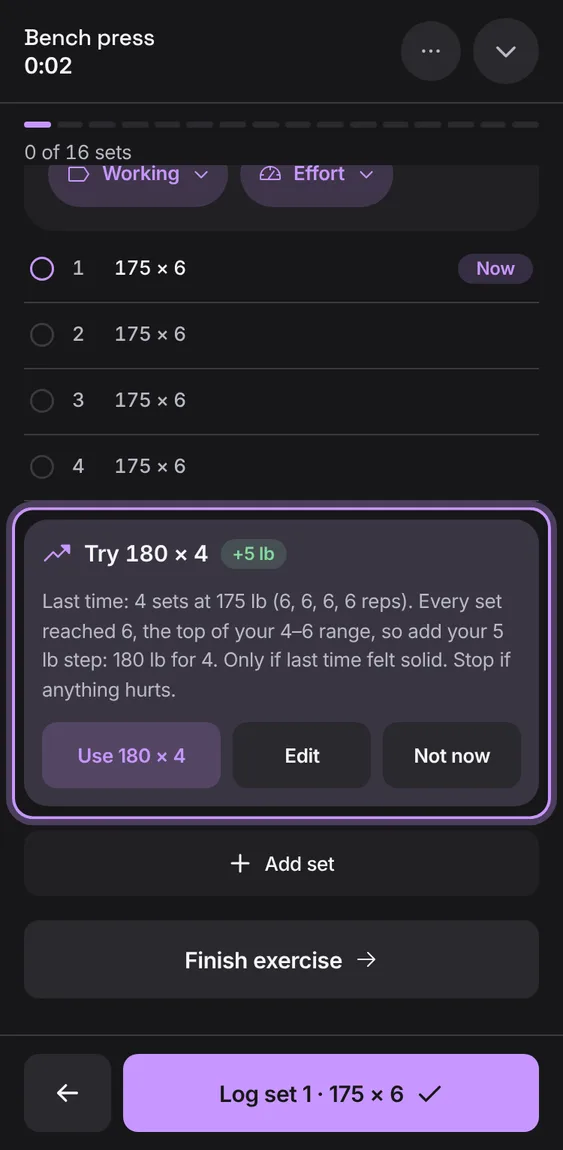
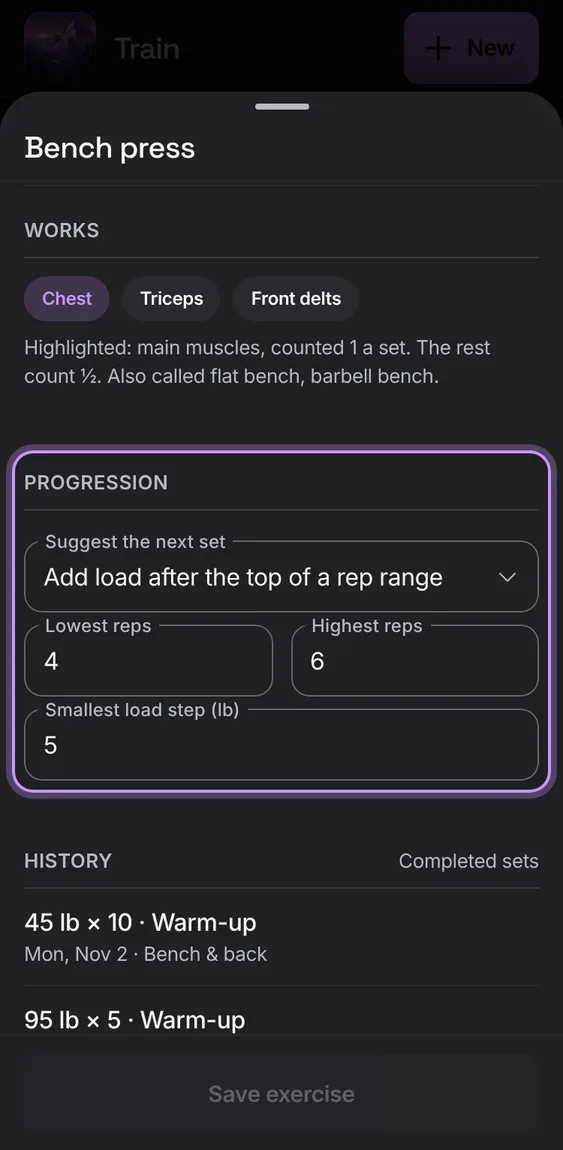
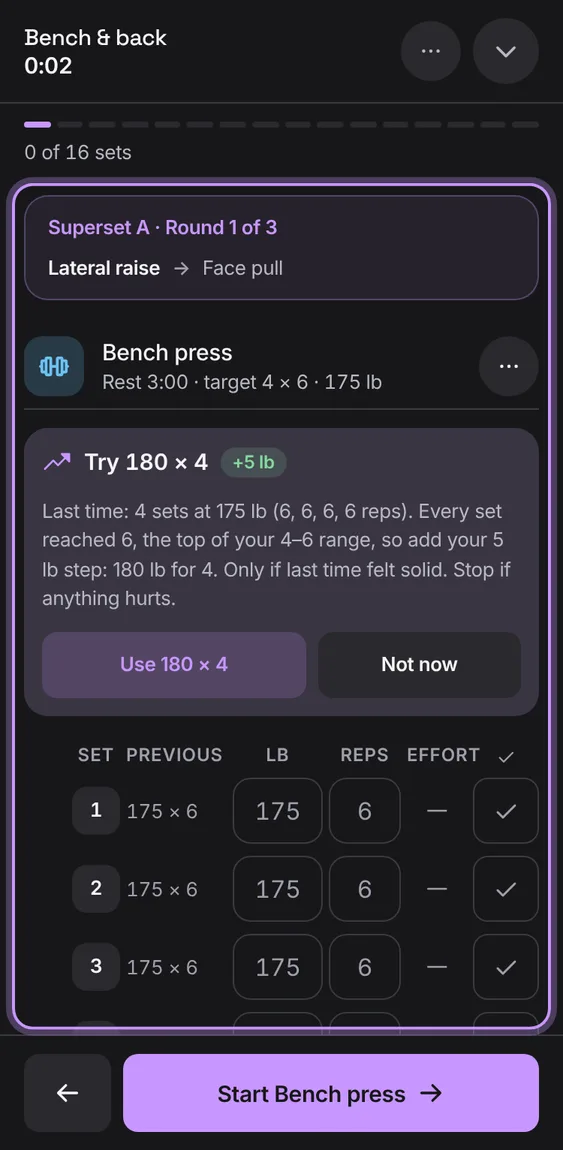
Talus suggests your next weight or reps from your last workout, and says why. You choose whether to use it.
With Talus notifications on, a notification says Rest's over even when Talus is in the background. Phones may still hold it back, so it's never promised.
Turn on Talus in Account › Notifications.
Start a rest; skipping or finishing cancels it.
Not in the demo. Needs notifications on your device.
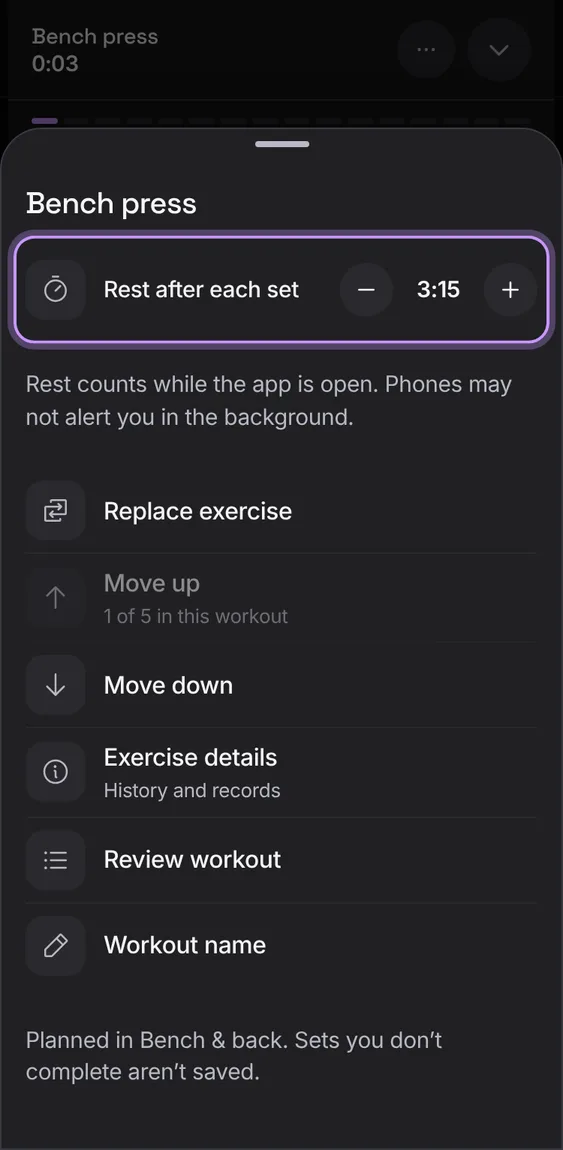
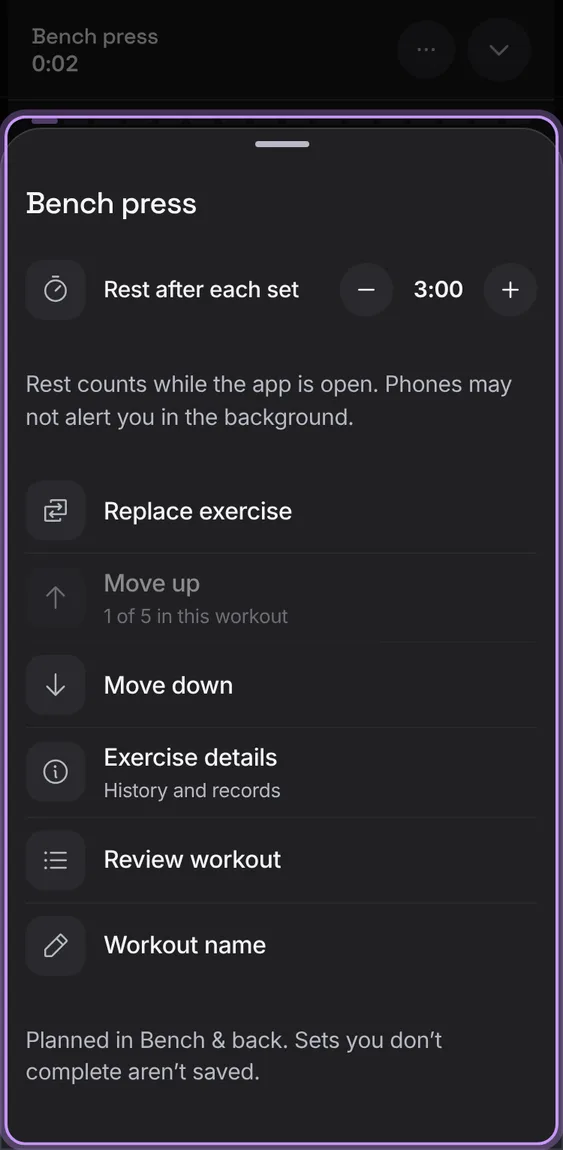
Each exercise has its own rest: the routine's, else what you used last time, else 2:00. Change it in the exercise's options; it's kept with the workout.
Open the exercise's options and change Rest after each set.
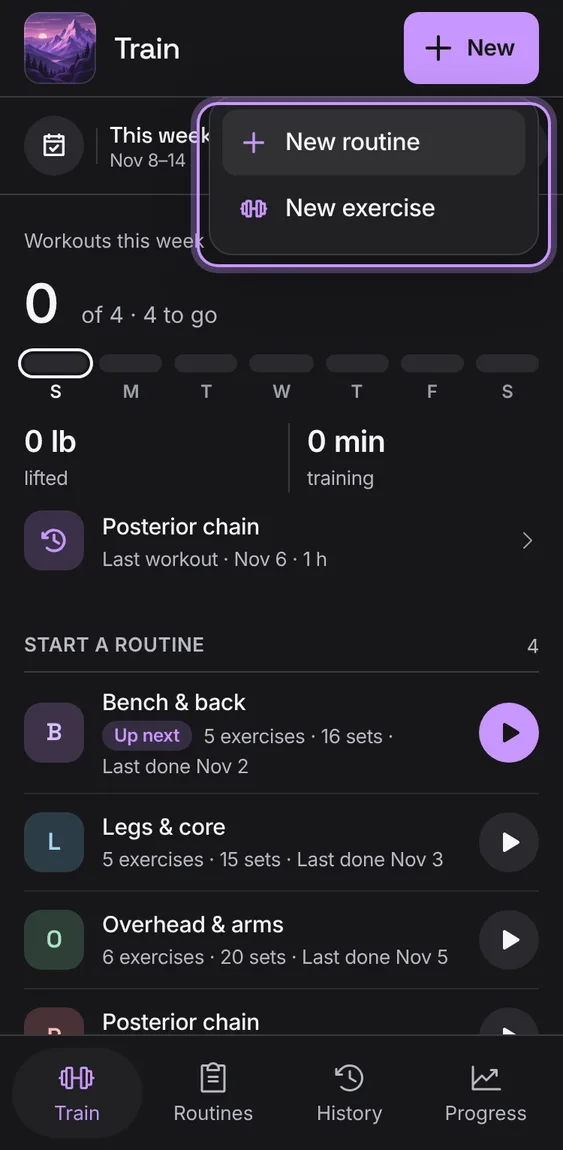
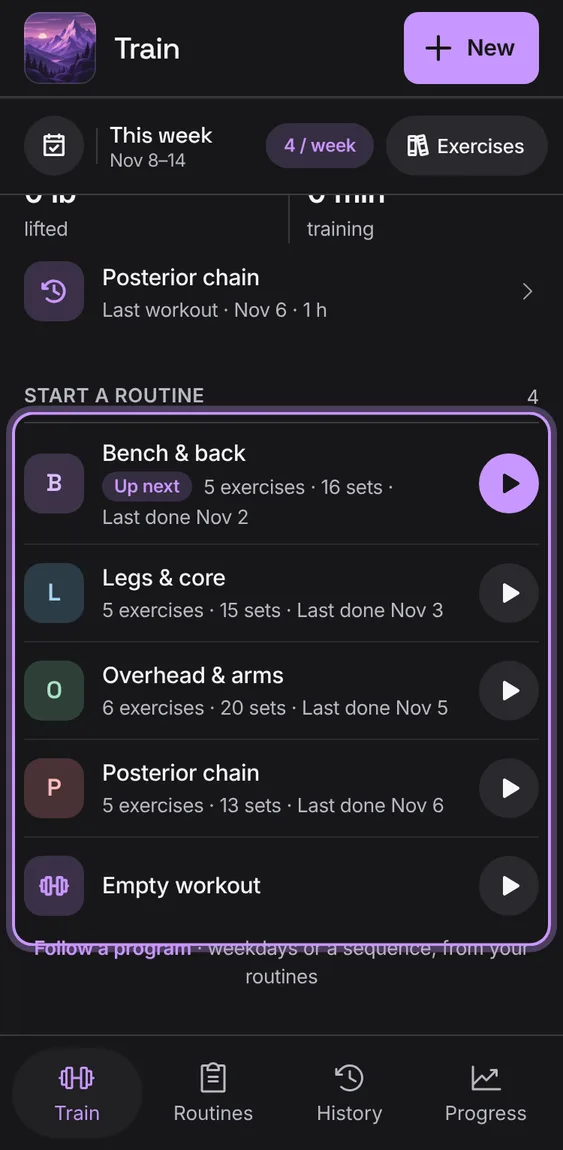
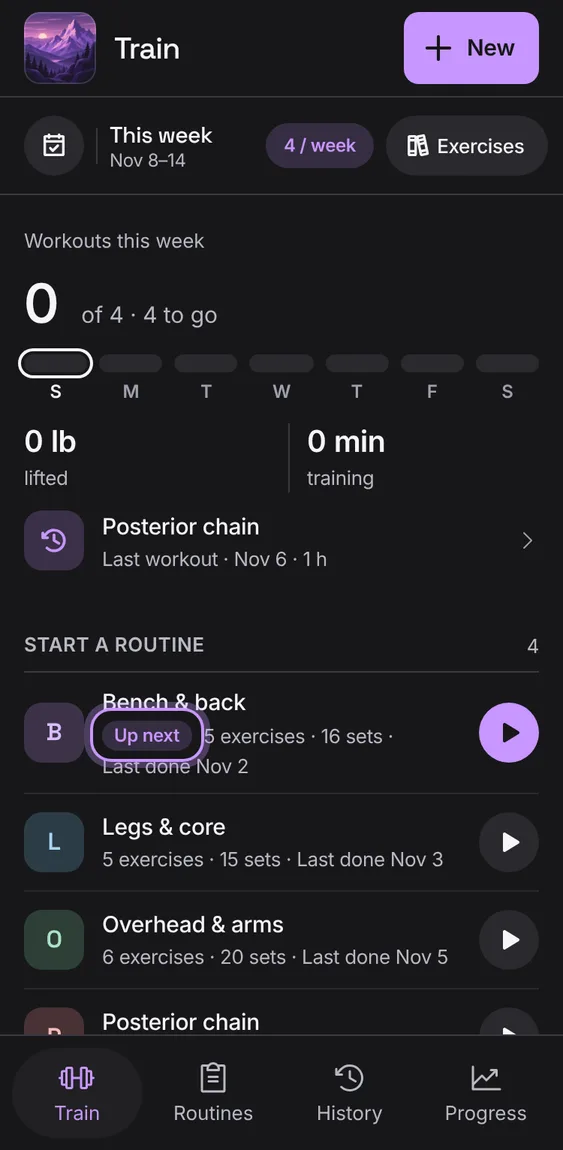
Every routine you keep, with its colour, how many exercises and sets, and when you last did it, each with its own Start.
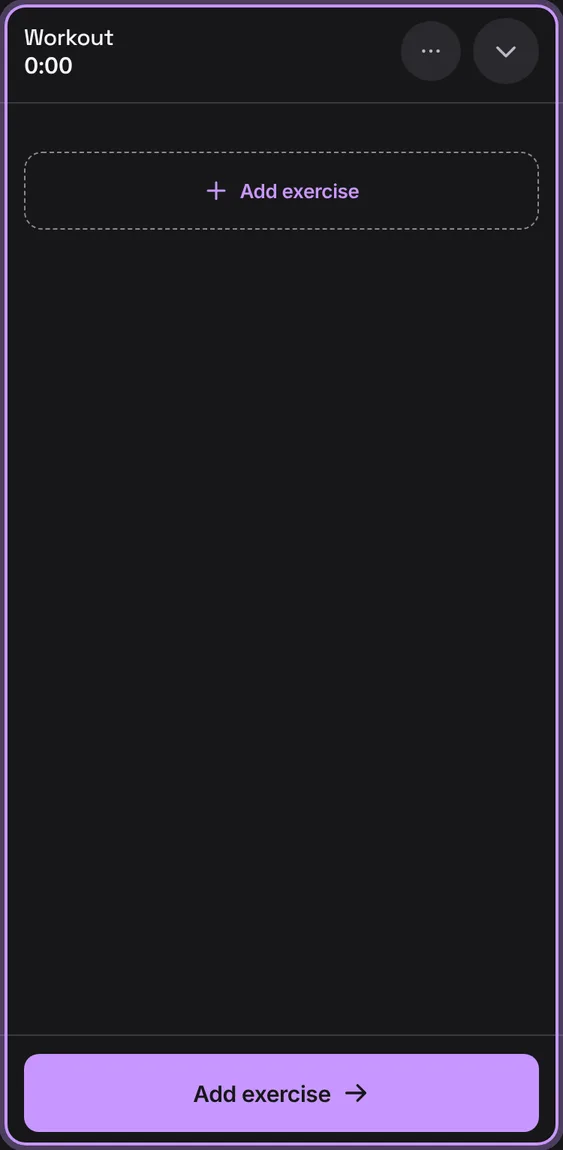
Start a workout with no plan and add exercises as you go.
Tap Empty workout at the end of the routines.
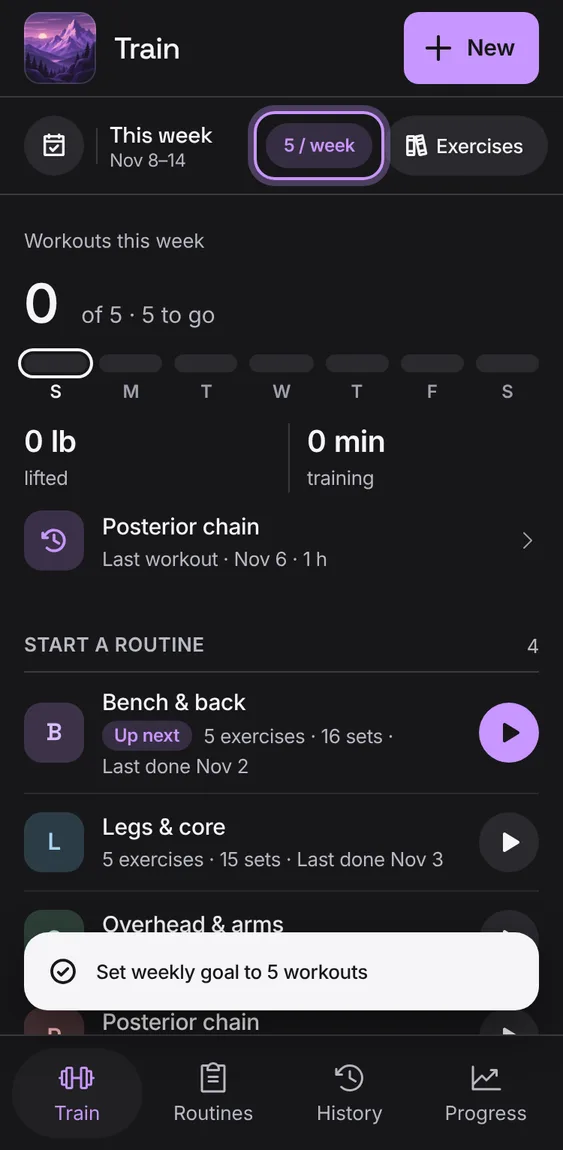
The routine after the one you did last is marked Up next, and its Start is the bright one.
Do your routines in the order they're listed; Up next moves along by itself.
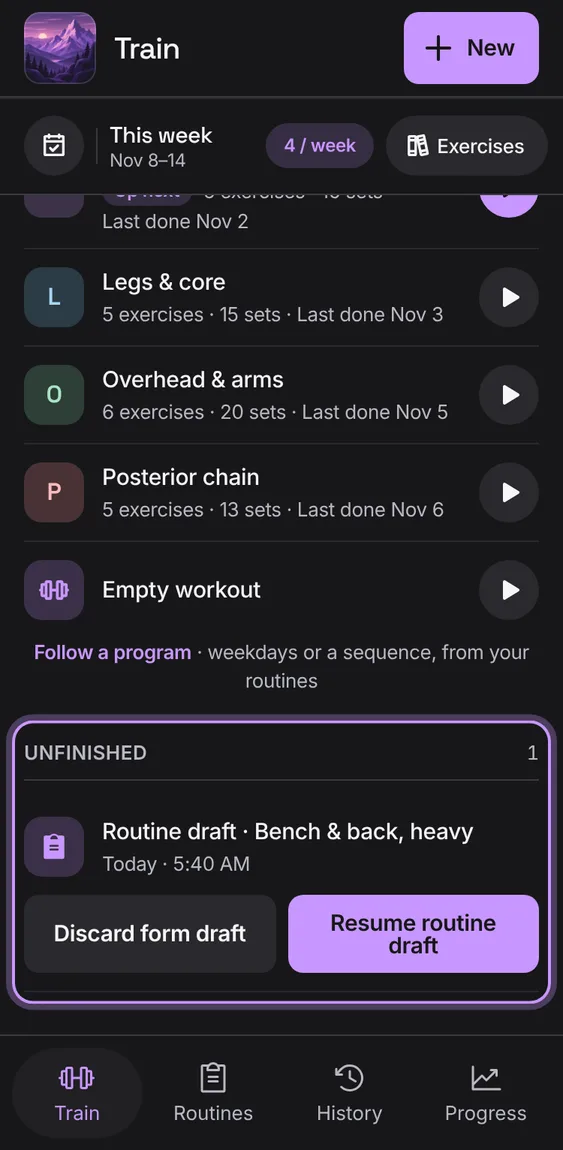
Forms left half done are kept on this device under Unfinished: a workout being named, a routine mid-edit, or a set typed for a workout that has closed. Resume or discard each.
If a workout closes before its notes are saved, the text stays on Train to try again or copy, and a recovery draft can be discarded after confirming.
Tap Try again, or discard the recovery draft.
Not in the demo. Shows for writing left unsaved when the app closed.
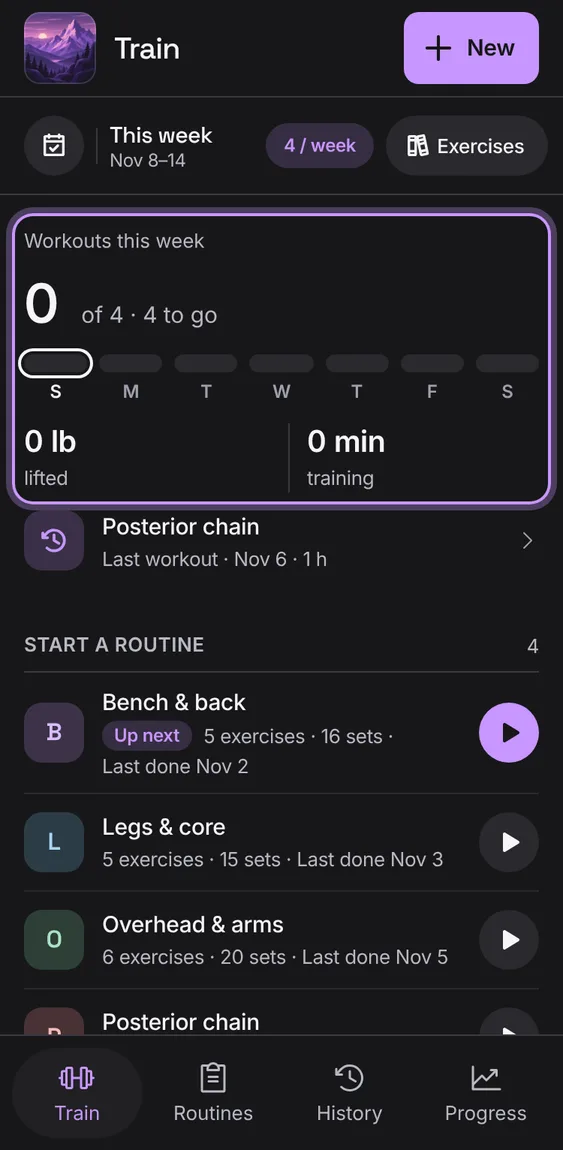
The week at the top of Train: how many workouts, a bar for each day you trained, and how much you lifted and for how long.
Shown at the top of Train once you've done a workout.
Weeks start on the day you chose in Account.
Set how many workouts you want a week; the pill shows it, and the week says how many are left.
Tap the pill ("3 / week", or Set a goal) in the This week bar.
Change the number with the stepper and tap Save goal.
Add lift goal opens a lift goal in Progress.
A workout fills the screen one exercise at a time, with its time and sets in the header. It keeps going if you leave it, reload or lose the connection.
Start a routine or an empty workout.
Minimise it to use the other tabs; Resume brings it back.
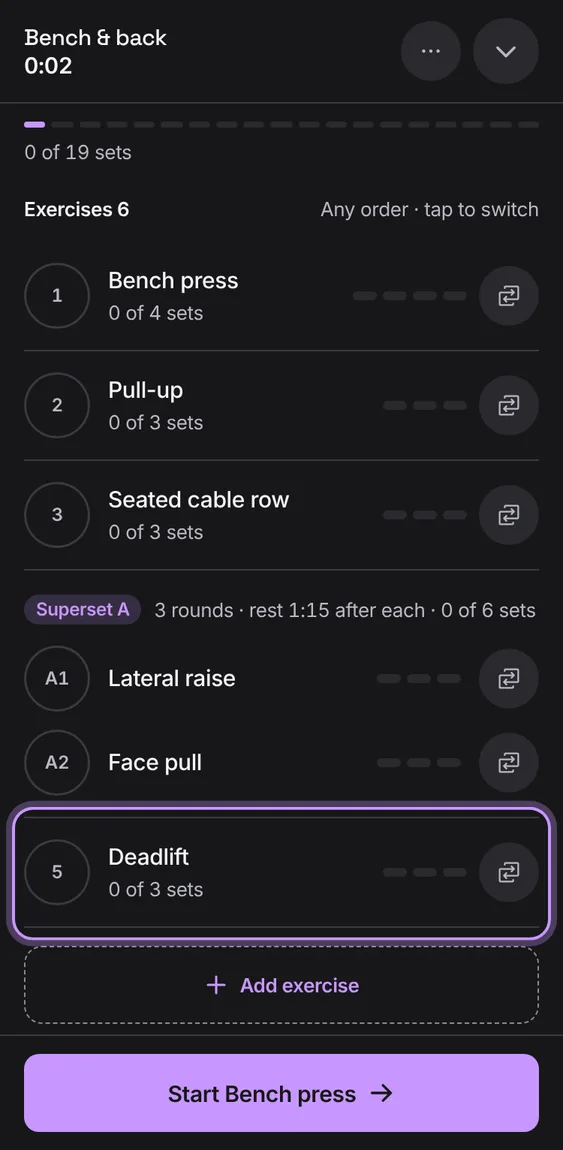
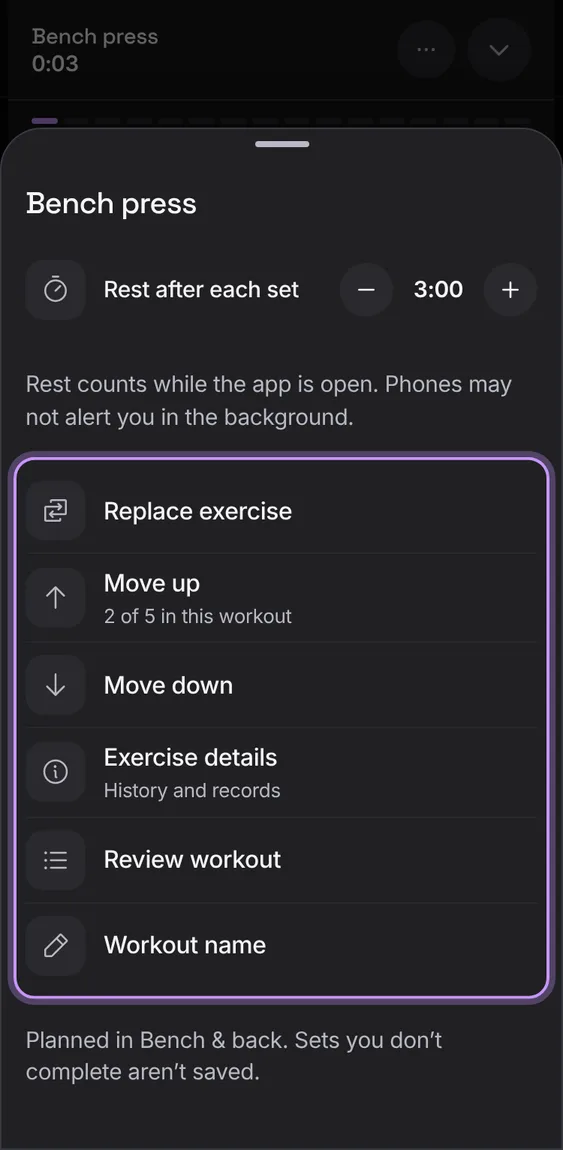
Change the workout's order: Move up or Move down, or Alt and the arrow keys on its options button. The order is kept and syncs.
Tap Move up or Move down in the exercise's options.
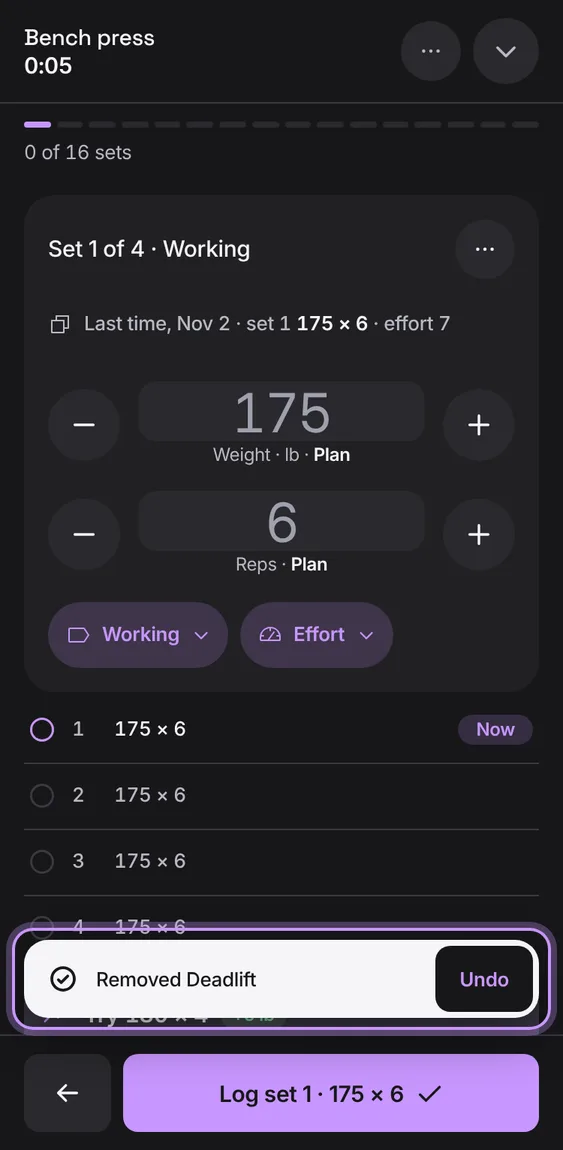
Remove an exercise you added, with its sets. Undo puts back exactly those sets.
Tap Remove exercise, then Undo in the message if you change your mind.
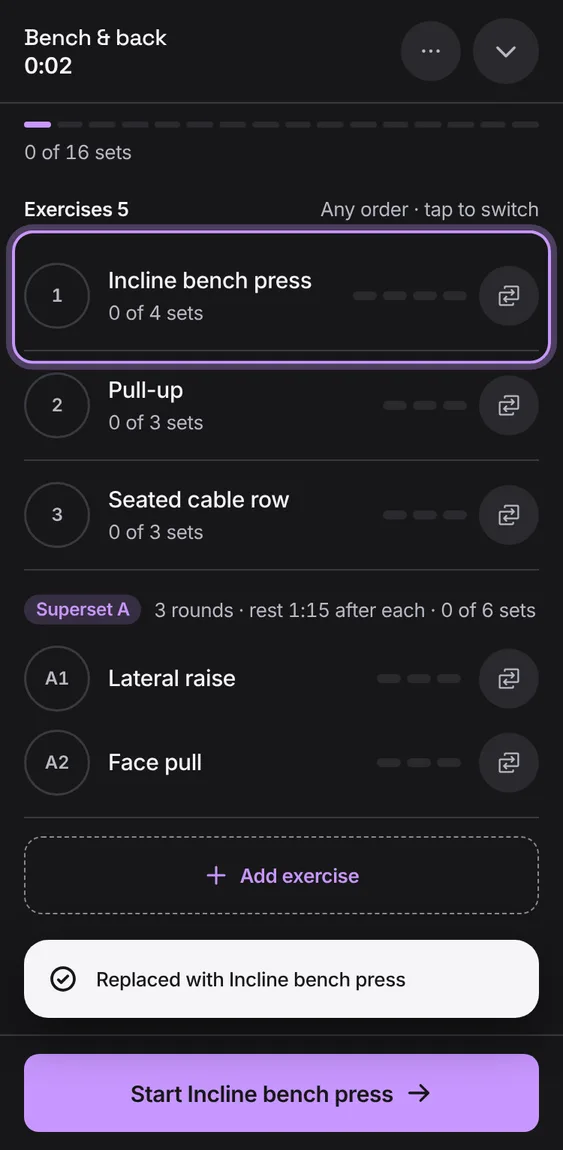
Swap an exercise for this workout only: the routine stays as it was, and the set says "In place of" the planned one. Lifts for the same muscle come first.
Tap Replace exercise (or the swap icon on its card) and pick another.
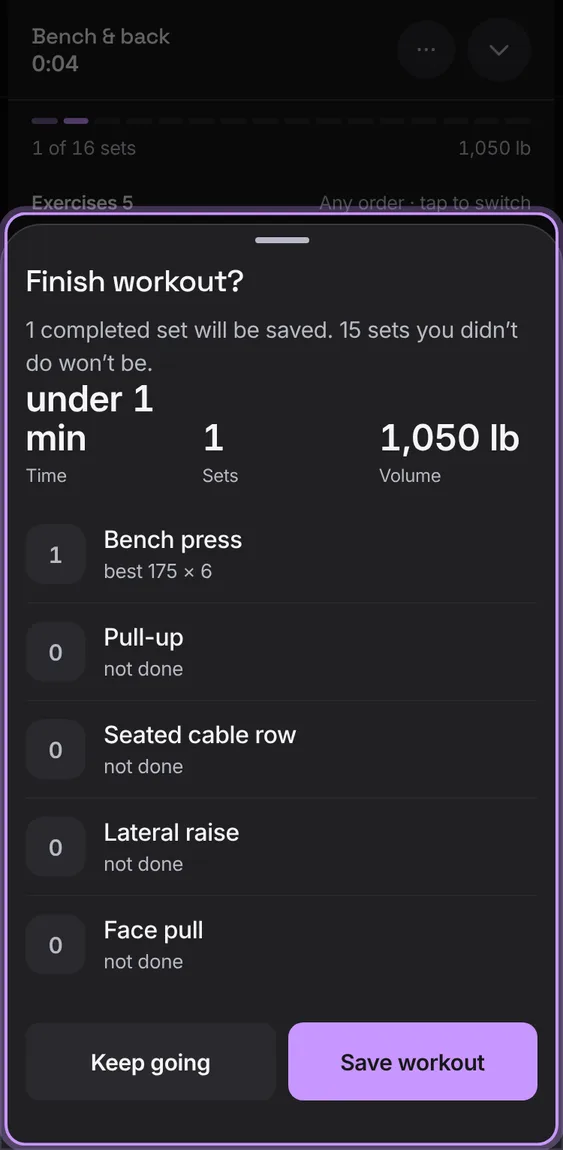
Finish workout shows what you did before it's saved: time, sets, volume and each exercise's best, and what won't be kept. Save workout saves it once.
Tap Finish workout, check it, then Save workout (or Keep going).
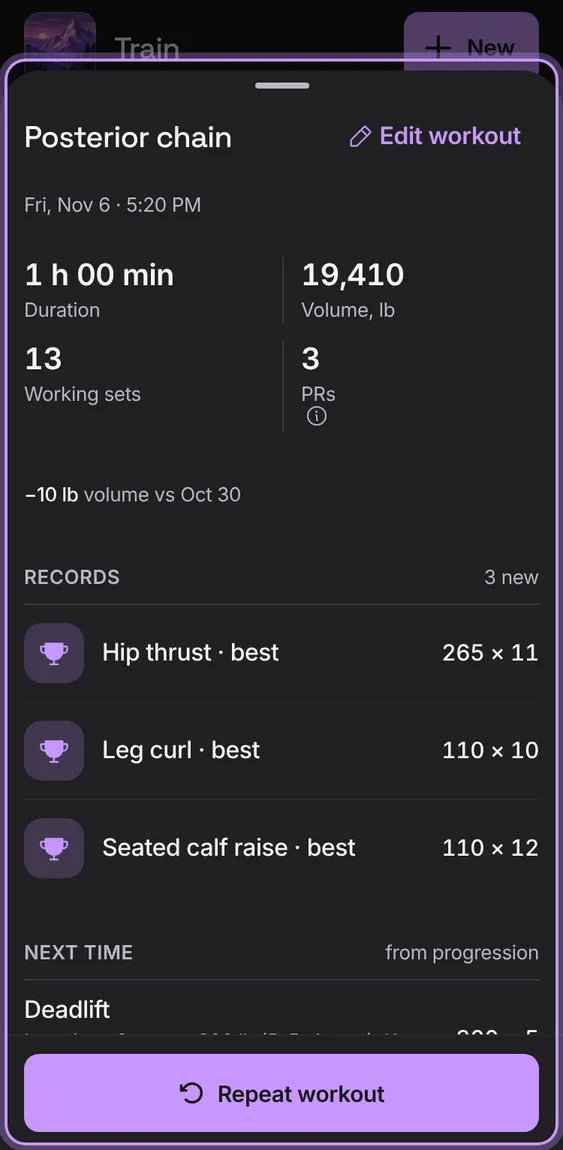
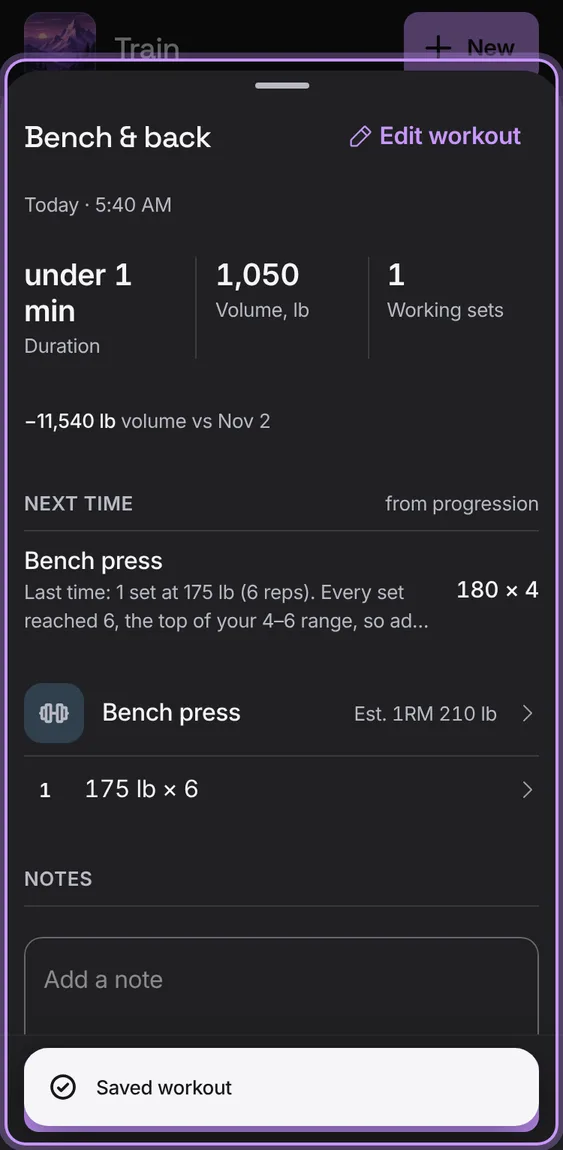
A saved workout opens at once with its records, its volume against last time and what to try next time. The message counts any new records.
Tap Save workout.
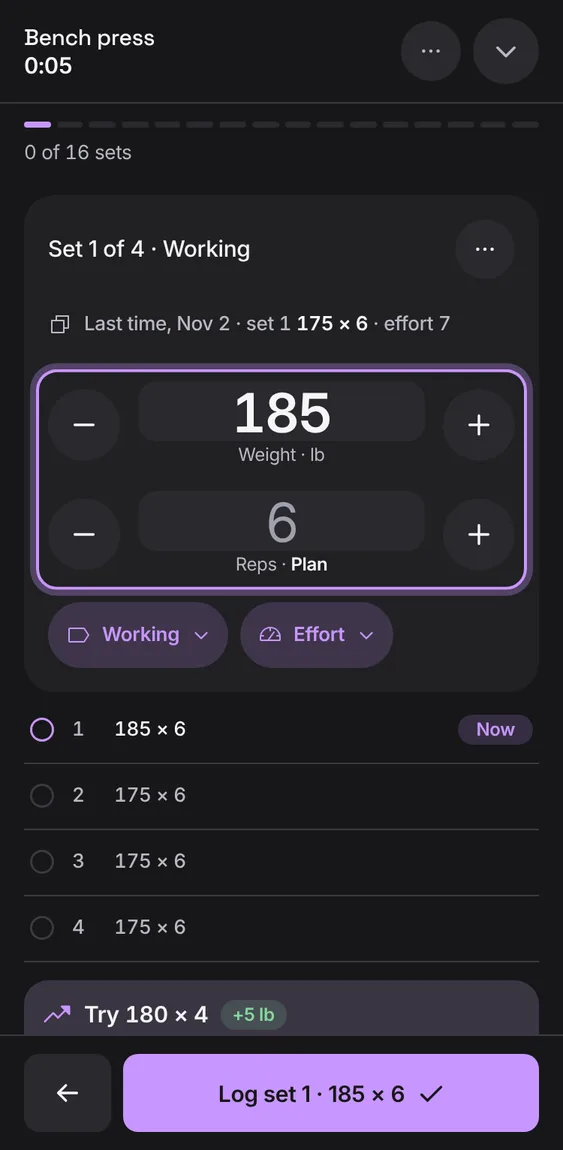
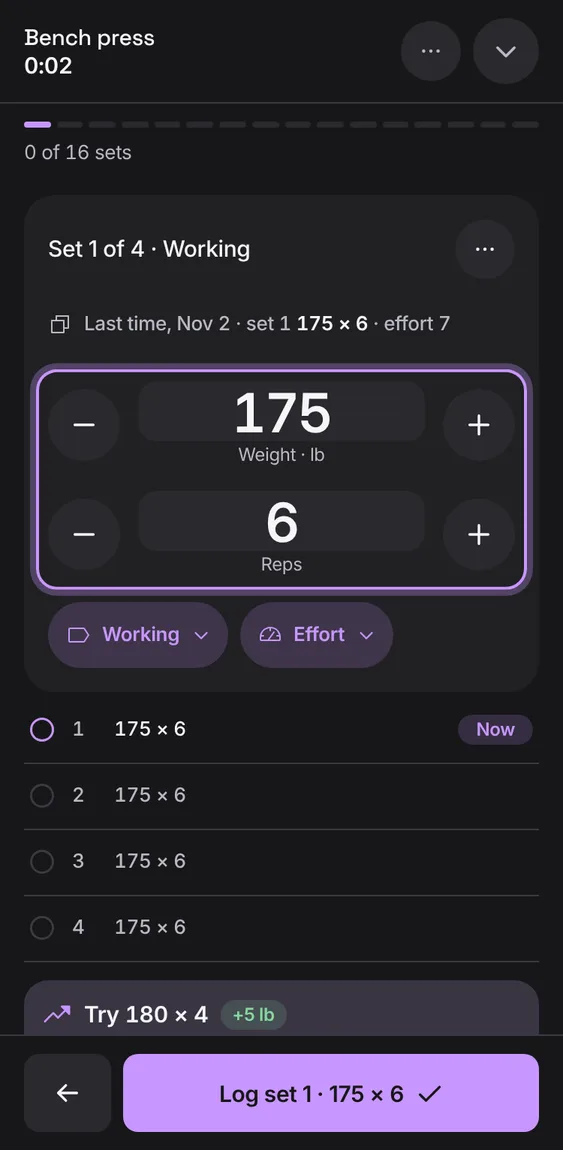
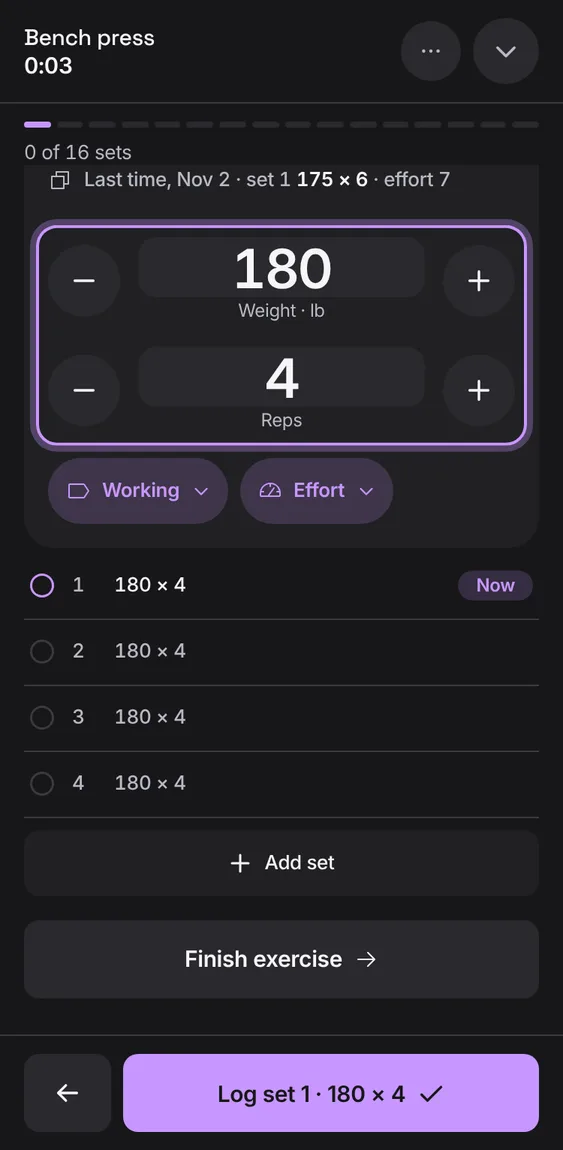
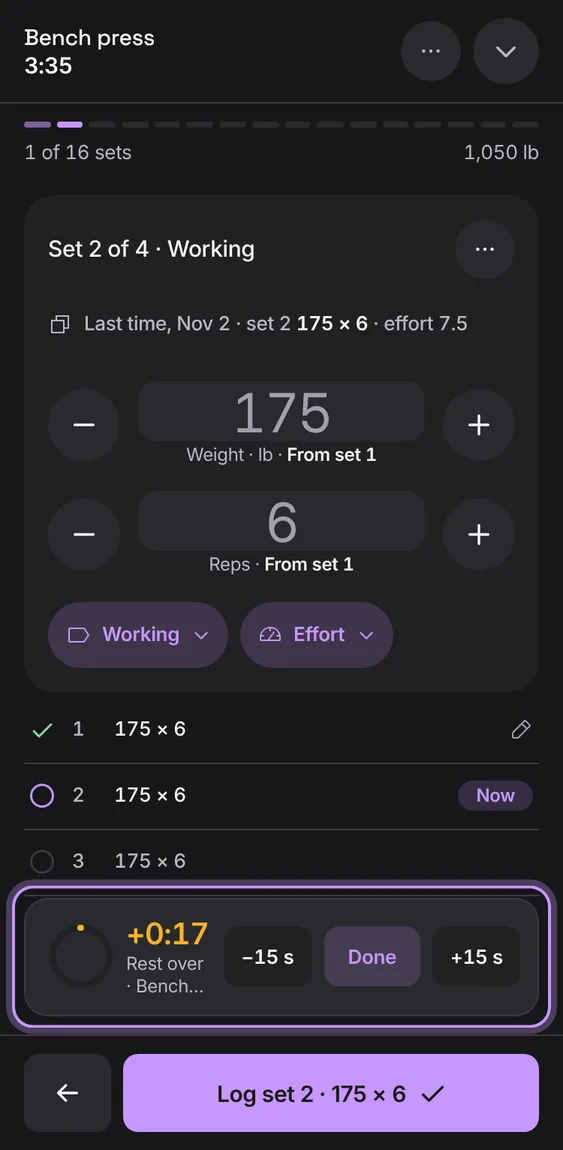
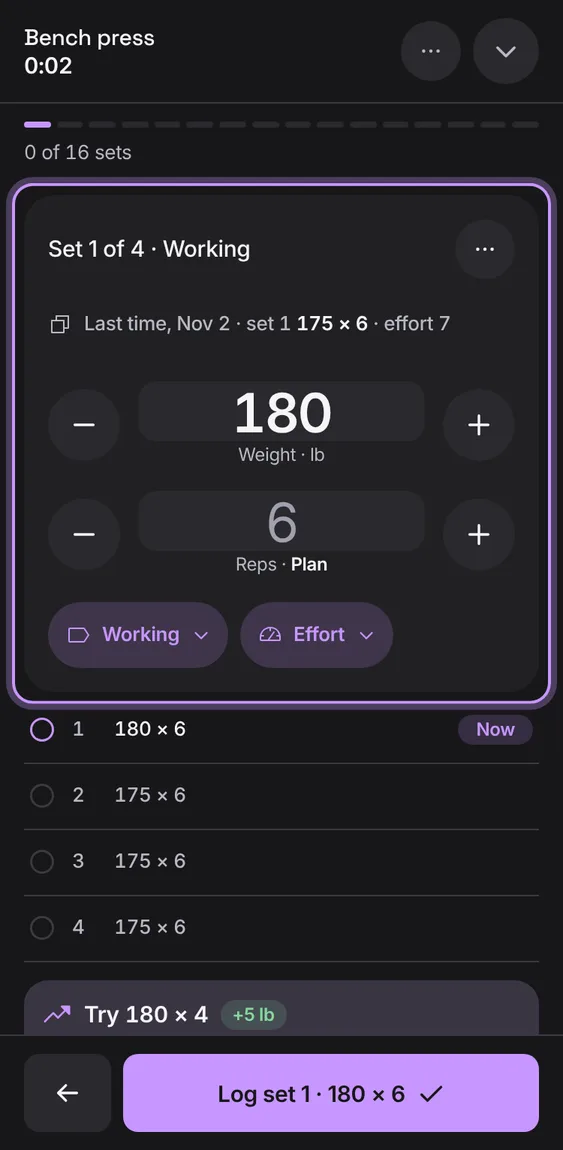
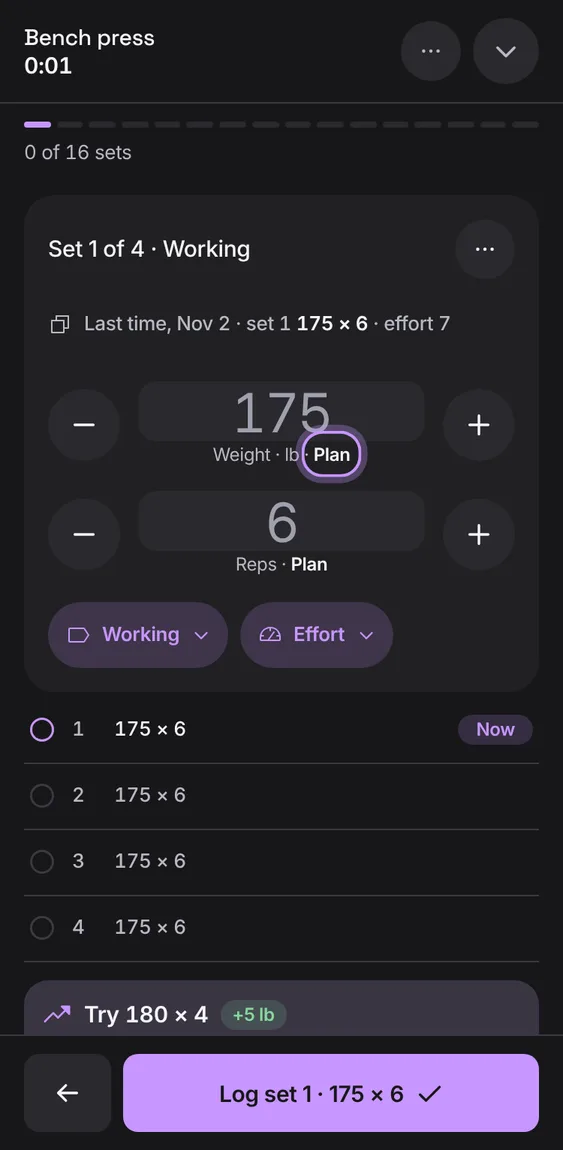
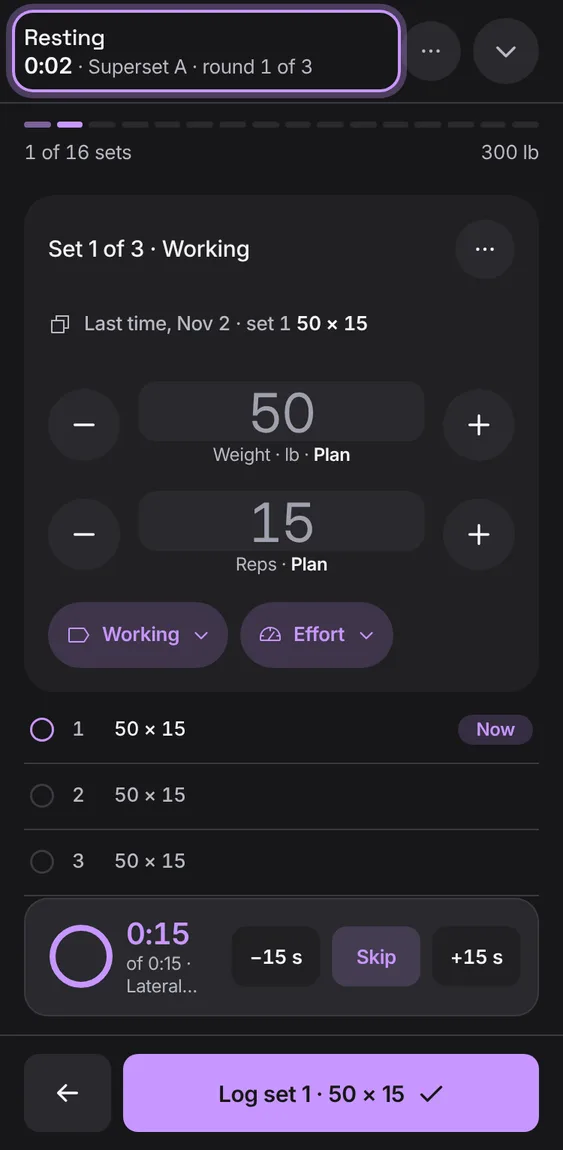
The exercise's set fills the screen: Set 2 of 4, its weight and reps with steppers, and the set list under it. The button says what it will log: Log set 2 · 185 × 5.
Go back to the exercises early; the sets you haven't done stay there for later. When every set is done it says what's up next.
Tap Finish exercise (Finish superset).
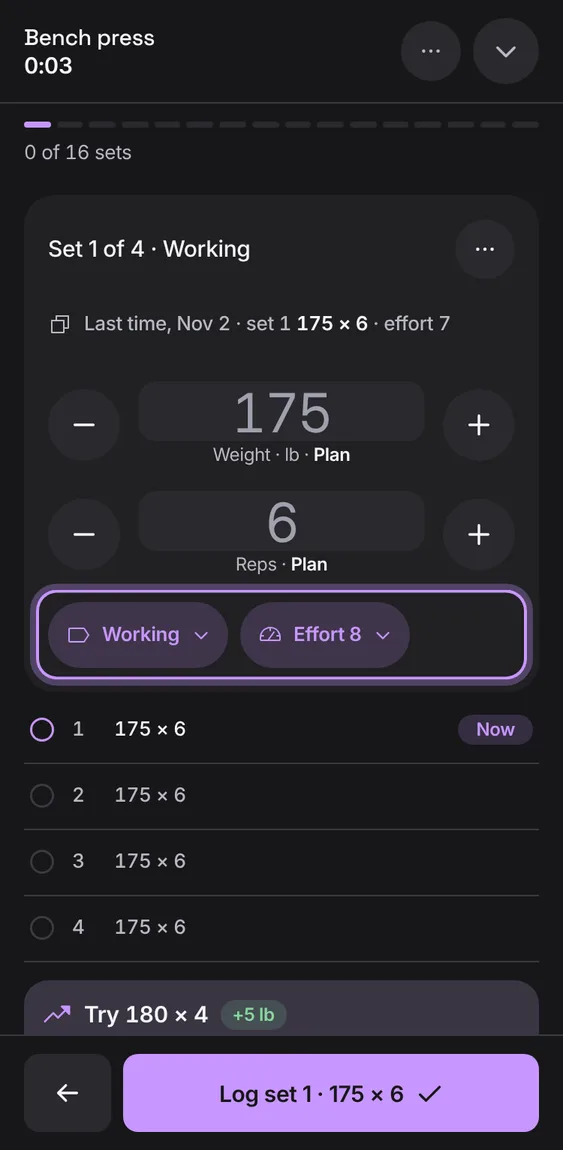
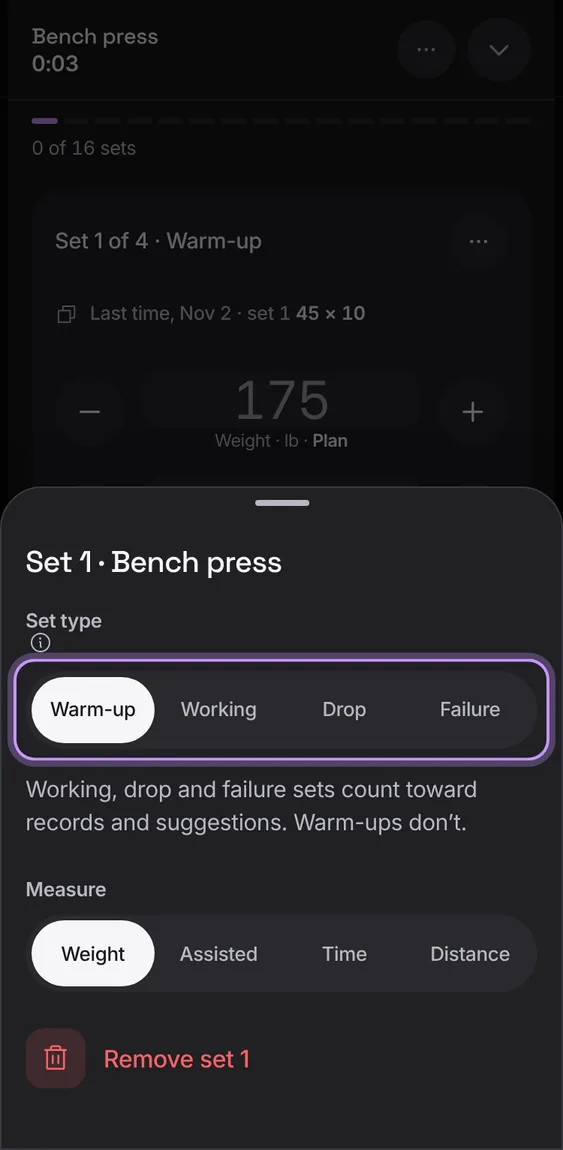
Until you change them, the weight and reps are a guess shown in a lighter tone and labelled: Plan, Last time, From set 1 or Suggestion.
Read the small label under the weight and reps.
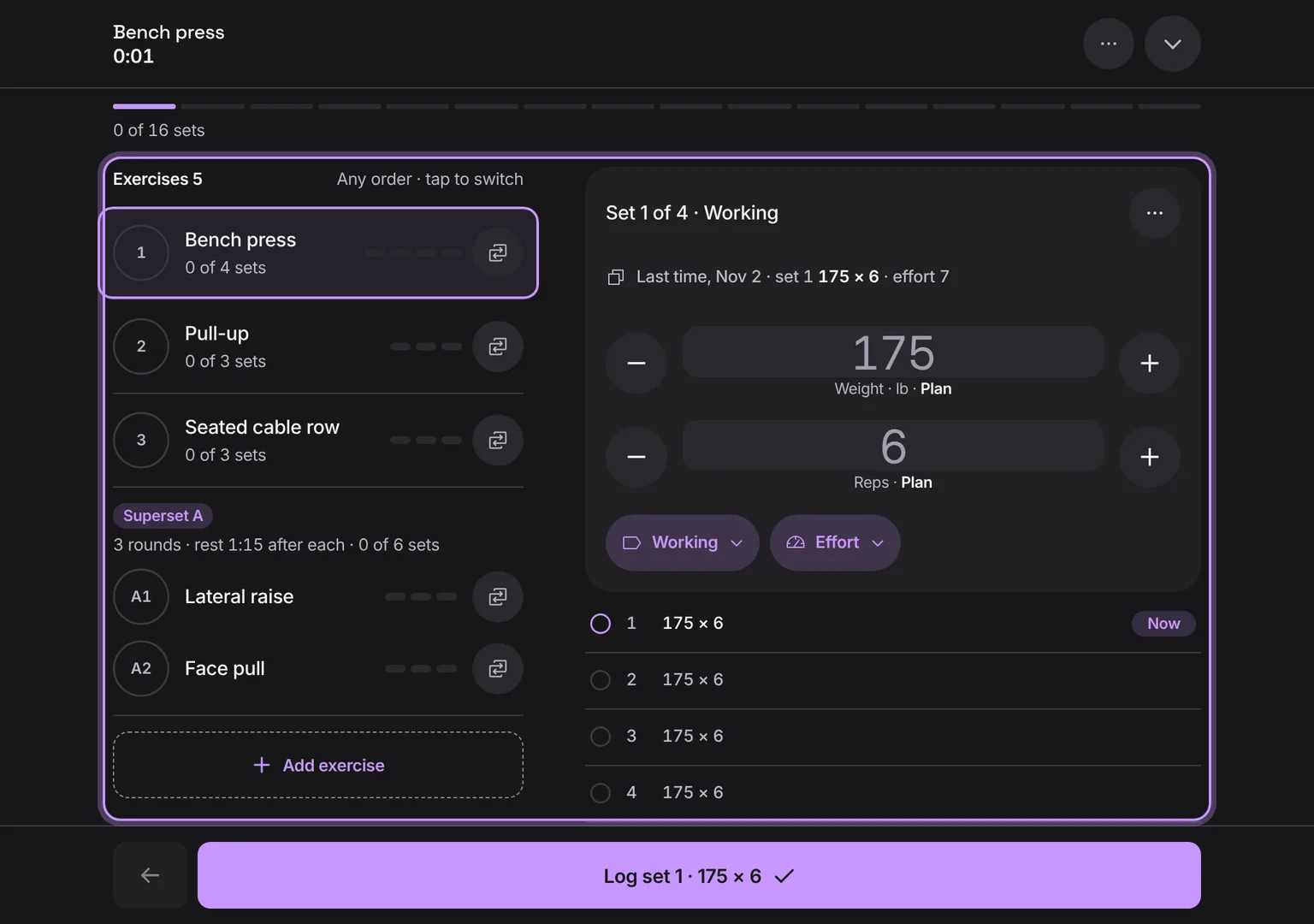
On a wide screen the exercise list stays beside the set, so you never go back to choose.
Open a workout on a computer or tablet.
Shown at a computer’s width.
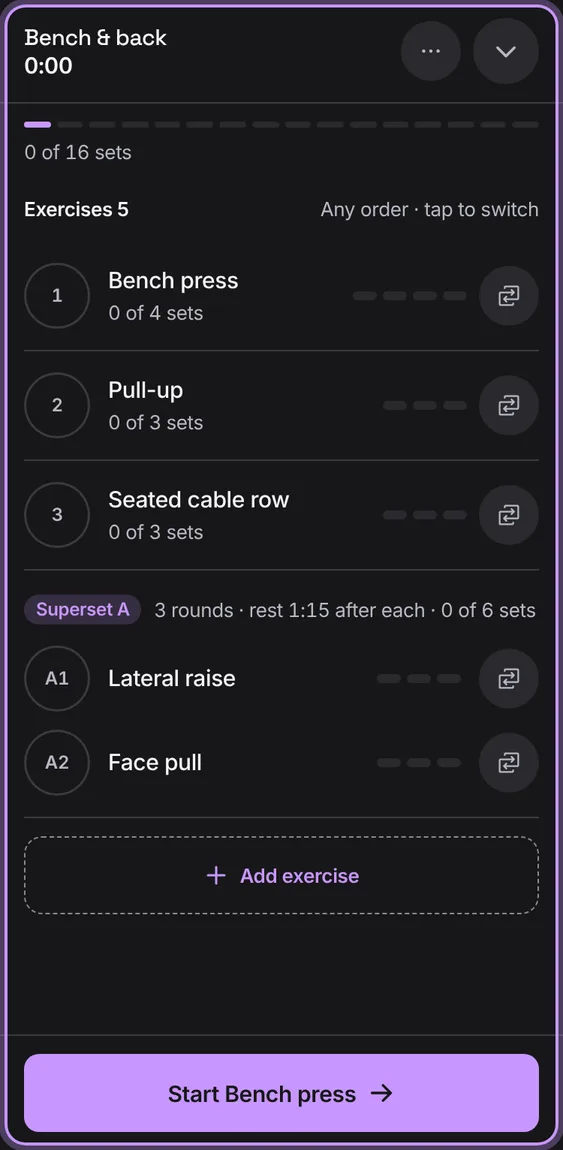
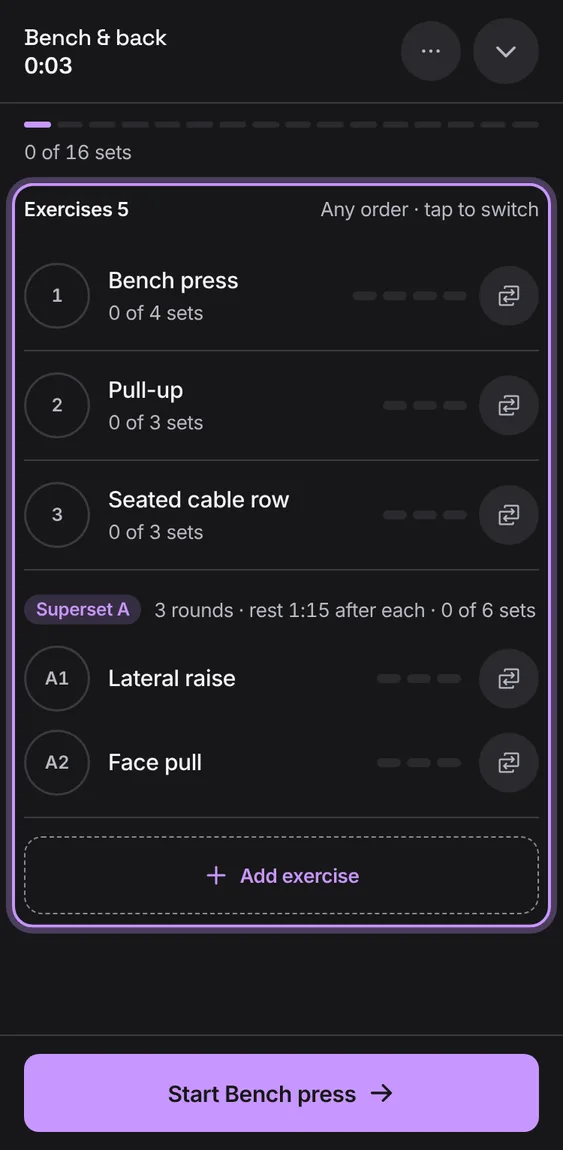
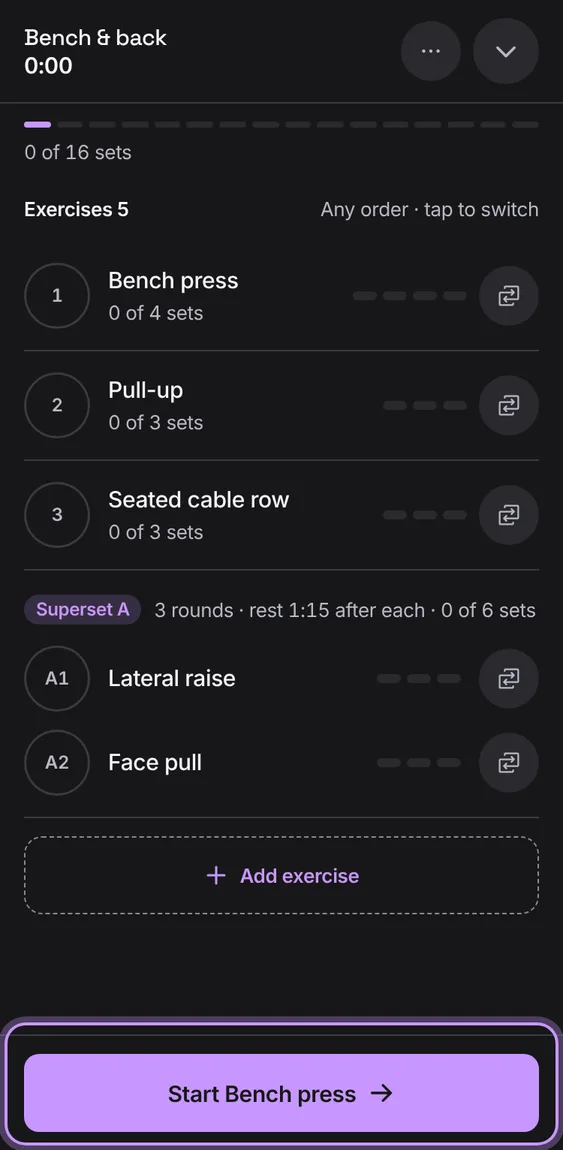
The footer's main button starts the next exercise ("Start Bench press"), says Continue once it's under way, and Finish workout once a set is done.
Tap the footer's button to keep going.
The workout can take the whole screen, hiding the browser's bars.
Tap Full screen in the workout's header.
Not in the demo. Needs the full screen.
In your first workout, a short note under the exercises says Talus logs and suggests but isn't medical advice.
Tap the (i) beside Not medical advice.
Not in the demo. Shows before anything is saved; the demo has sample data.
Minimise the workout to use other tabs. A bar above the tabs shows its name, time, sets or rest, with Resume.
Tap Minimise (the down arrow) in the workout.
Tap Resume to go back.
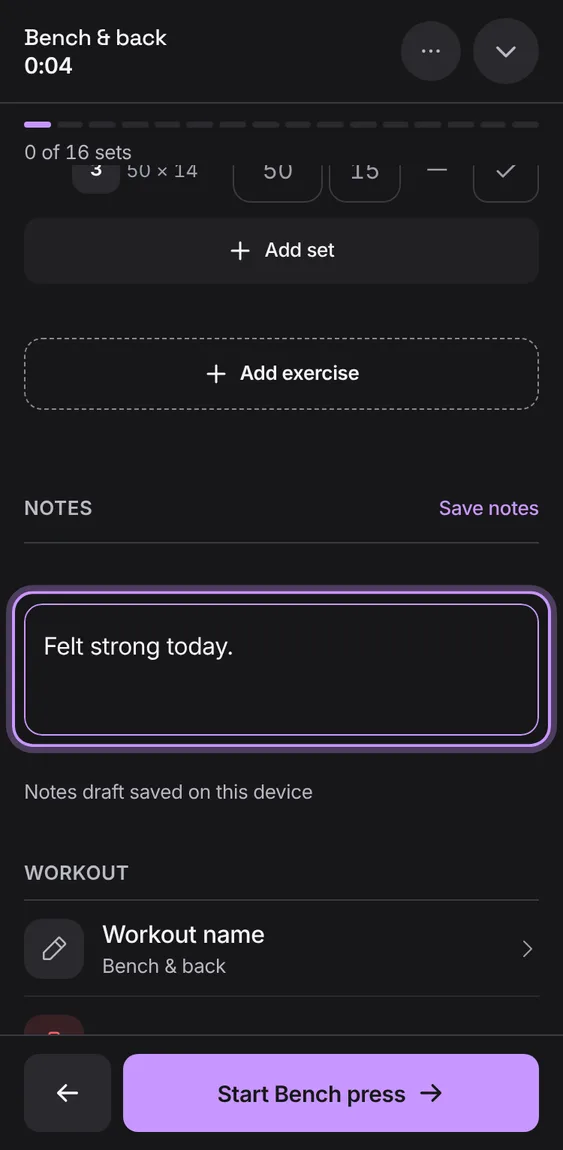
Notes for the workout ("How did it feel?"), saved on this device as you type and kept through a reload.
Open Review workout and write under Notes.
Two tabs see the same workout. A set changed in another tab shows its latest values instead of being overwritten.
Nothing to do: open Talus in two tabs and both stay in step.
Not in the demo. Needs a second device editing at once.
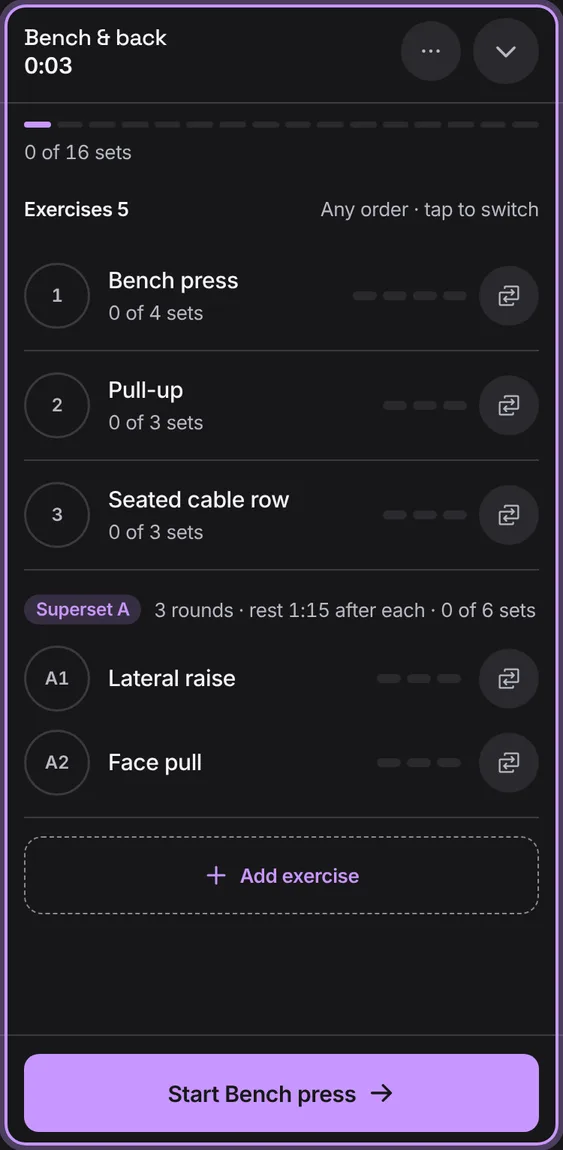
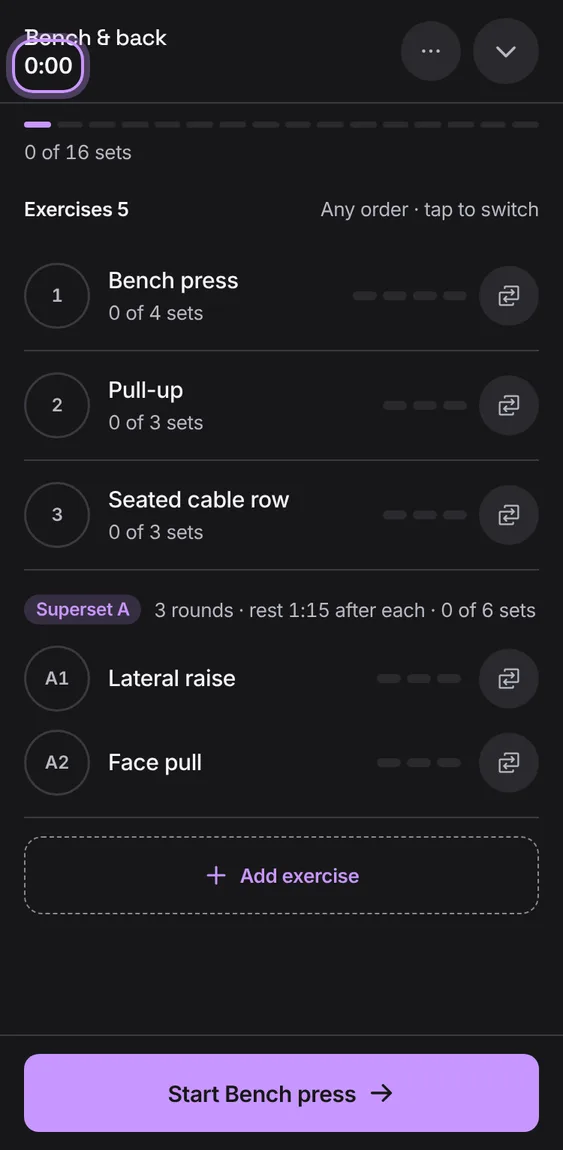
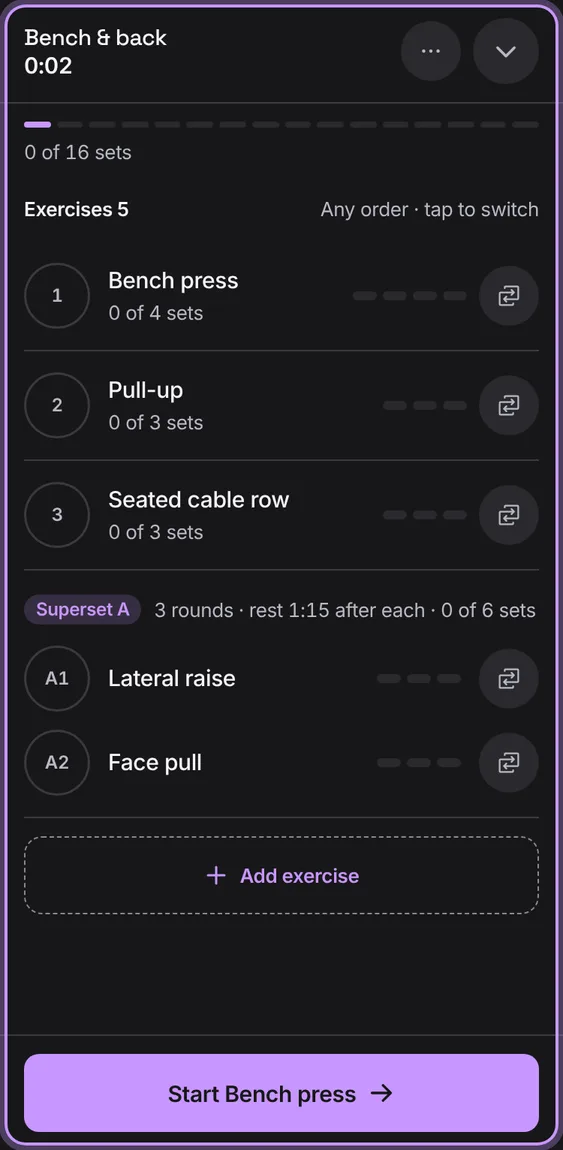
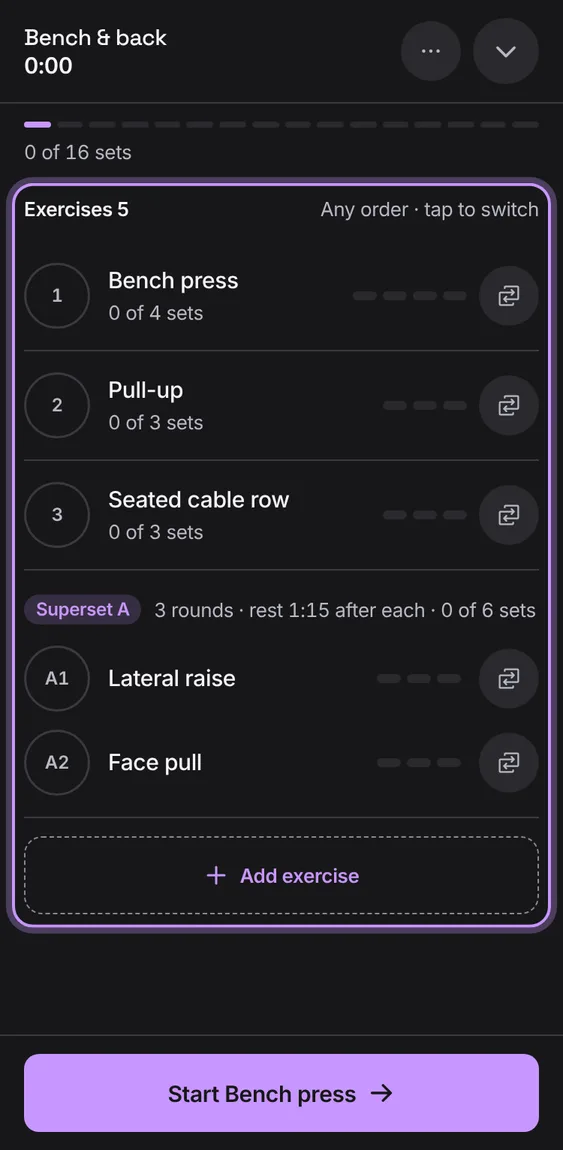
The workout's exercises as cards in order, each with its sets done and best so far. Pick any one, in any order.
Tap an exercise's card to start it.
A finished one opens for review.
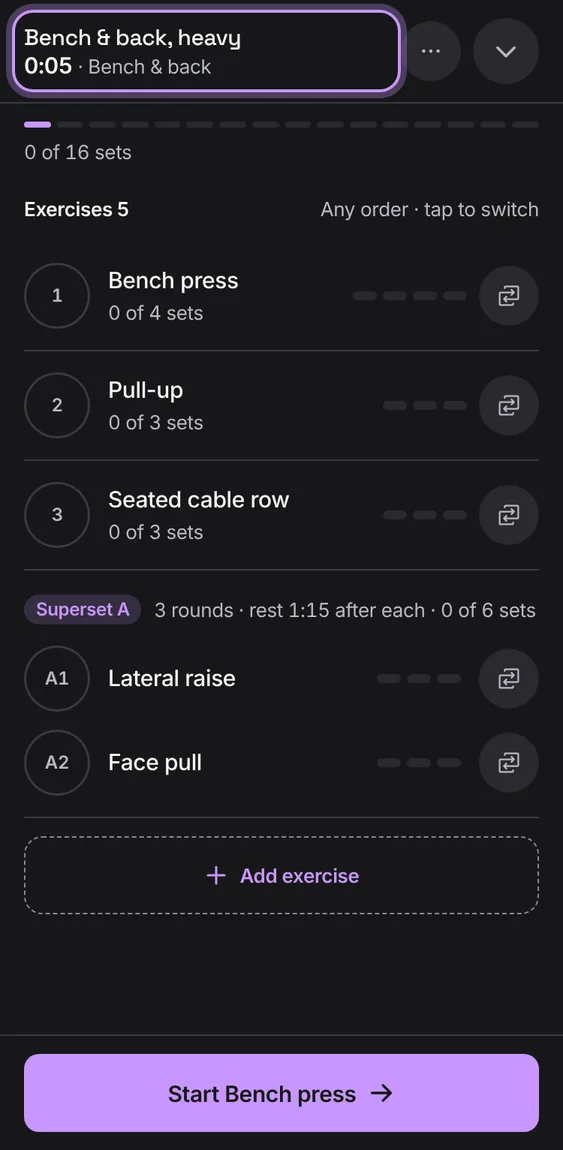
Rename the workout while you're in it.
Open Workout options and tap Workout name, then Save name.
Every exercise and set of the workout as one list, with last time's sets beside each, notes, the name and Discard.
Open an exercise's options and tap Review workout.
Back to exercises returns to one set at a time.
While the workout is open the screen doesn't dim; it's let go when you minimise or close it. There's no switch for it.
Nothing to do: it's automatic where the browser allows it.
Start a routine or an empty workout from Train, Routines, History or Progress. With a workout going, Start takes you back to it instead.
Tap Start beside a routine, or Empty workout.
Only one workout runs at a time.
A superset is one card. The workout alternates its exercises, shows the round (Superset A · round 2 of 3) and uses its rest between exercises and after each round.
 Talus