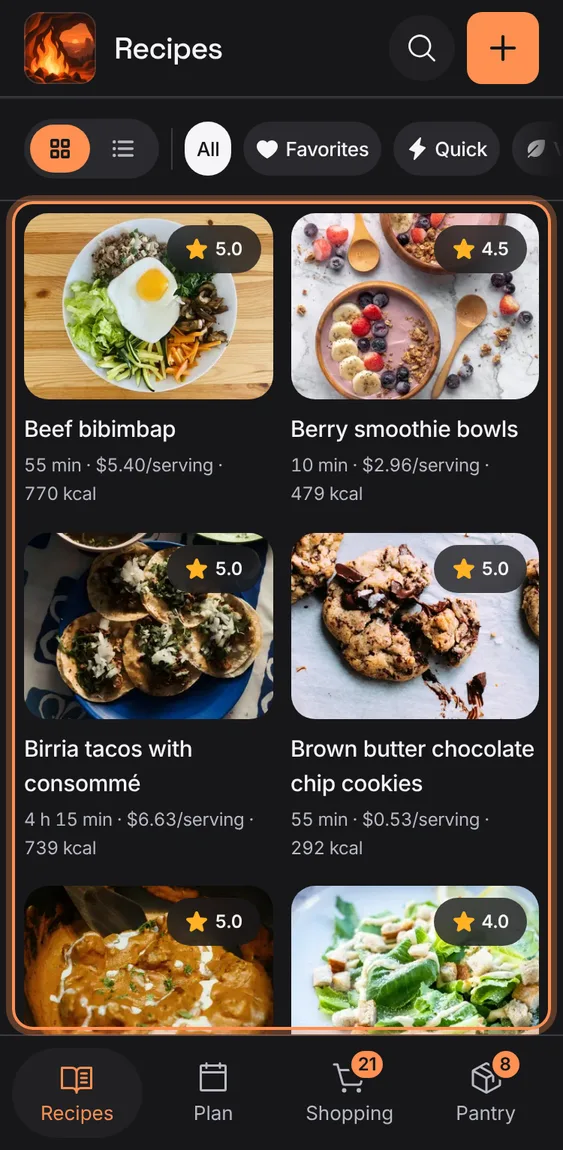
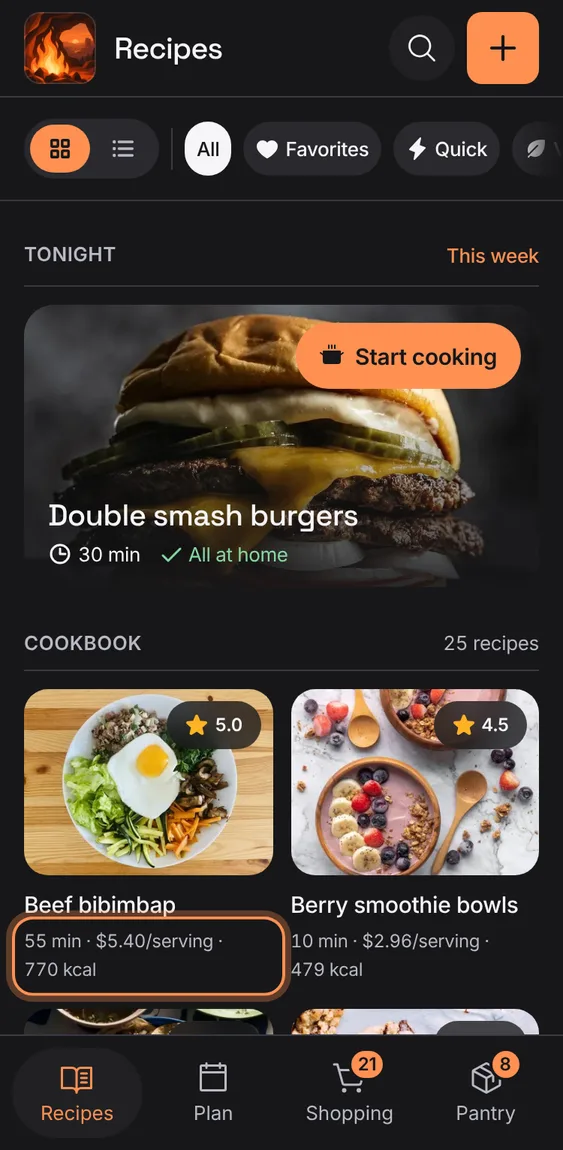
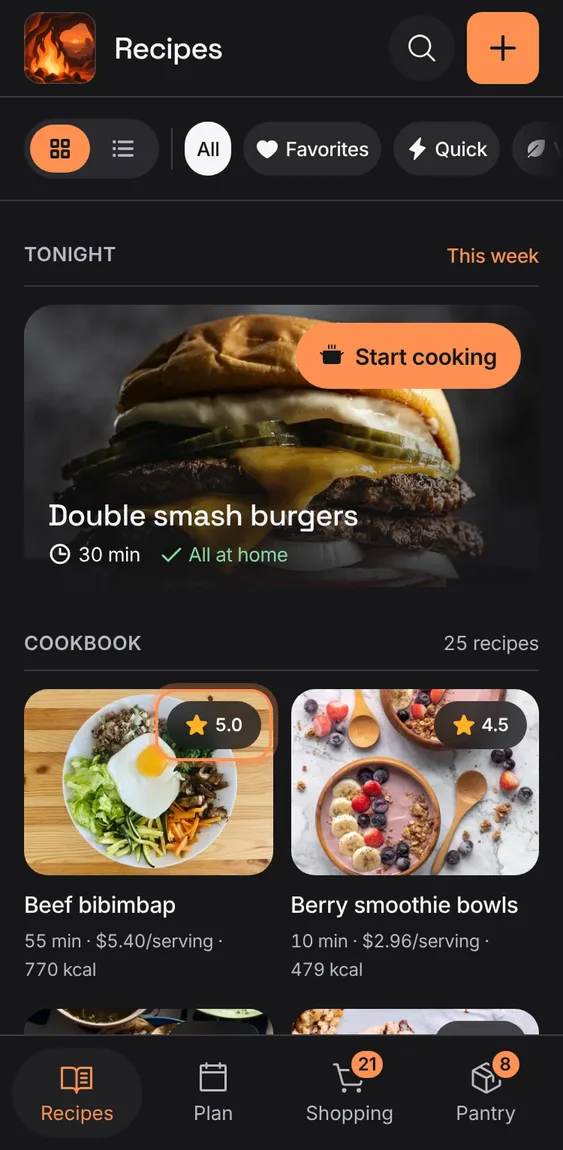
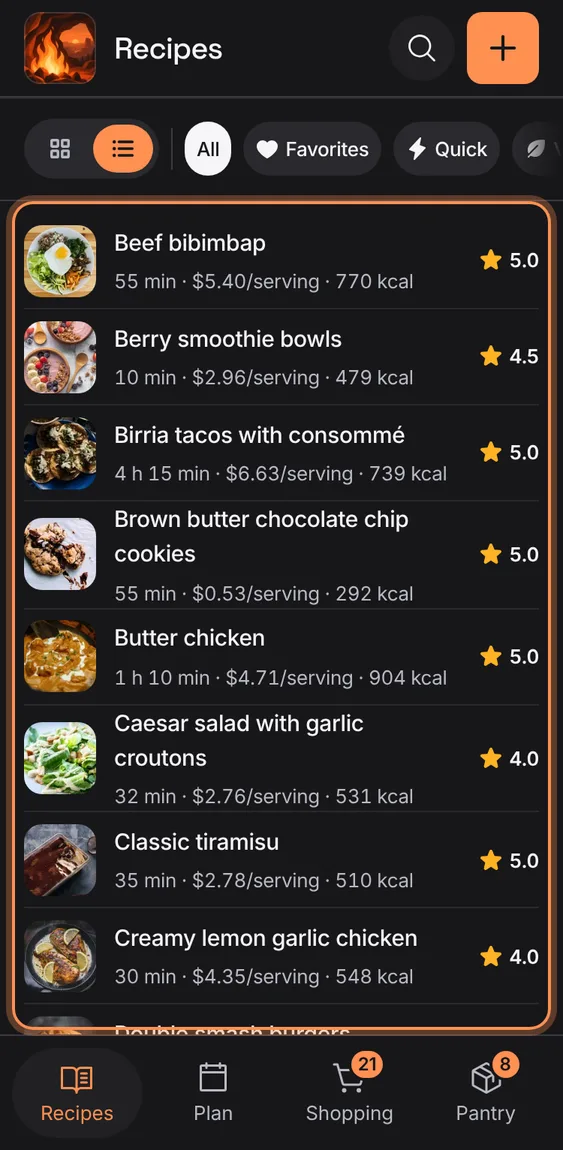
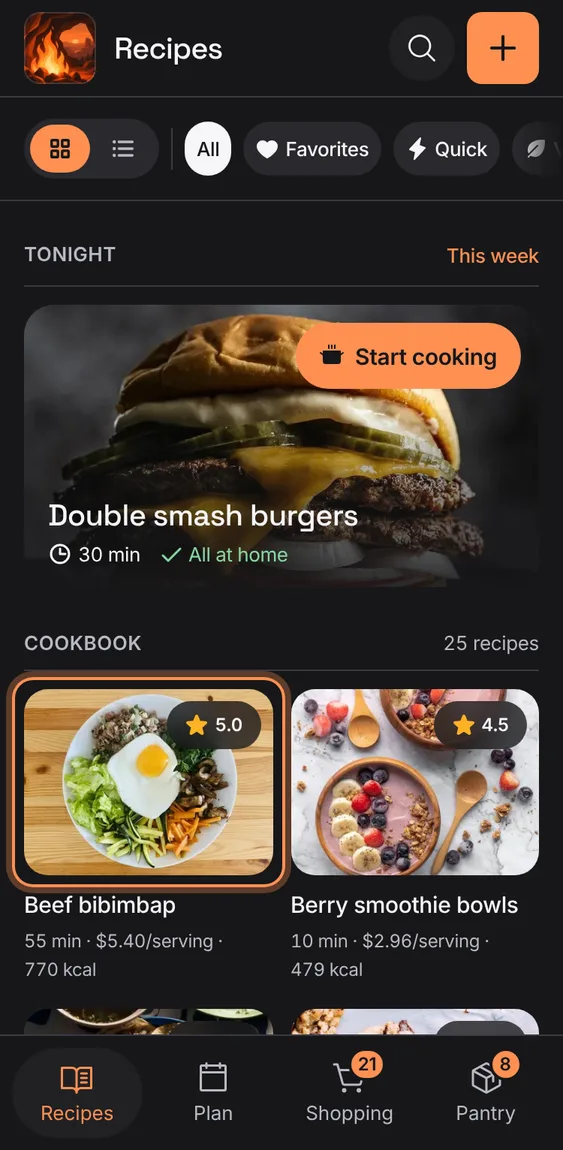
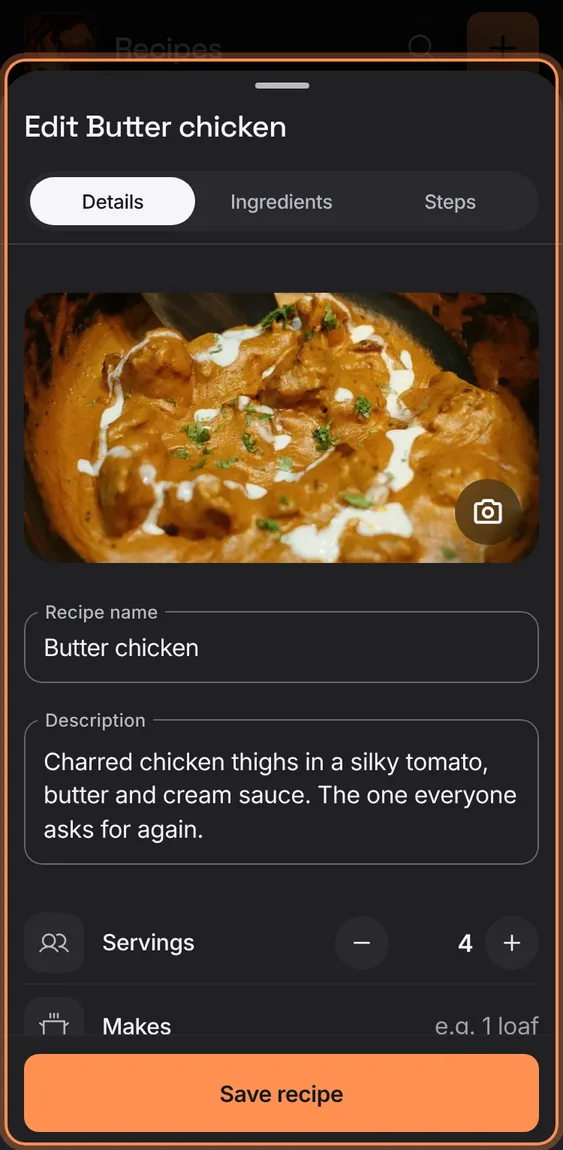
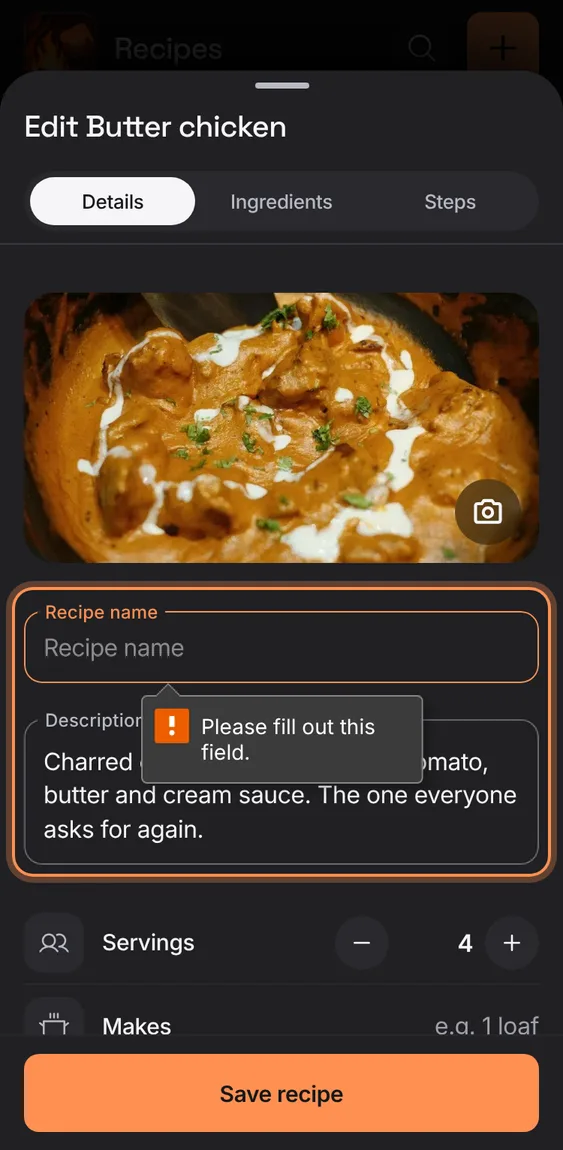
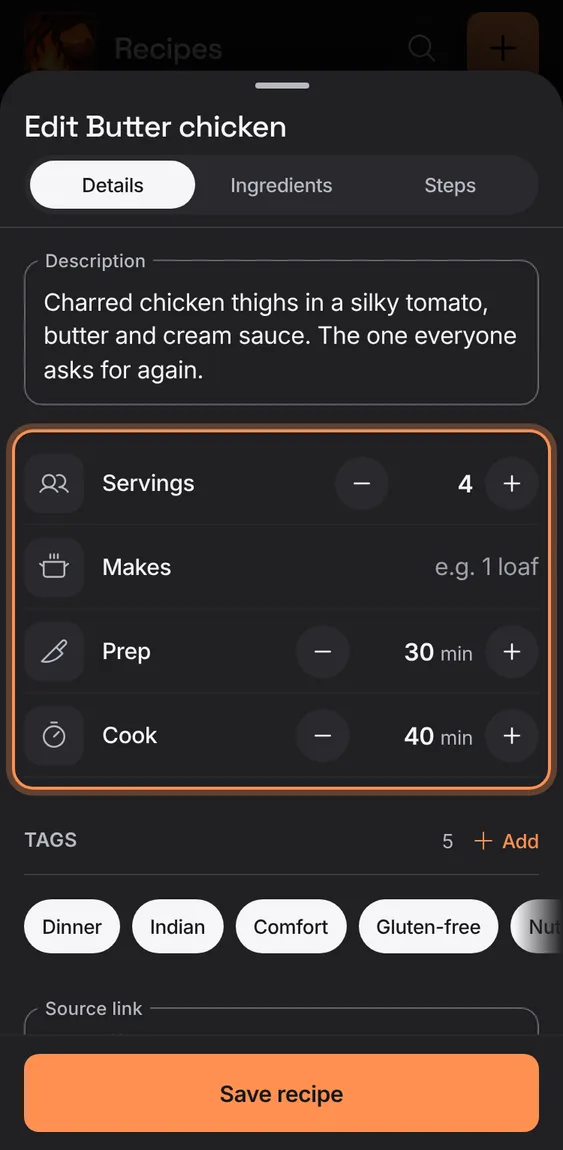
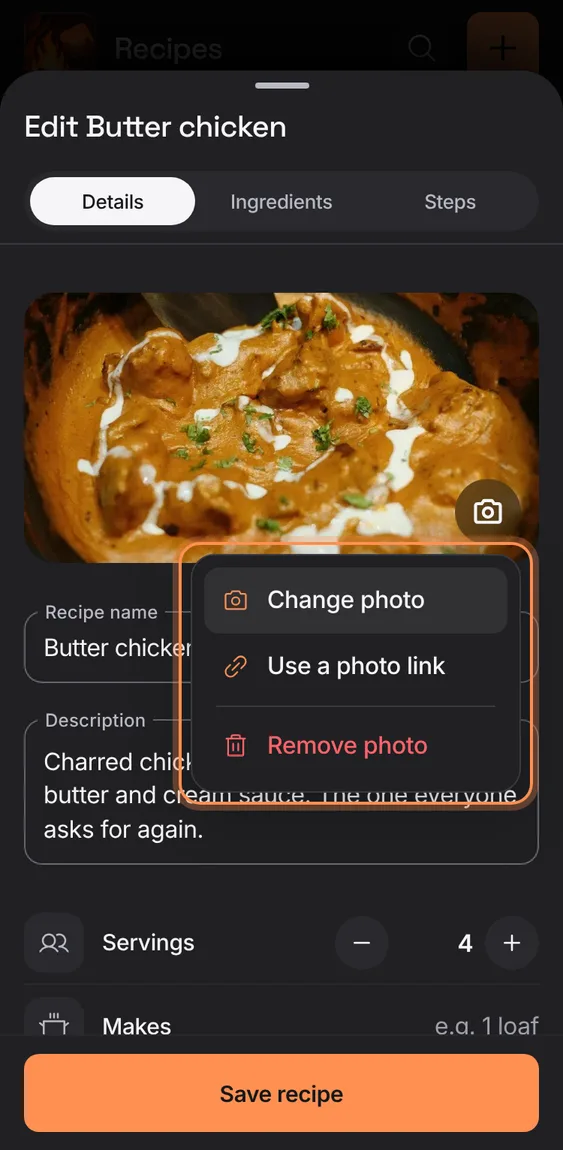
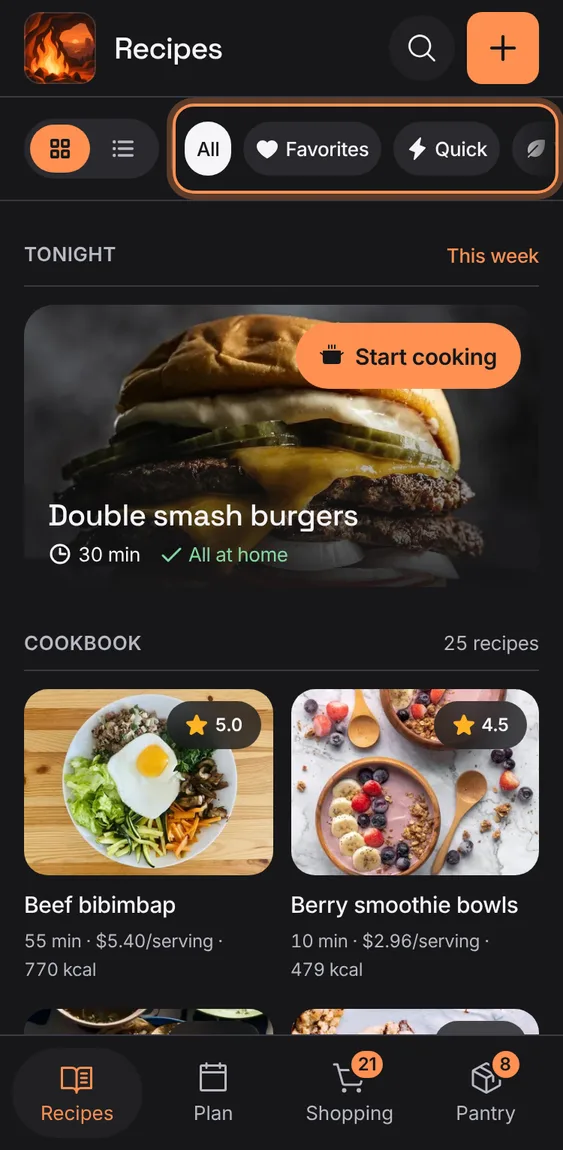
A recipe imported without a photo of the finished dish gets a watercolor painting of it; a source's own photo is kept.
Nothing to do: it's painted during the import, signed in.
Not in the demo. Needs an account: the demo has none.
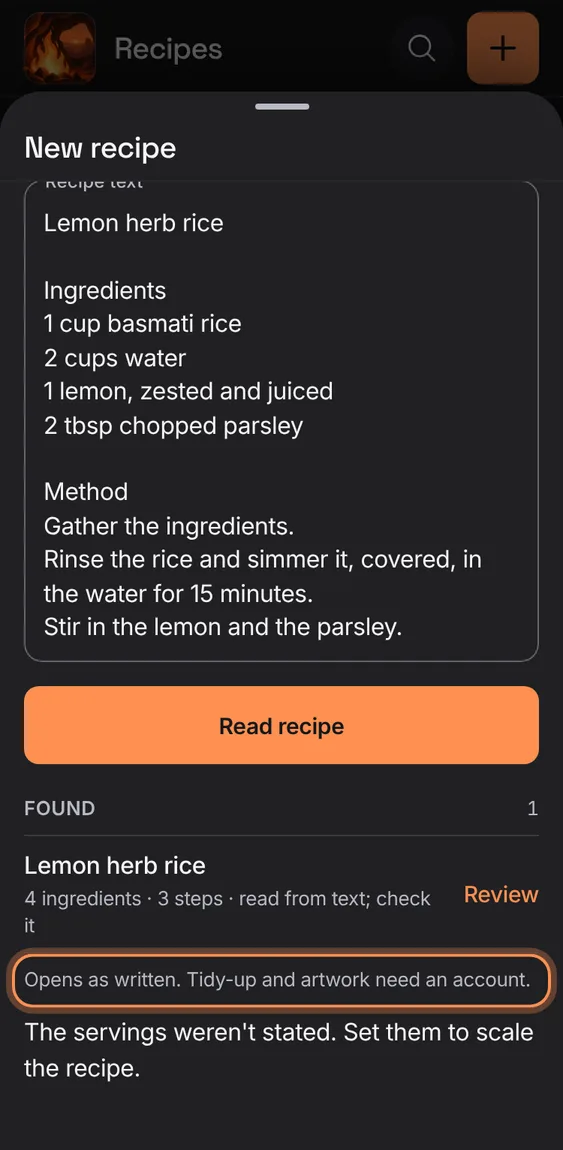
Signed out, offline or in the demo, a pasted or saved recipe still opens as a draft, as written, and says what's left out.
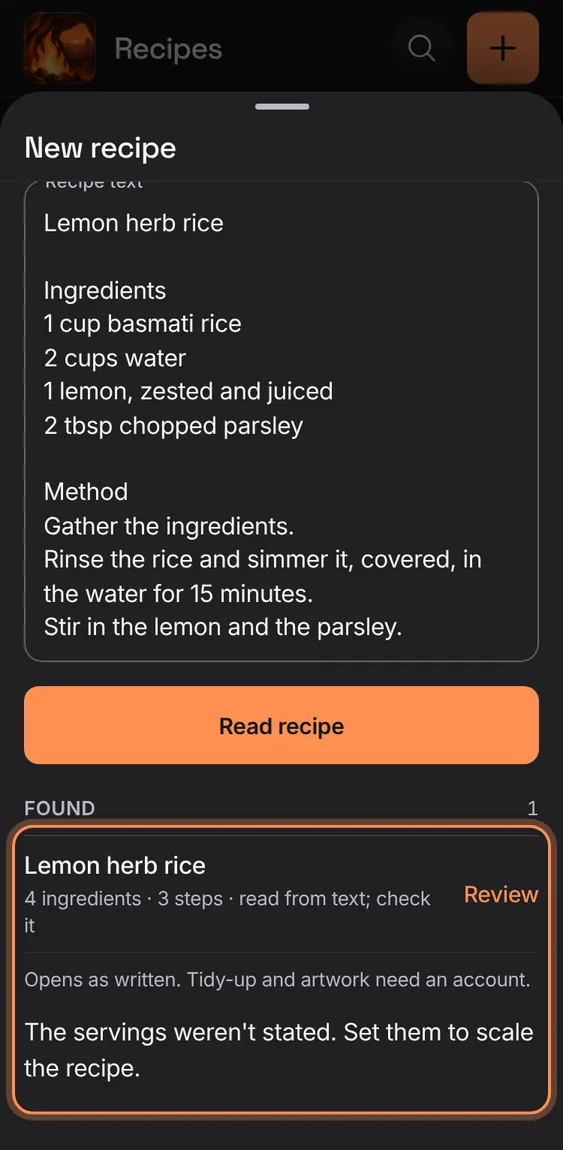
The found recipe's row says "Opens as written".
Signed in, its method is tidied once you're back online.
Paste up to 20 addresses, one per line; each is read in turn with its own result, and a failed one can be retried or its text pasted.
Link › Several addresses (or paste several).
Tap Read all, then Review each recipe found.
A failed address offers Retry and Paste its text.
Not in the demo. Needs an account: the demo has none.
When a page or photo holds several recipes, each is listed with its counts and any warnings, to review one at a time.
Tap Review on the one you want.
Not in the demo. Needs a file from your device.
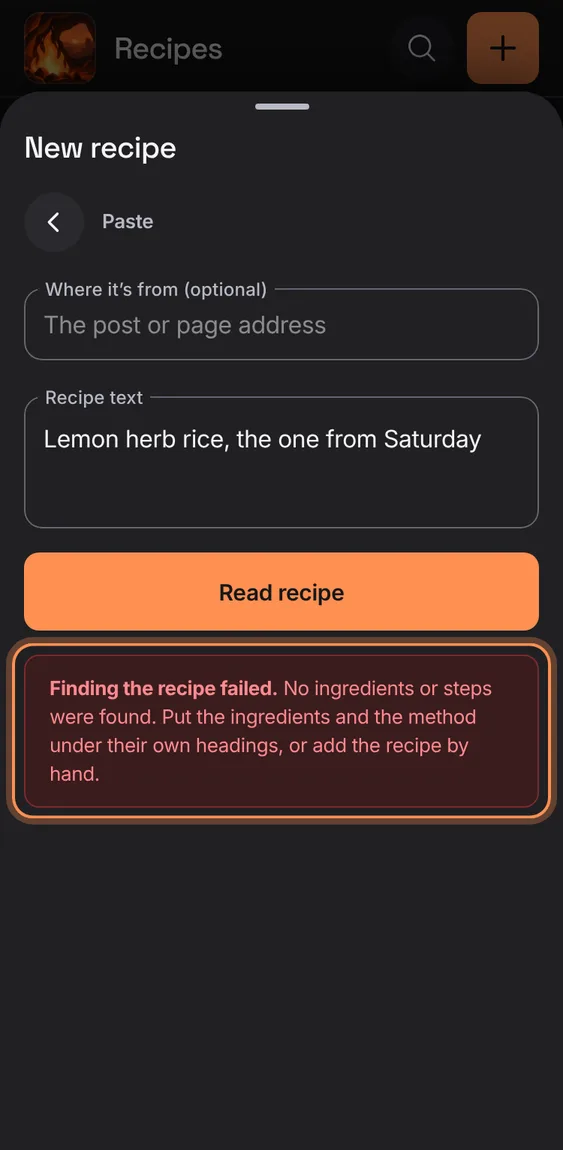
A failed import says which stage failed (fetching the page, finding the recipe…) and keeps your source to retry; it never saves an empty recipe.
Tap Retry, or Paste text instead.
A web page saved to your device, or a text or JSON file, is read like a link.
Upload › choose the .html, .txt or .json file.
Not in the demo. Needs a file from your device.
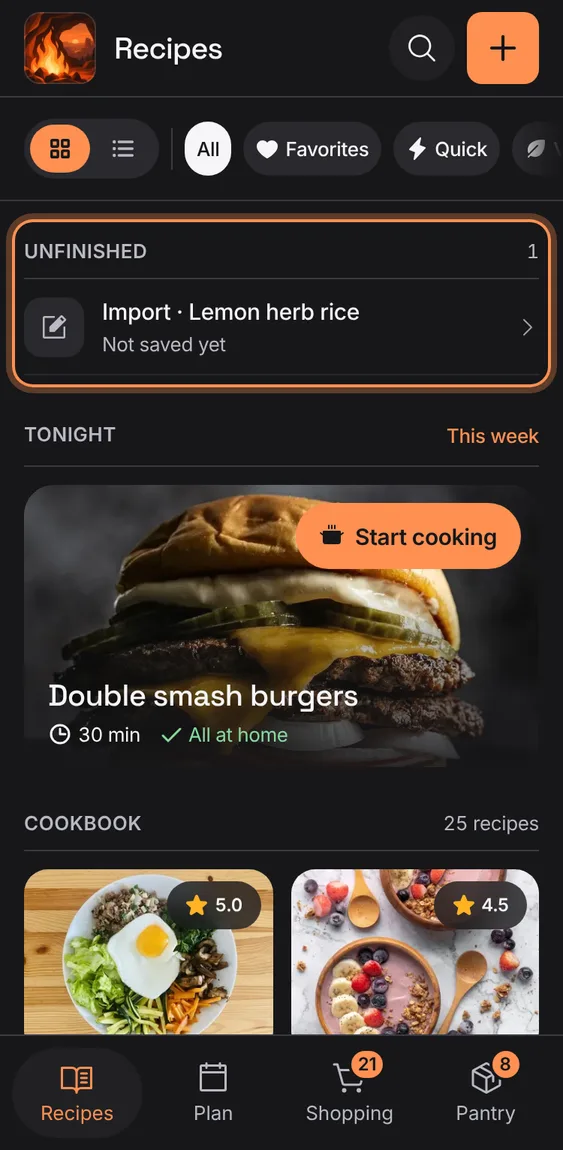
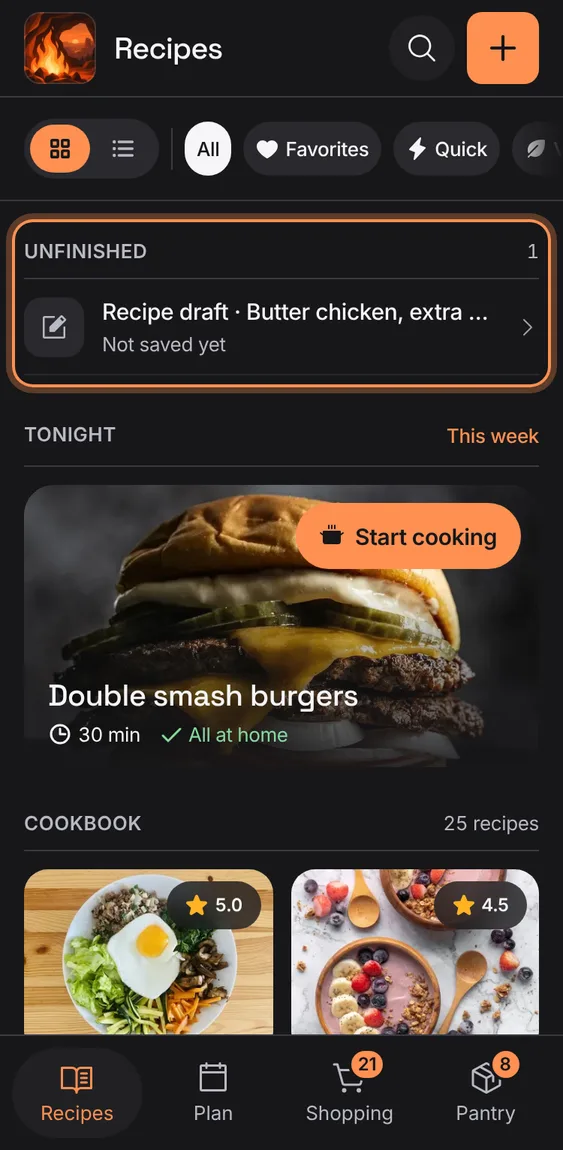
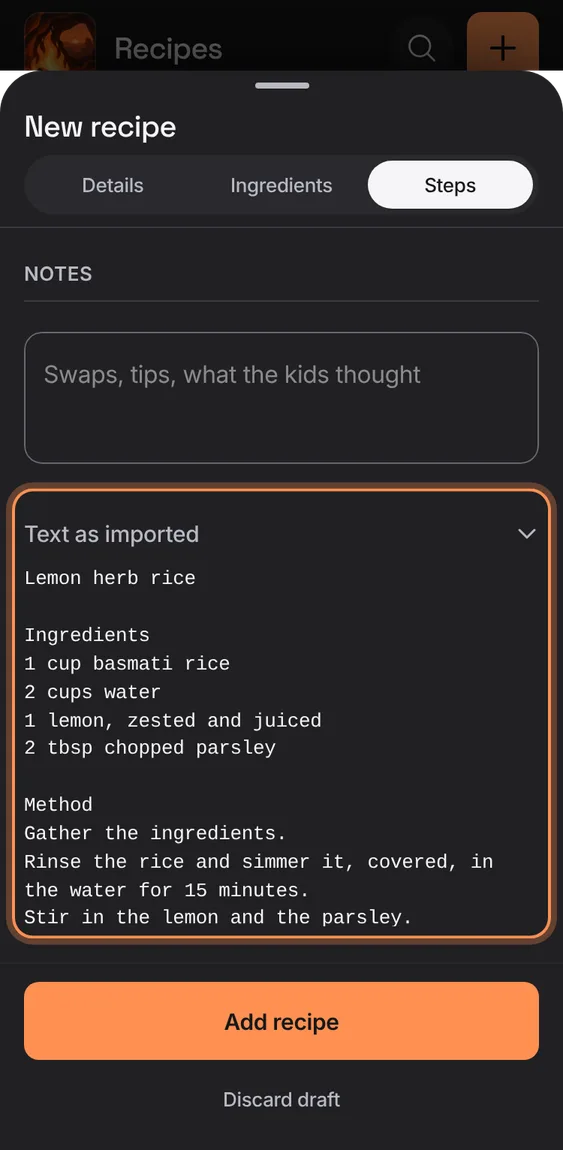
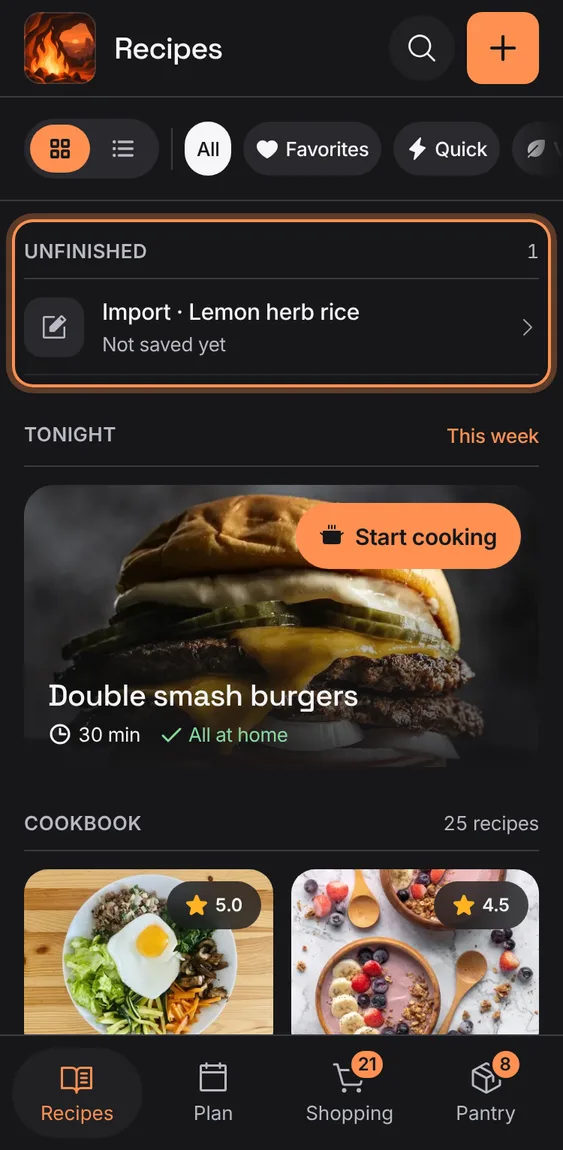
What you pasted or the addresses you gave are kept on this device until the recipe is reviewed, through reloads and failures; Discard this import lets them go.
Find it under Unfinished on Recipes.
Discard this import asks first.
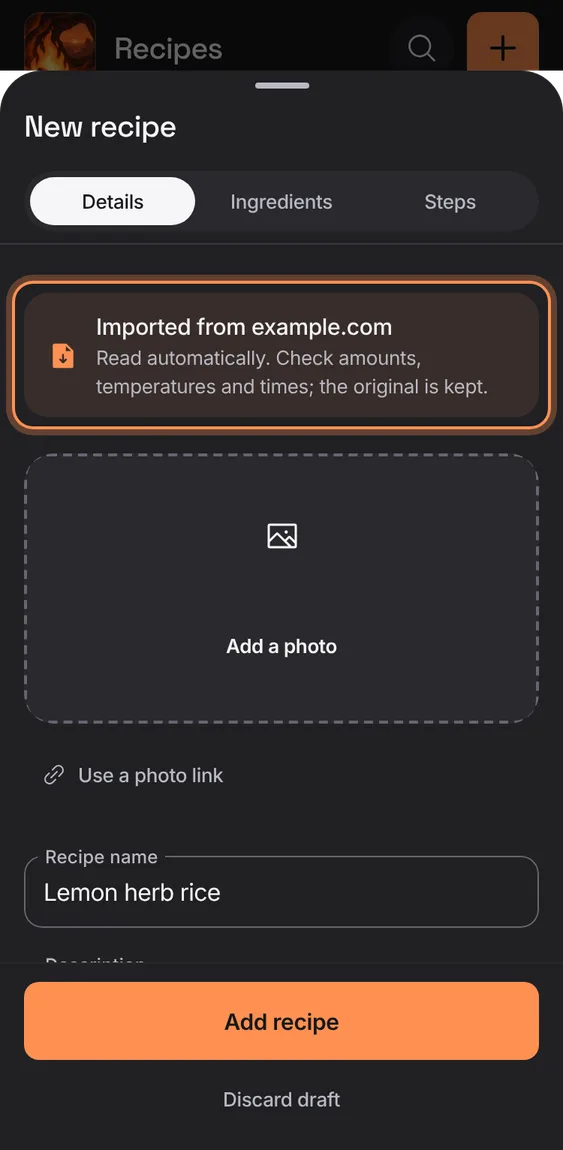
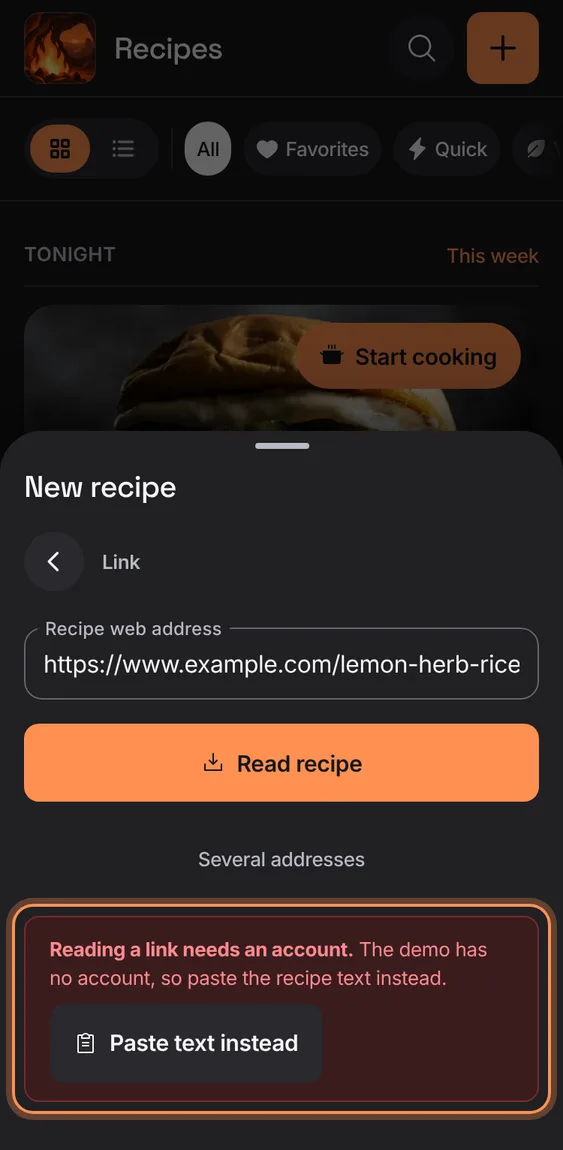
Paste a recipe's web address; the page's recipe is read on the server and shown as a draft with where it came from.
New recipe › Link.
Paste the address and tap Read recipe.
A page with several recipes lets you choose one.
Not in the demo. Needs an account: the demo has none.
For a link to a post, the creator's own recipe page is looked for, so the draft has their exact amounts and method.
Nothing to do: it runs when a post has no full recipe.
Not in the demo. Needs an account: the demo has none.
Reading a link, photo or video happens on the server, so signed out it says so, with Sign in and Paste text.
Tap Sign in, or Paste text instead.
Up to four photos or screenshots of a recipe are read as written into a draft; a page with two recipes offers both.
Upload › choose photos.
Check the result before saving.
Not in the demo. Needs an account: the demo has none.
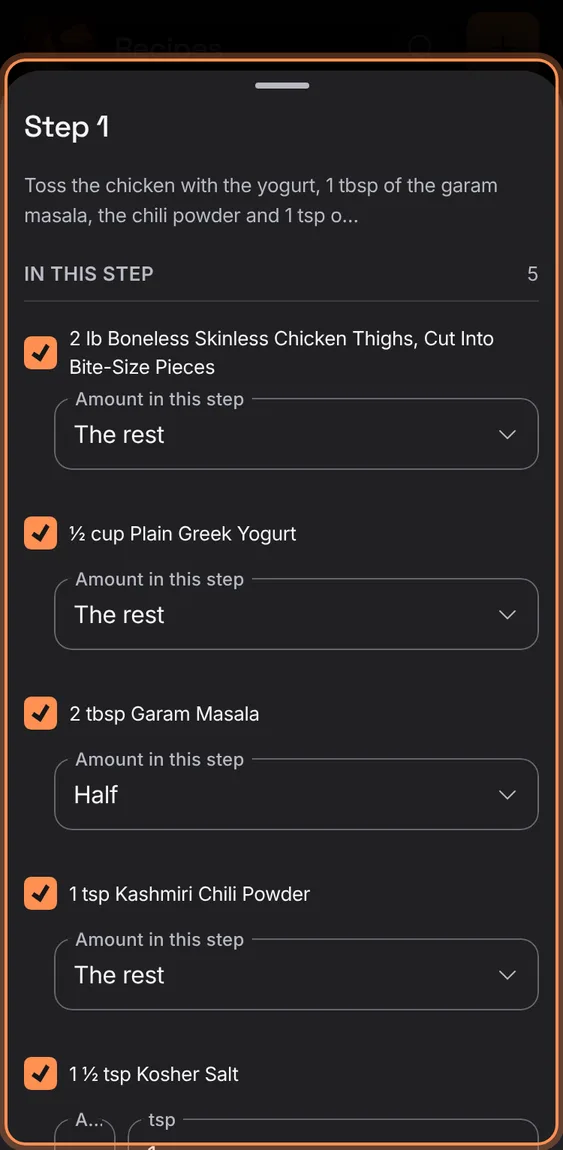
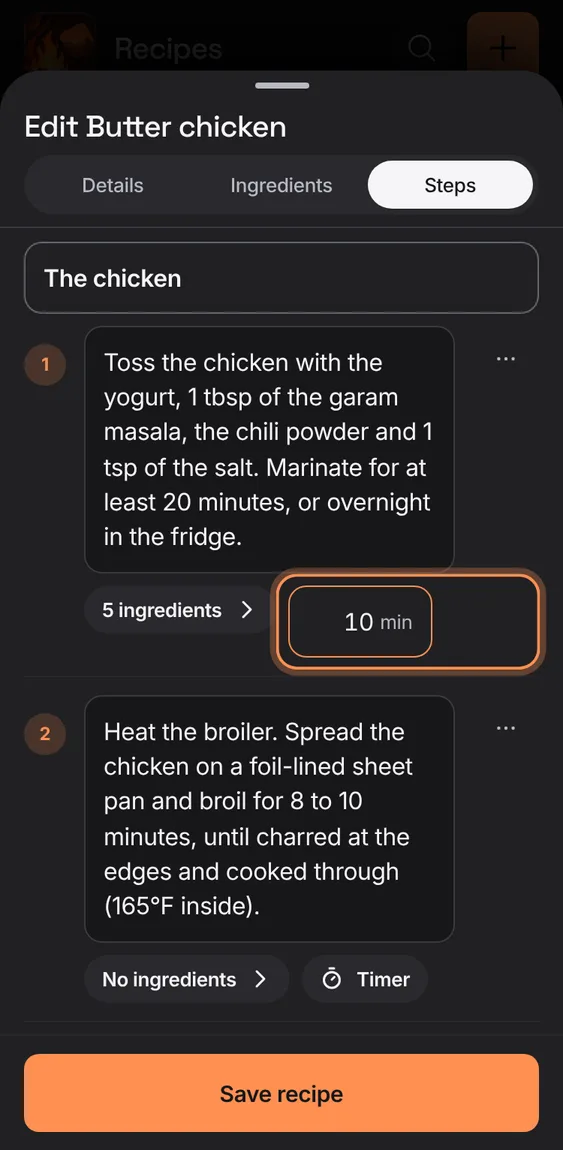
Before the editor opens, the method is split into one action per step and each step is linked to the ingredients it uses, checked so nothing is lost or invented.
Nothing to do: it runs on import, signed in and online.
Not in the demo. Needs an account: the demo has none.
While a recipe is read, prepared and painted, an animated fire on a stone hearth shows each stage: read, prepare, paint, keep.
Wait on the fire; each stage ticks off.
With reduced motion the fire stays still.
Not in the demo. Needs an account: the demo has none.
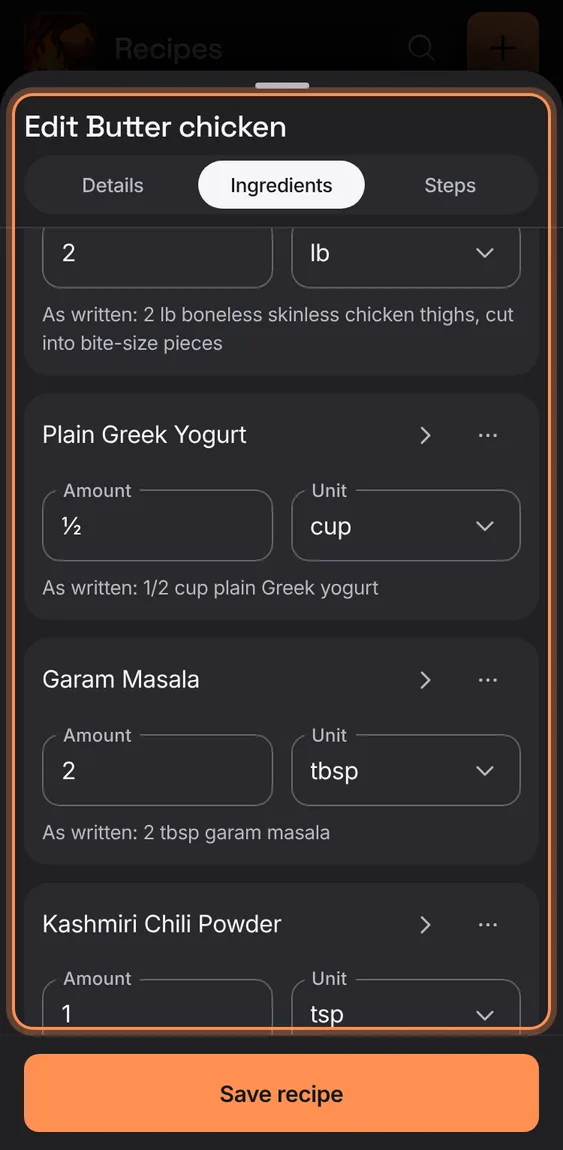
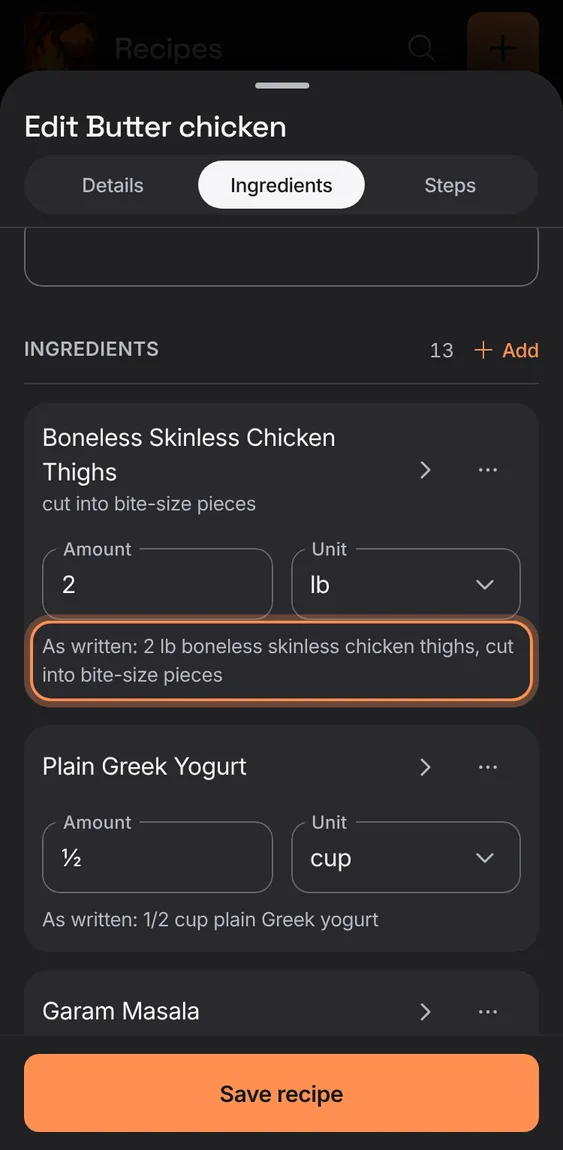
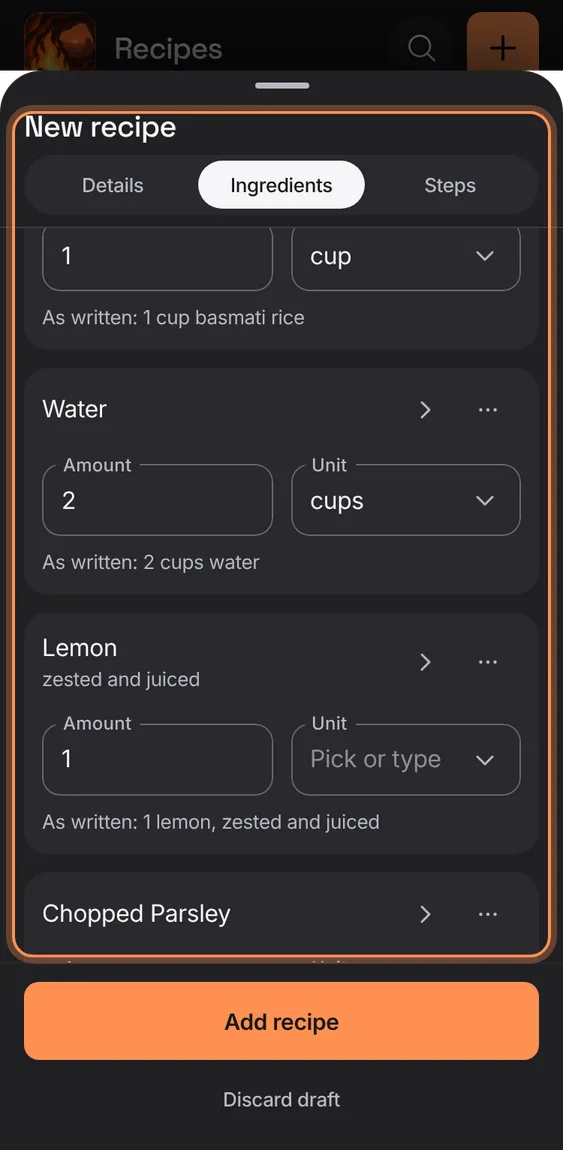
Each line's amount, unit, food and preparation are read as the recipe writes them, without guessing what isn't there.
Nothing to do: every import does this.
On a phone with Hearth installed, share a link or text from another app to Hearth and the import opens with it.
In the other app, tap Share and choose Hearth.
Not in the demo. Starts in another app, from its Share button.
A link to a recipe post reads its caption, finds the creator's recipe, and if needed its spoken words and on-screen text.
Paste the post's link in Link.
If nothing complete is found, the caption is kept to paste or add to.
Not in the demo. Needs an account: the demo has none.
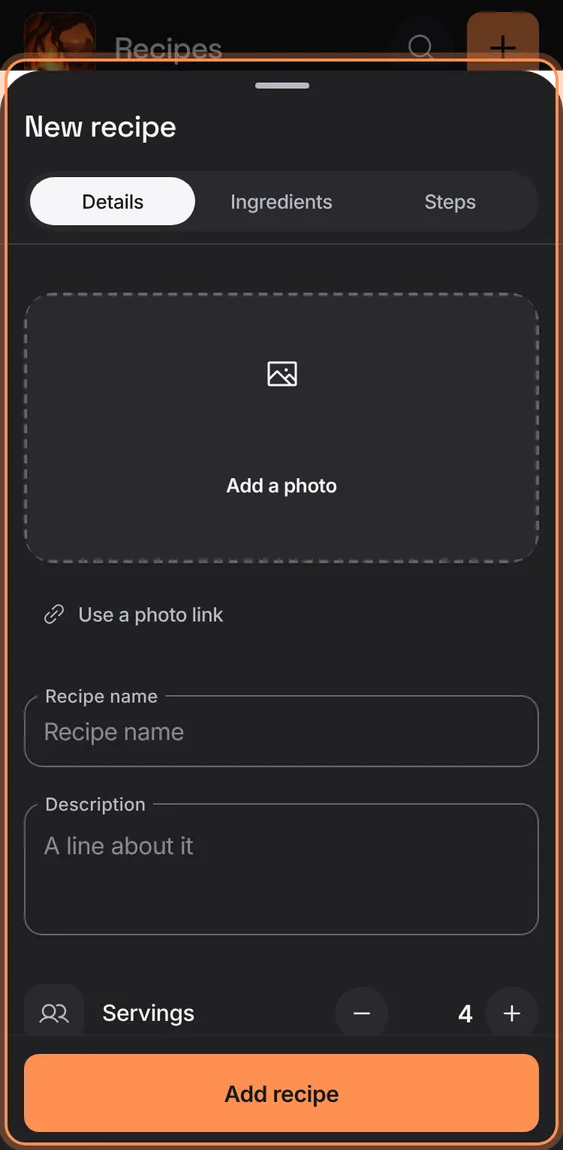
Paste a recipe's text, with or without headings; it's read into a draft that keeps the original text.
New recipe › Paste.
Paste the text, add where it's from if you like, and tap Read recipe.
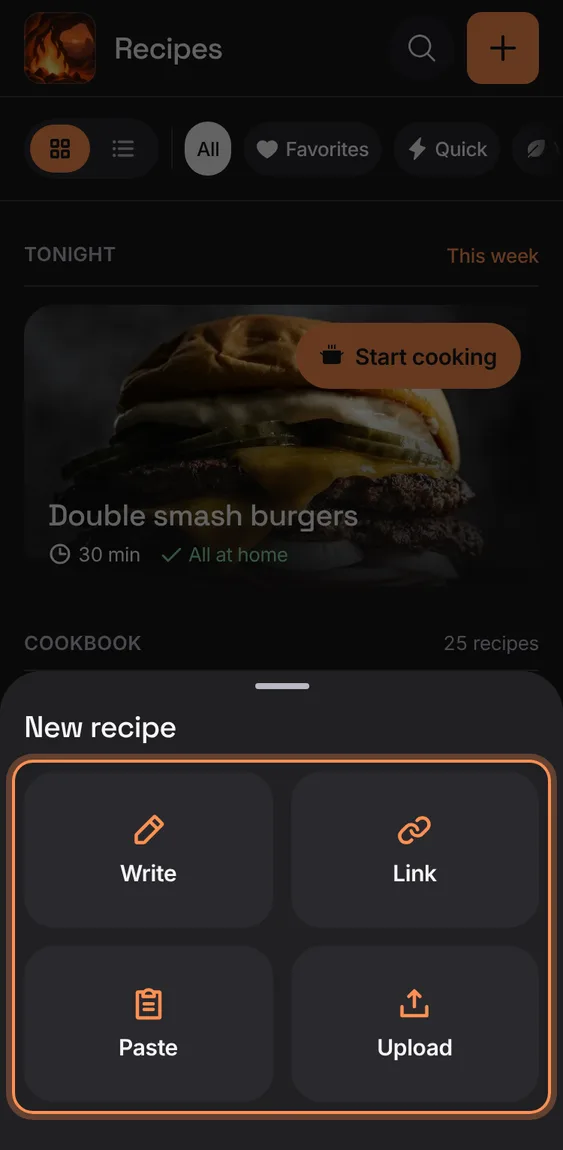
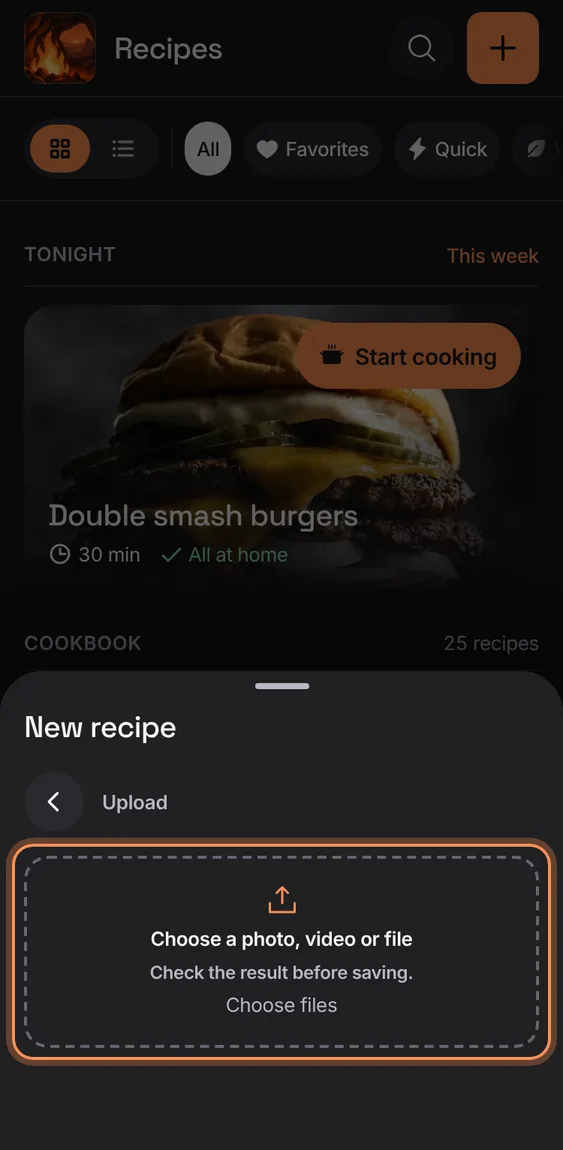
One button takes a photo or screenshots of a recipe, a short video, or a saved web page or text file.
New recipe › Upload.
Choose the file: photos are read, a video is transcribed, a page is parsed.
A short clip (up to three minutes, under 25 MB) is read from its frames and its sound into a draft to check.
Upload › choose the video.
Or Paste caption, or Use screenshots.
Not in the demo. Needs an account: the demo has none.
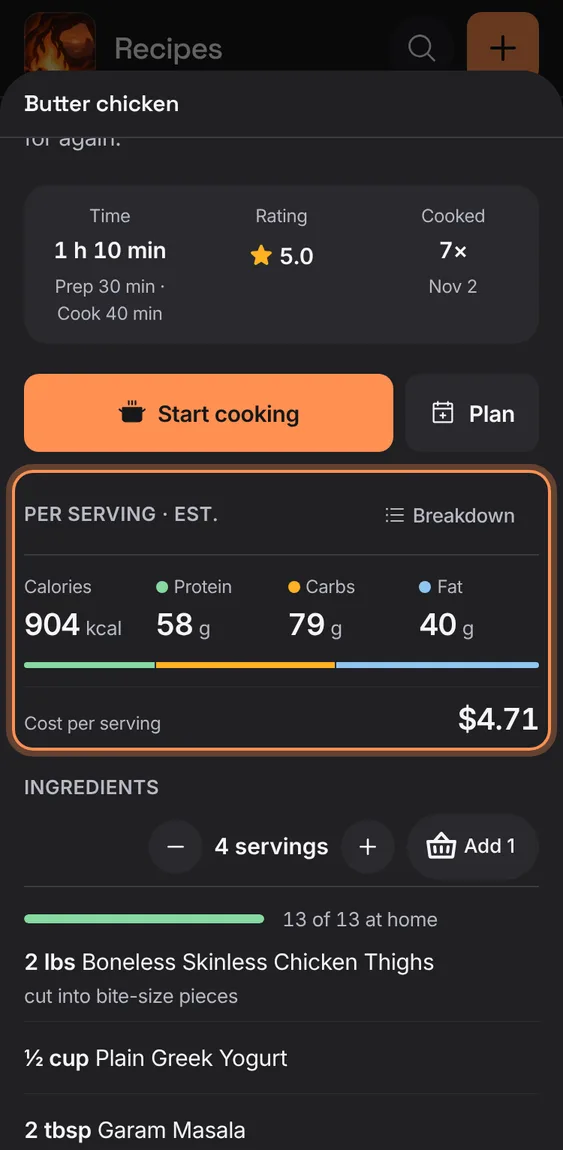
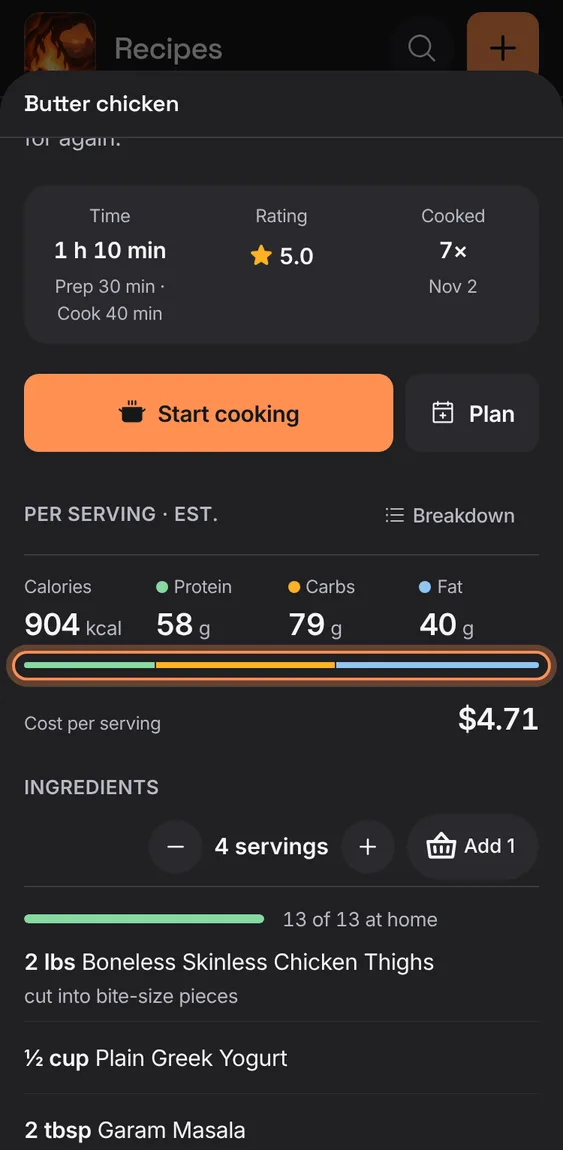
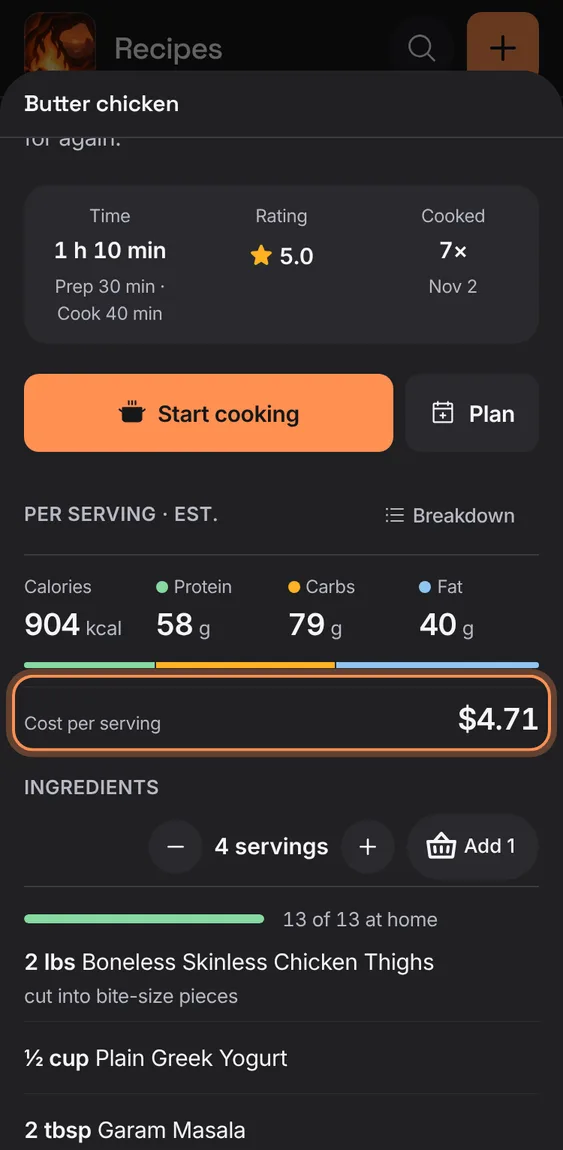
Per serving: calories, protein, carbs and fat, and what it costs, all from the ingredient lines; what isn't known is said, never counted as zero.
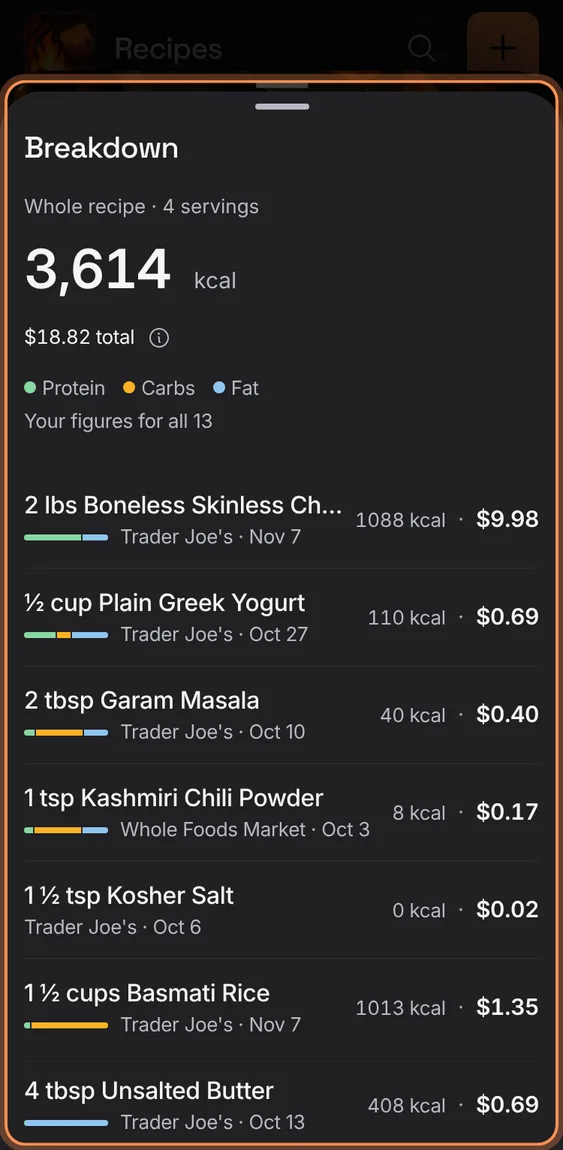
Every ingredient with its calories, an energy bar by protein, carbs and fat, where its figures and price came from, and the whole recipe's total.
Tap Breakdown by Per serving.
Lines you've corrected are marked Edited.
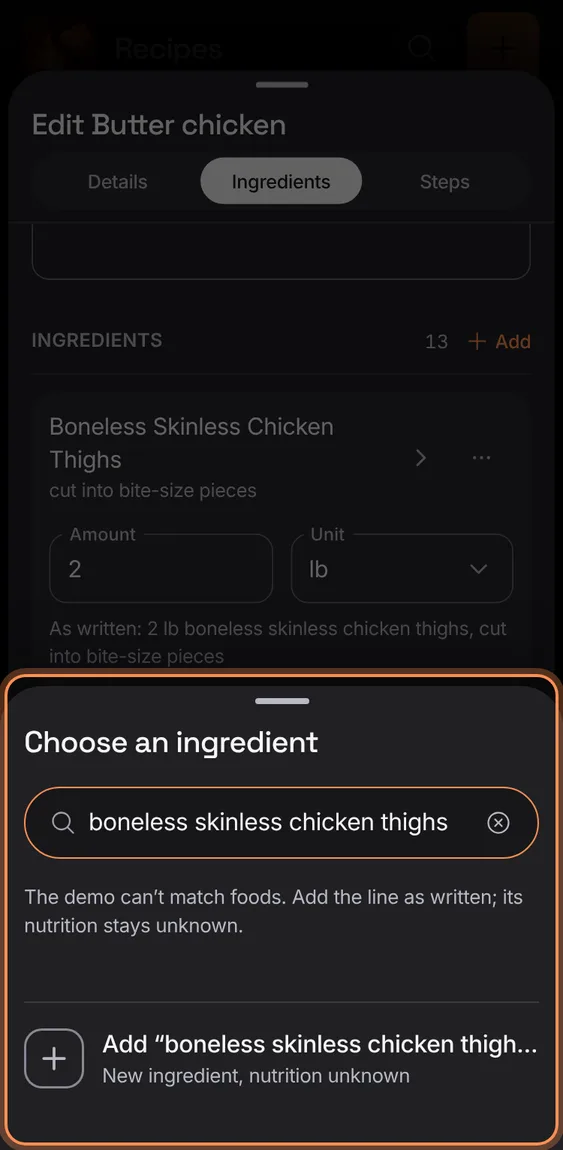
Choose another food for a line, enter its weight, have it matched again, or leave it out; your choice is kept from then on.
In Breakdown, tap a line.
Search foods, Save weight, Match it for me again, or Don't count this ingredient.
Not in the demo. Needs an account: the demo has none.
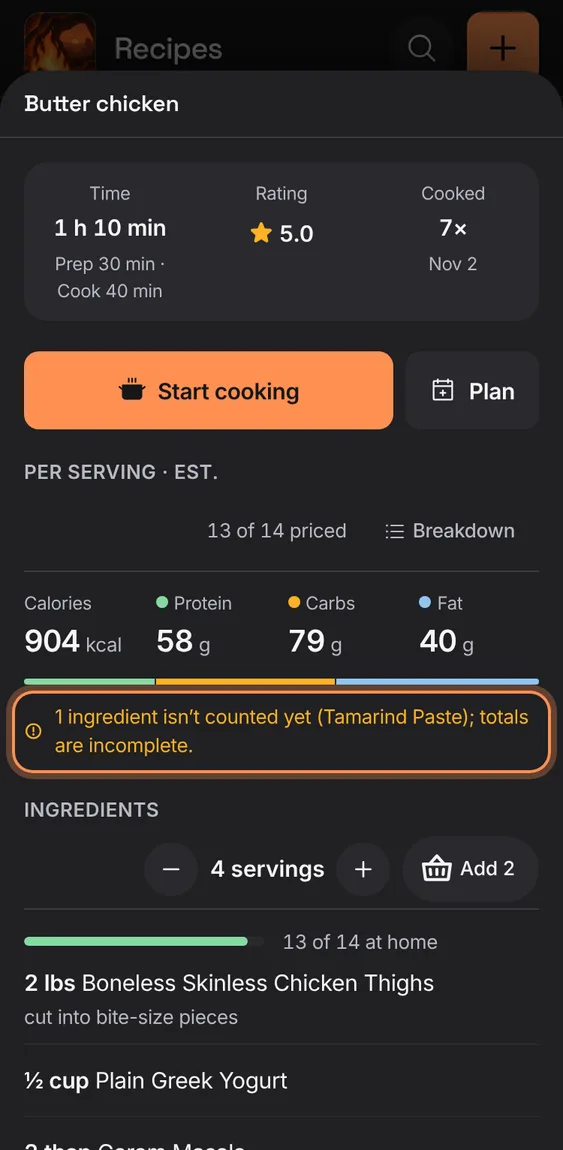
When some lines aren't counted yet or have no amount, the figures say so and name them, marked with a "+".
Read the note under the figures.
A thin bar splits the calories by protein, carbs and fat, with the grams of each.
Read it under the figures; Breakdown shows it per line.
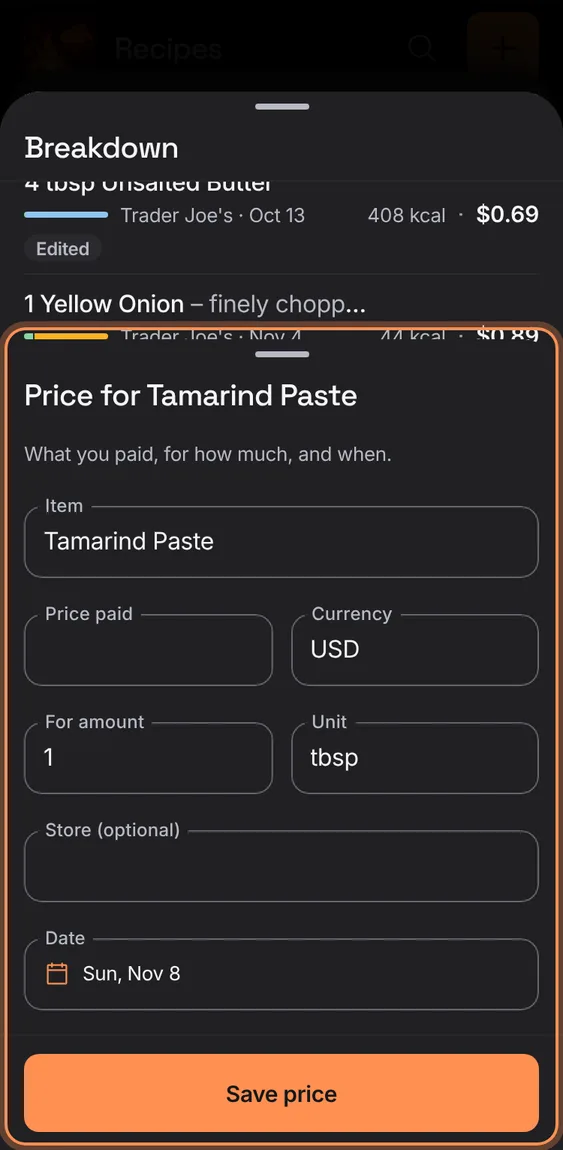
Record what you paid for an ingredient, for how much and when; recipe costs use the latest price in a unit that converts.
In Breakdown, tap + Price on an unpriced line.
Enter the price, currency, amount and date, then Save price.
The cost is shown only when every line that can be priced has a price; otherwise it says how many are priced.
Prices come from Kroger matches and prices you add.
Every ingredient is matched to a USDA FoodData Central food and weighed, behind the scenes; the recipe's own headline figures are never used.
Nothing to do: lines are matched as they're saved, signed in.
Not in the demo. Needs an account: the demo has none.
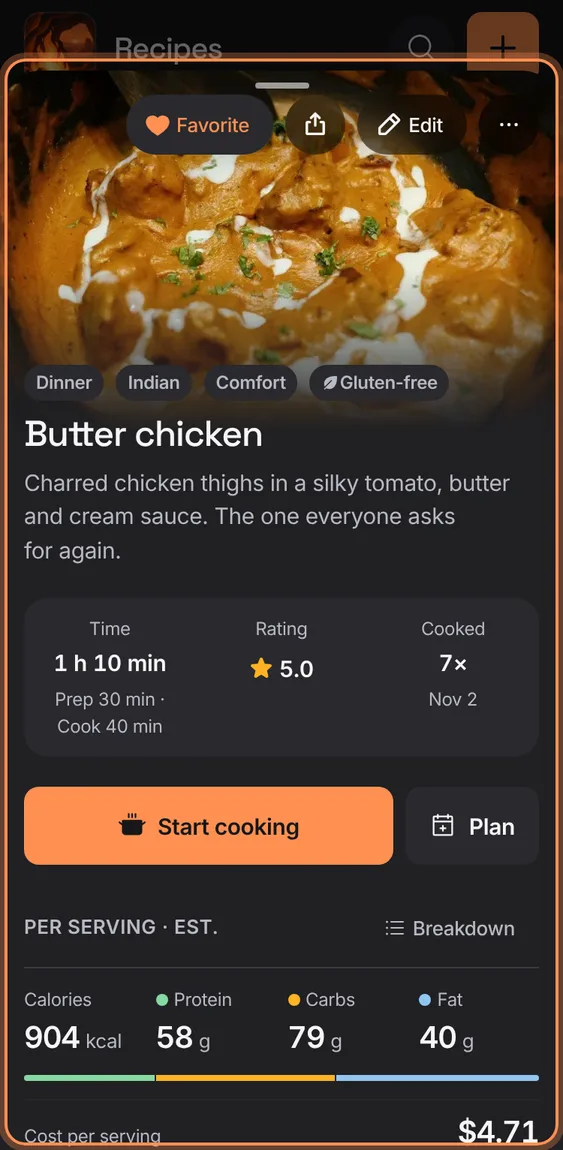
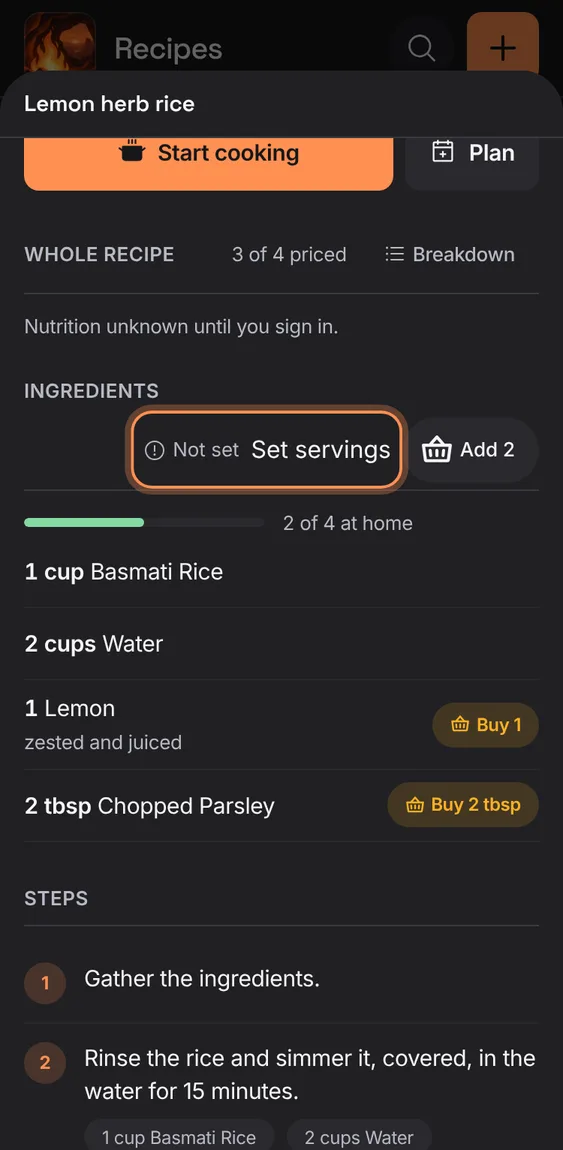
A recipe on one page: its photo, what it is, time, rating and cooks, Start cooking and Plan, nutrition, ingredients against your pantry, the steps, notes and ratings.
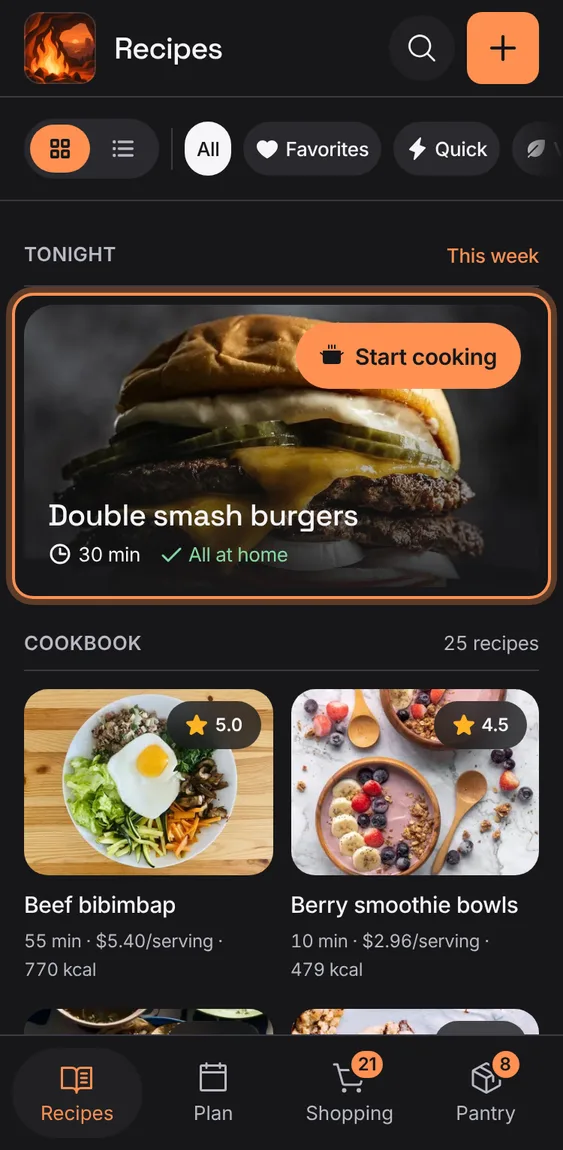
Tap a recipe anywhere: the cookbook, the plan, the pantry.
Close it by tapping outside, Back, or pulling it down.
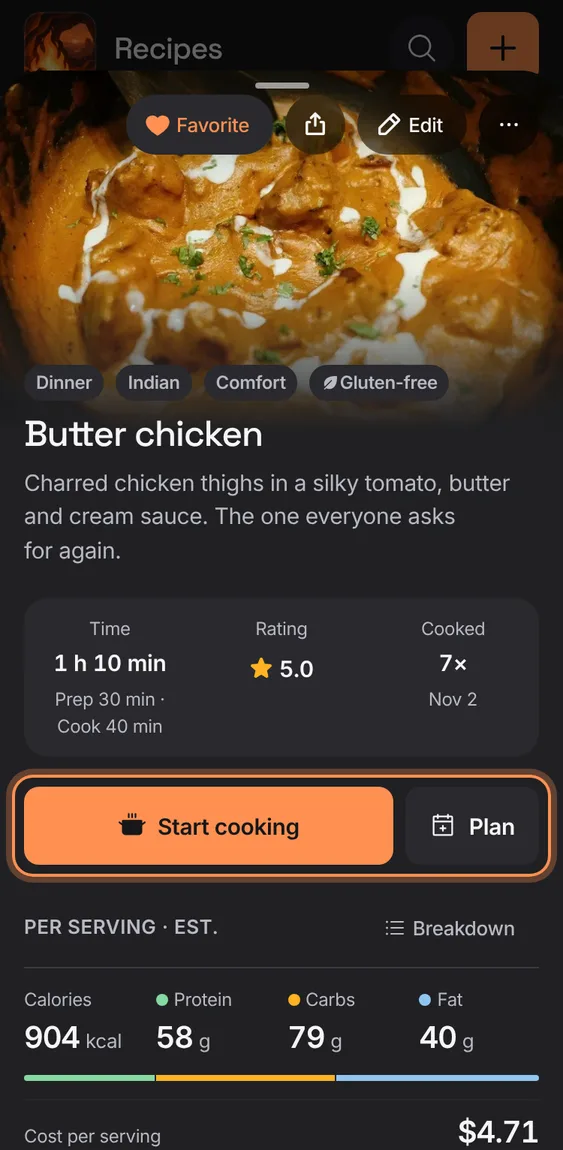
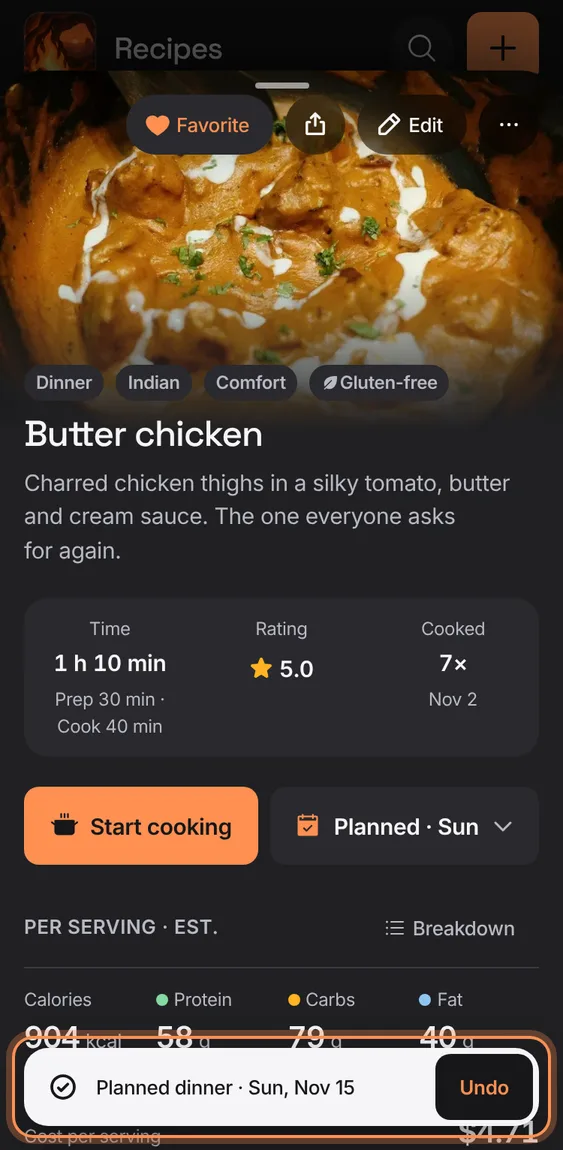
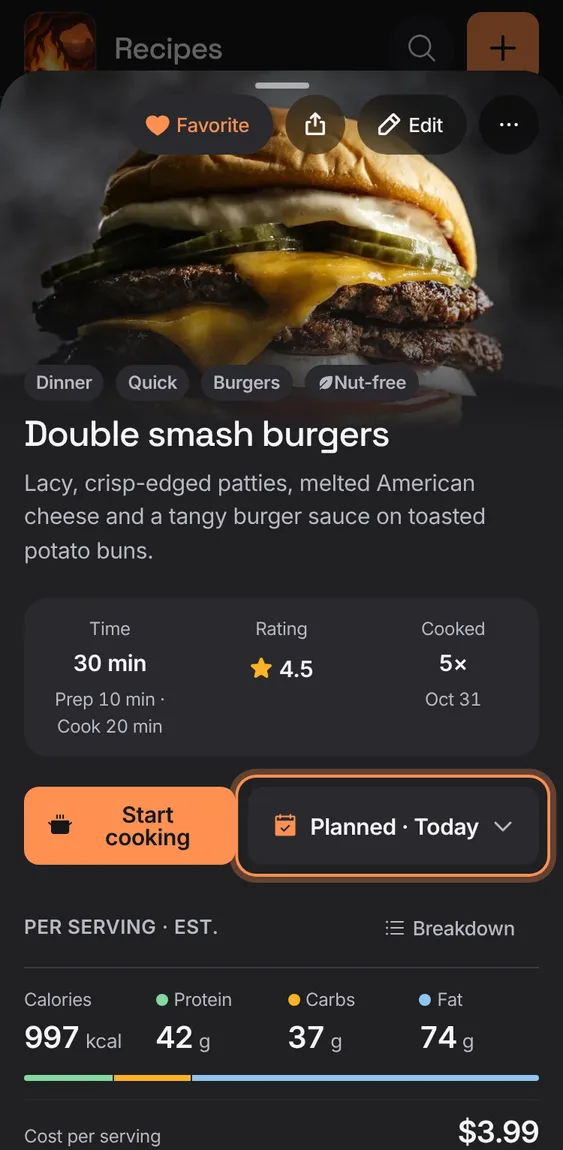
Two big buttons under the facts: Start cooking, and Plan, which reads "Planned · Wed" once it's on the plan.
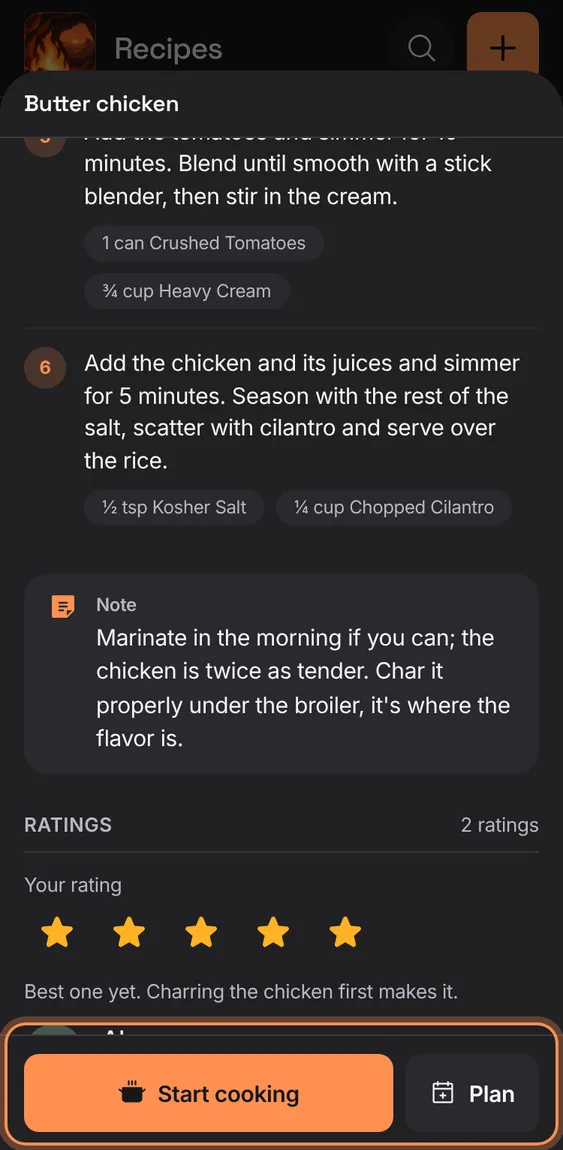
Scroll down and they stay pinned at the foot of the screen.
Put the recipe on a day and meal in a few taps, at the servings you want.
Tap Plan.
Pick a day from the next two weeks (or another date), then the meal.
If something is already planned there, choose Replace or Add alongside.
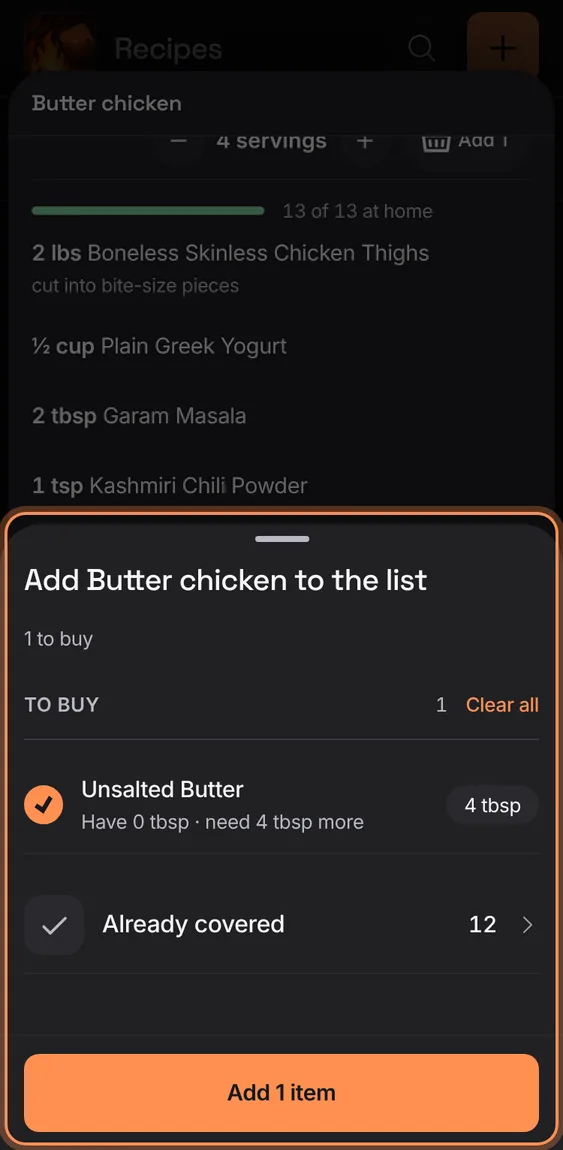
The basket by Ingredients adds what's missing to the shopping list, at the servings shown.
Tap the basket ("Add 3").
Check what to add and tap Add.
When everything's covered, a toast says so; Show lists what covers it.
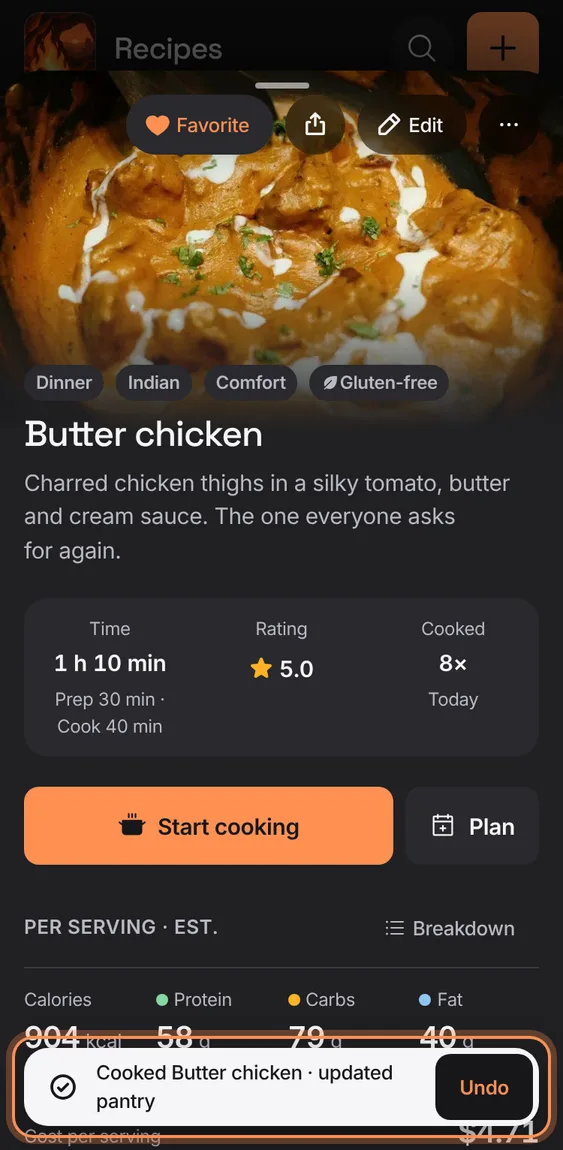
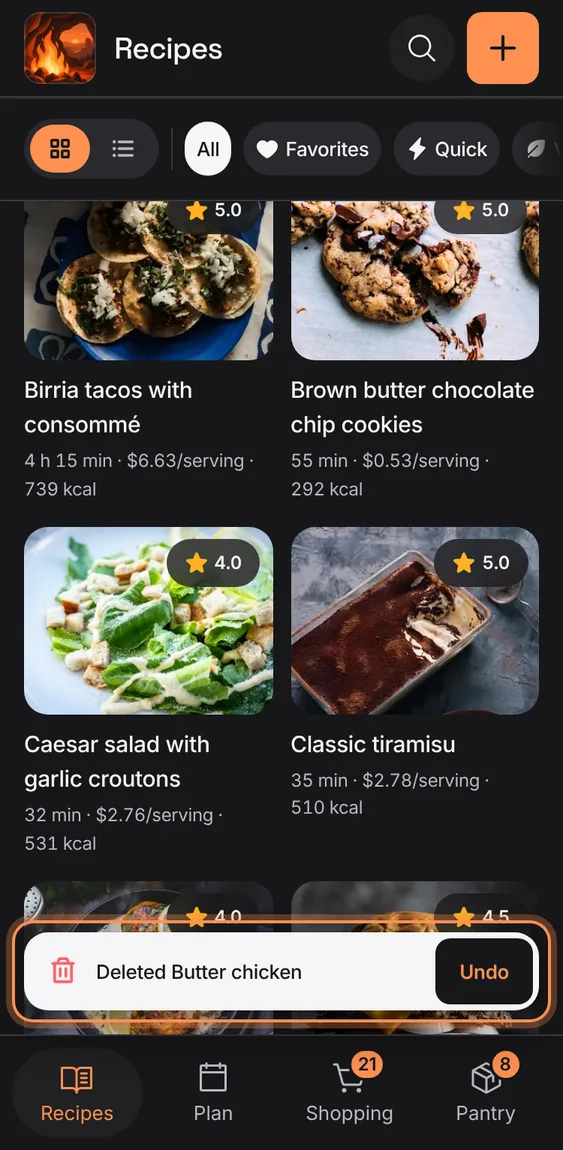
Deleting a recipe asks first, says which planned meal goes with it, and then can be undone from the toast.
⋯ › Delete recipe, or Delete recipe at the end of the editor.
Tap Undo on "Deleted …" to bring it back with its cooks, ratings and planned meals.
Scroll down a recipe and its title stays on top while Start cooking and Plan are pinned at the foot.
Scroll the recipe.
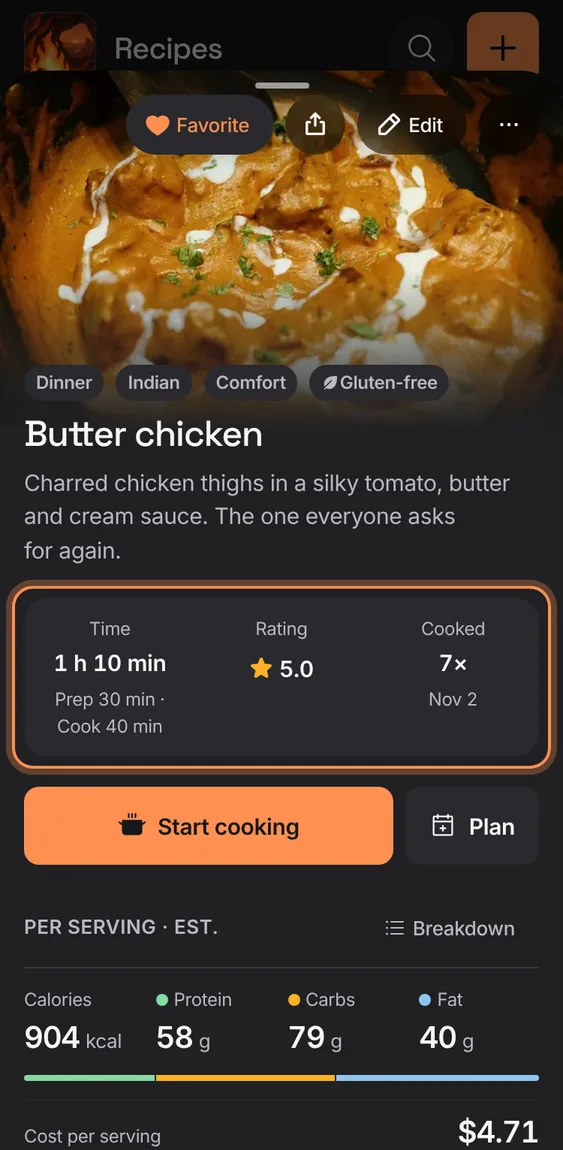
Three figures under the title: the total time with prep and cook, the household's average rating, and how often it's been cooked and when last.
Tap the rating to rate it yourself.
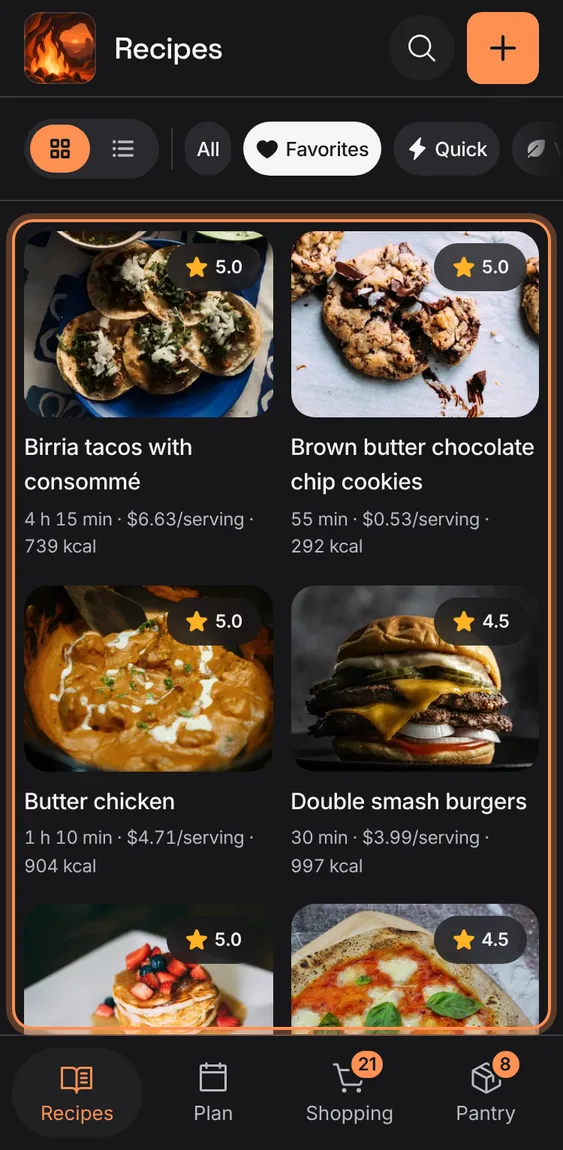
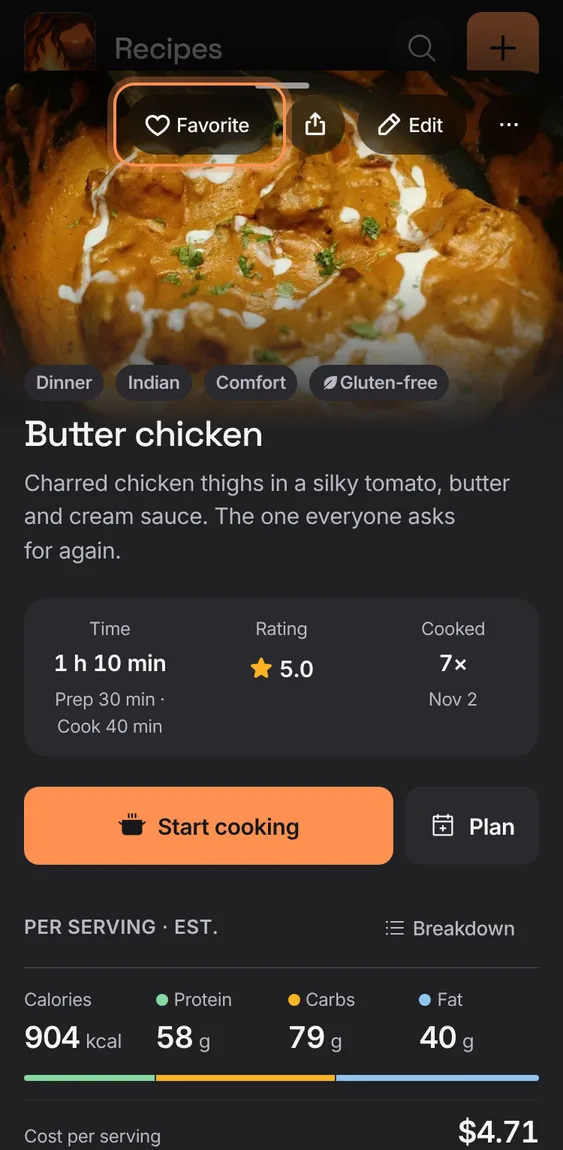
Mark a recipe with a heart so the Favorites chip finds it.
Tap Favorite on the photo; tap again to unmark.
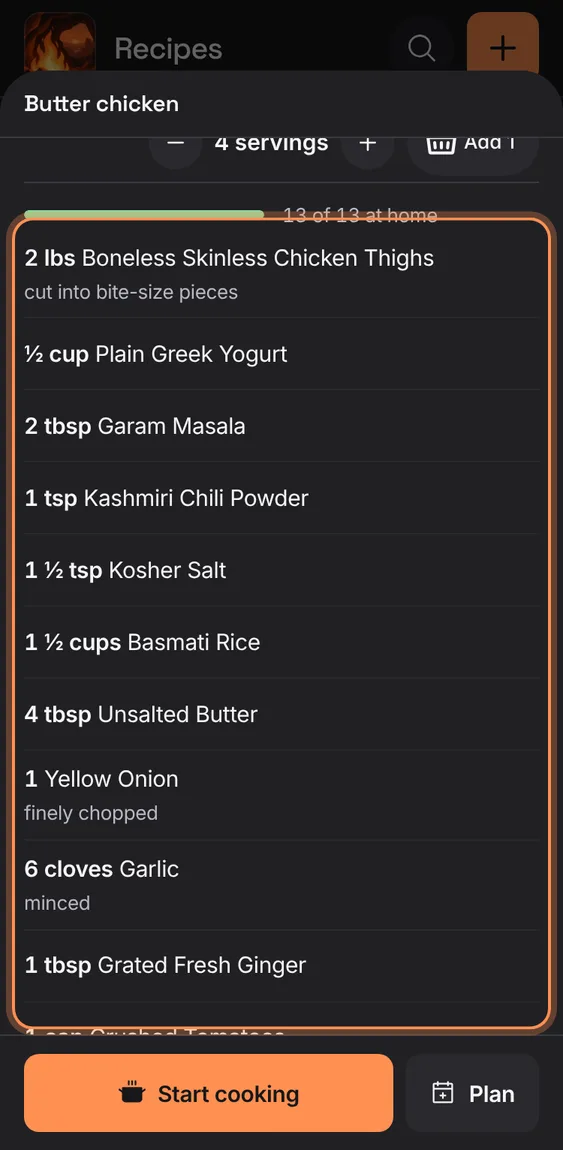
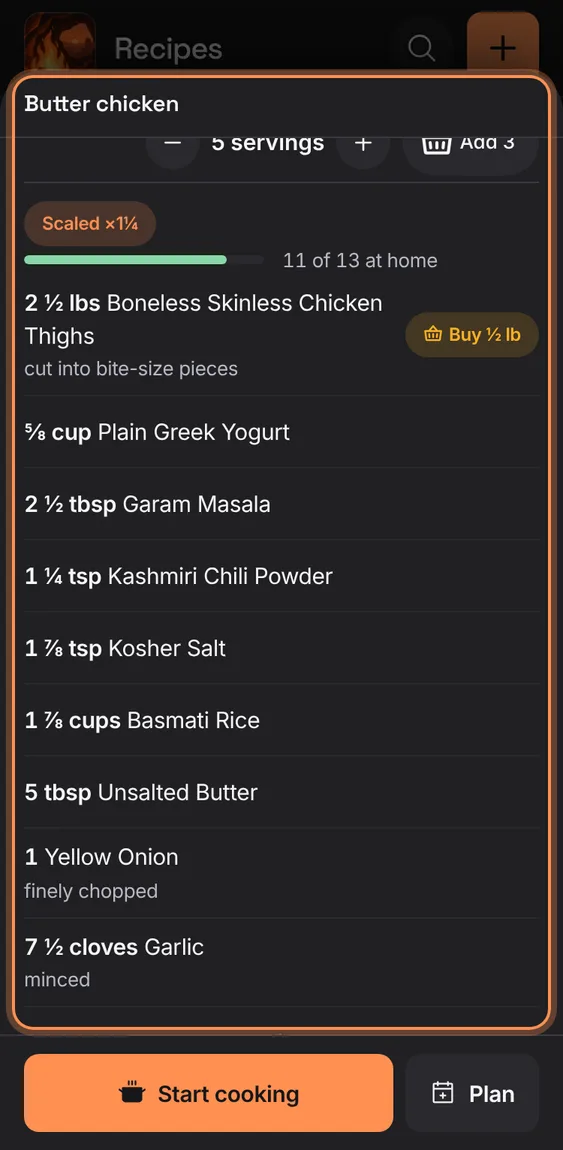
Each ingredient reads like a cook writes it: the amount in kitchen fractions, the food by name, and its preparation underneath, under the recipe's own headings.
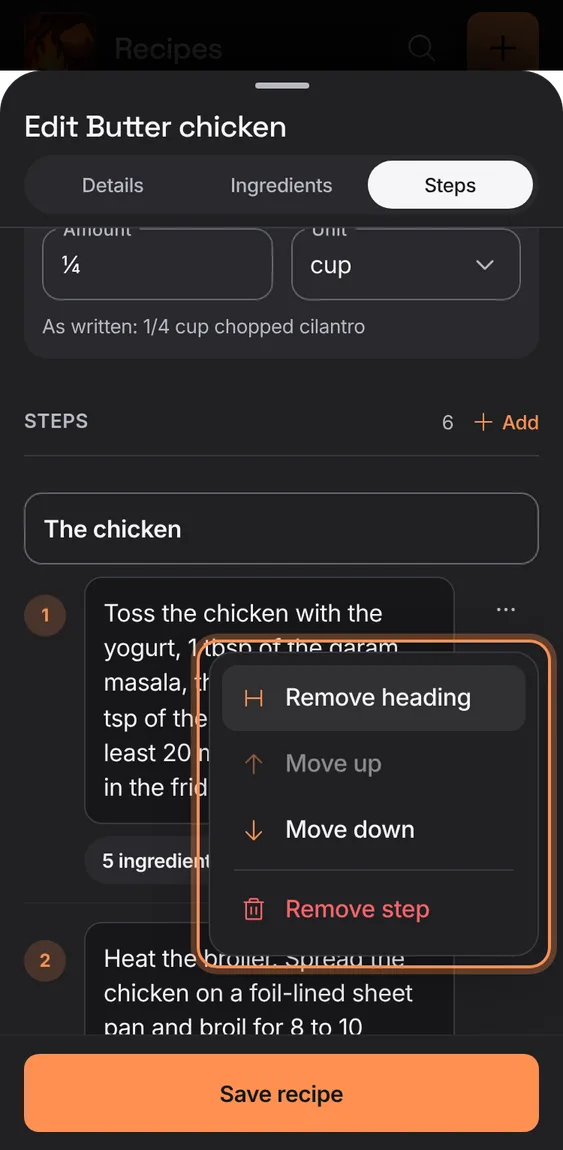
Headings such as "For the sauce" group the lines as the recipe does.
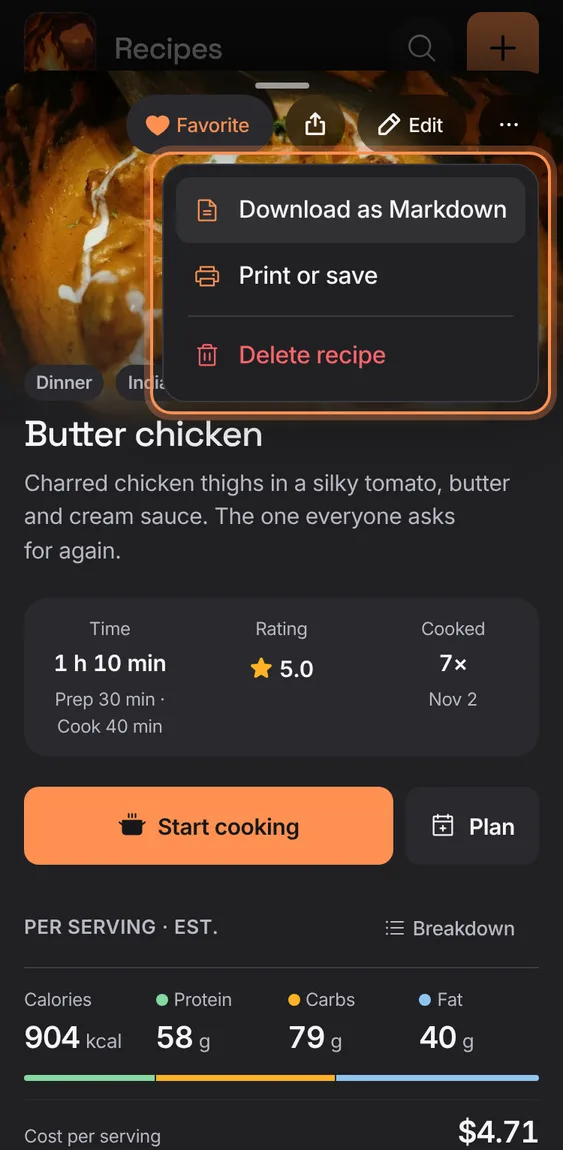
The recipe's ⋯ menu saves it as a Markdown file, prints it, or deletes it.
Tap ⋯ on the photo.
Download as Markdown, Print or save, or Delete recipe.
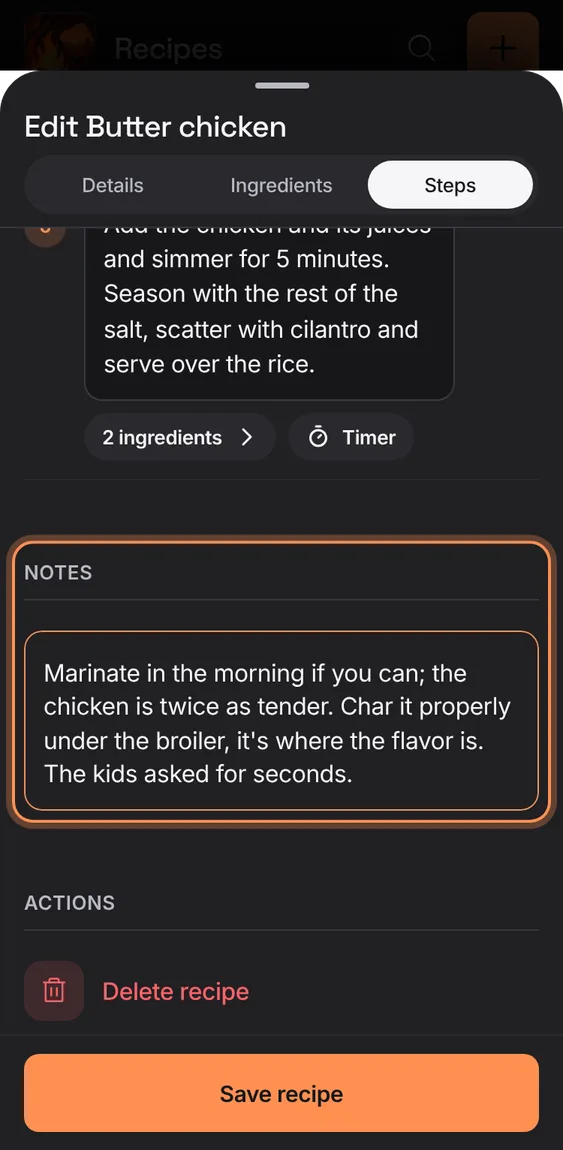
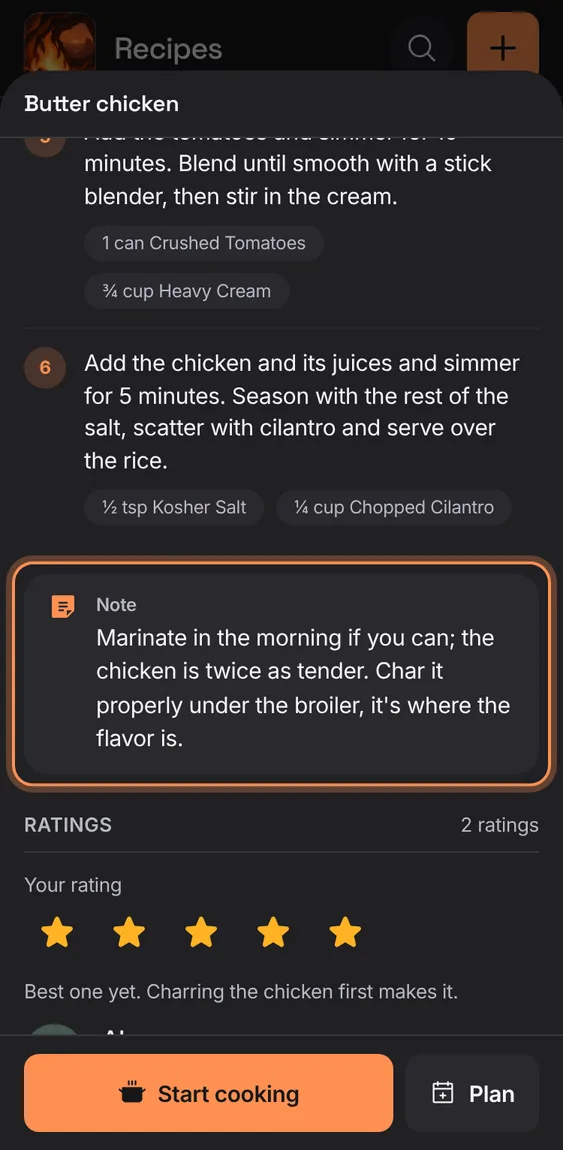
The recipe's note (swaps, tips, what the kids thought), labelled as a note.
Write it in the editor's Notes.
Once a recipe is planned in the next two weeks, its Plan button says when, and opens that meal to change it.
Tap "Planned · Wed" to move it or change its servings; it never replaces another meal unless you choose Replace.
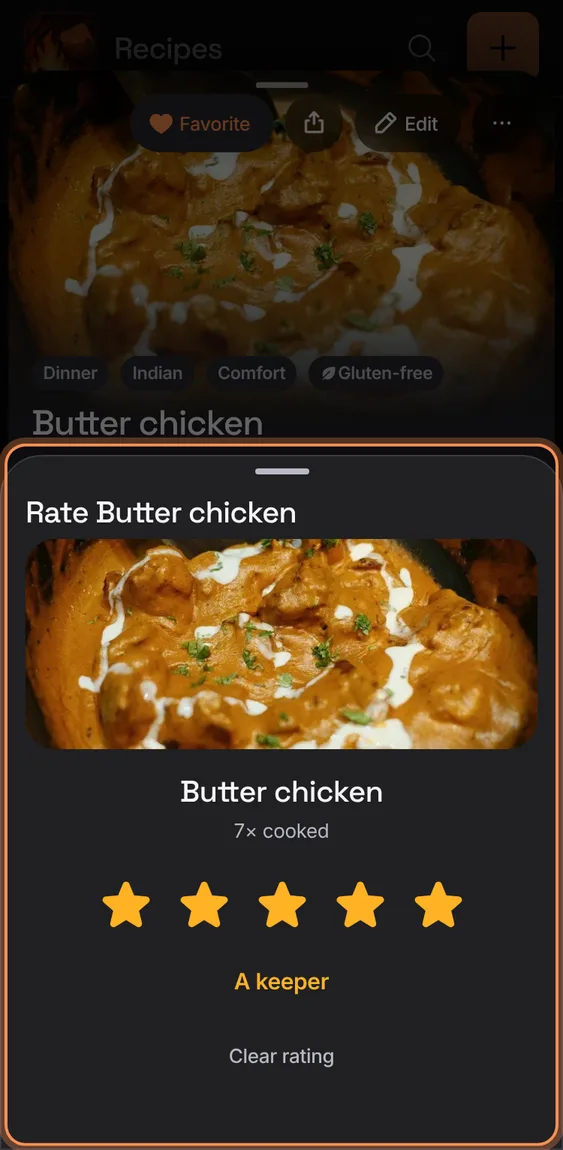
A small dialog with five stars that save as you tap, a word for each ("A keeper"), and Clear rating.
Tap the rating figure on the recipe.
Undo is on the toast.
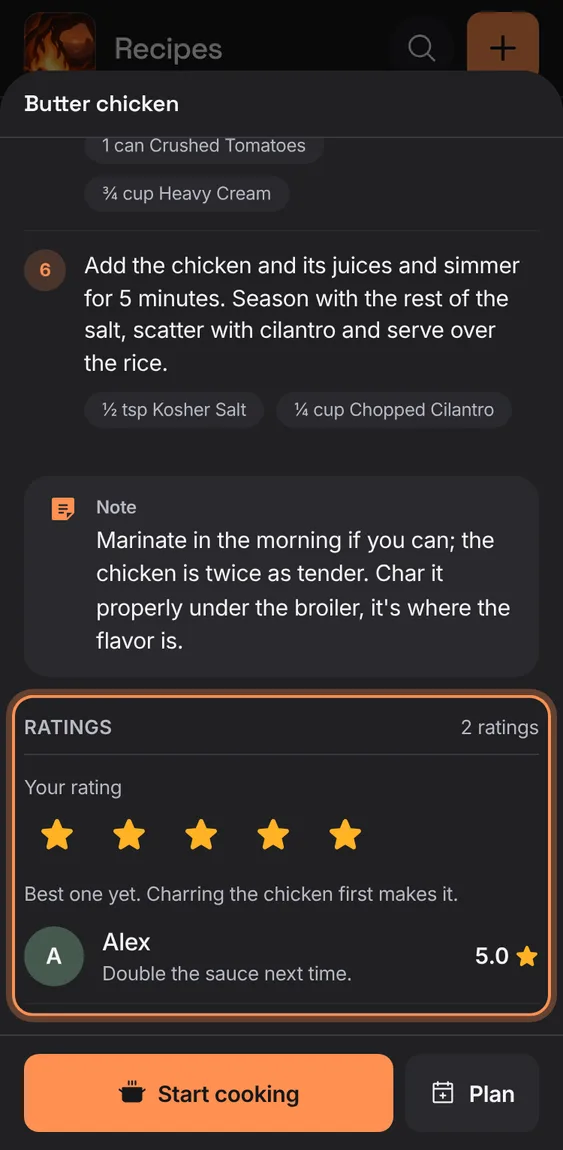
Your own star rating, and every household member's rating and note under their name.
Tap a star under Your rating; it saves at once.
Ratings by others show their name and note.
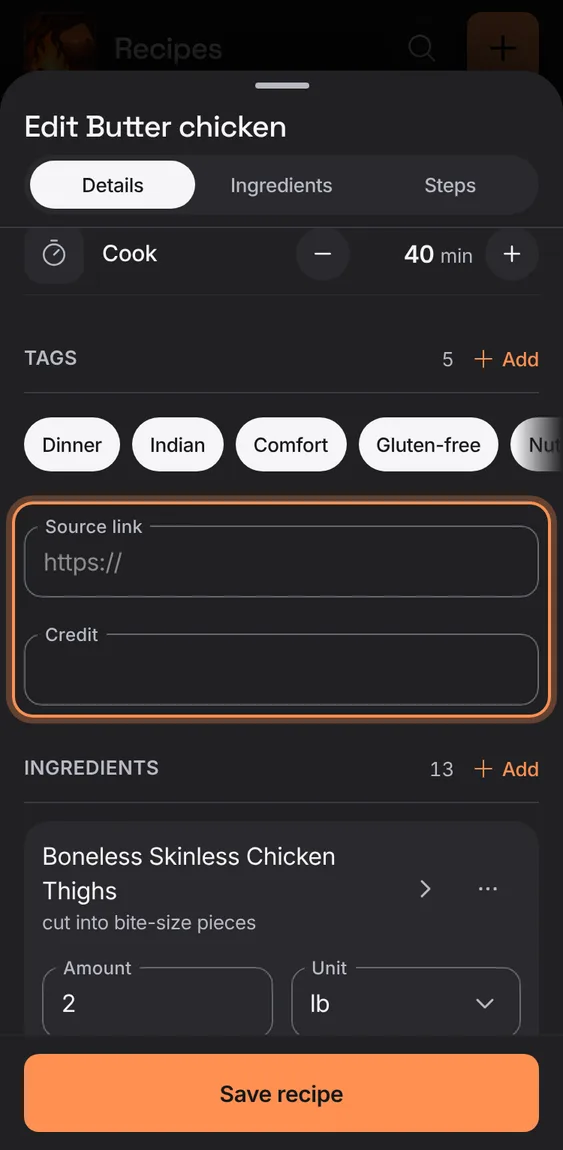
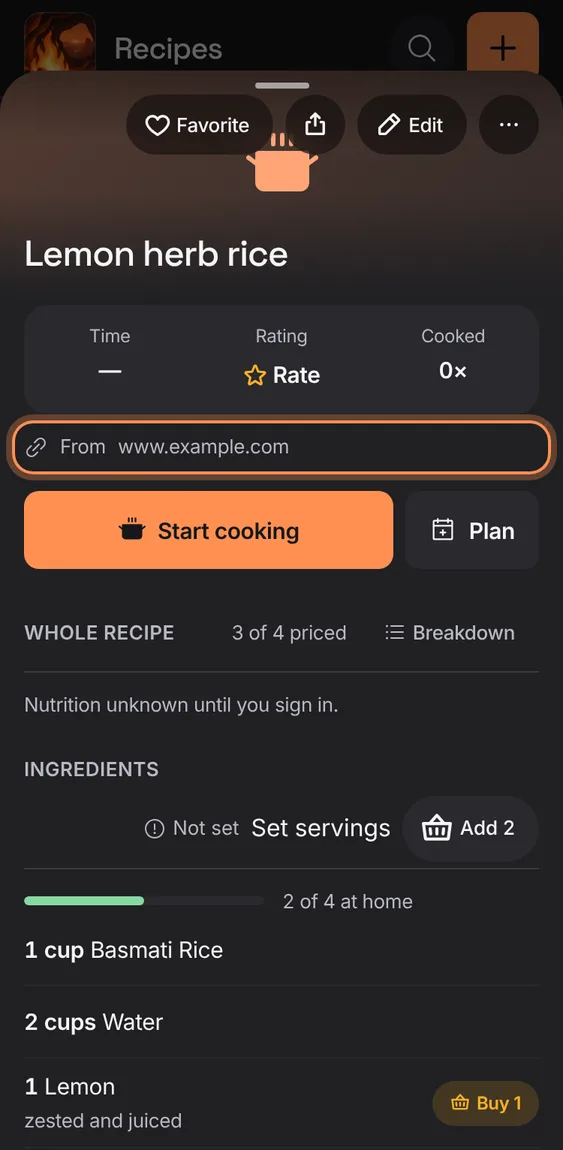
A recipe from the web links back to its page, credited by name, and says what it makes.
Tap the source to open the original page.
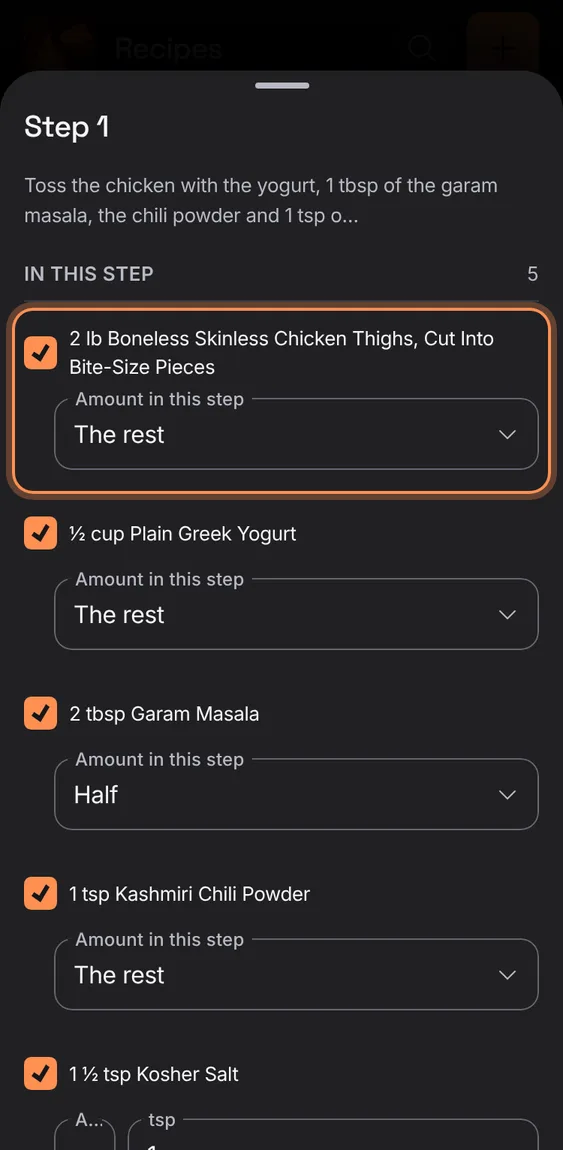
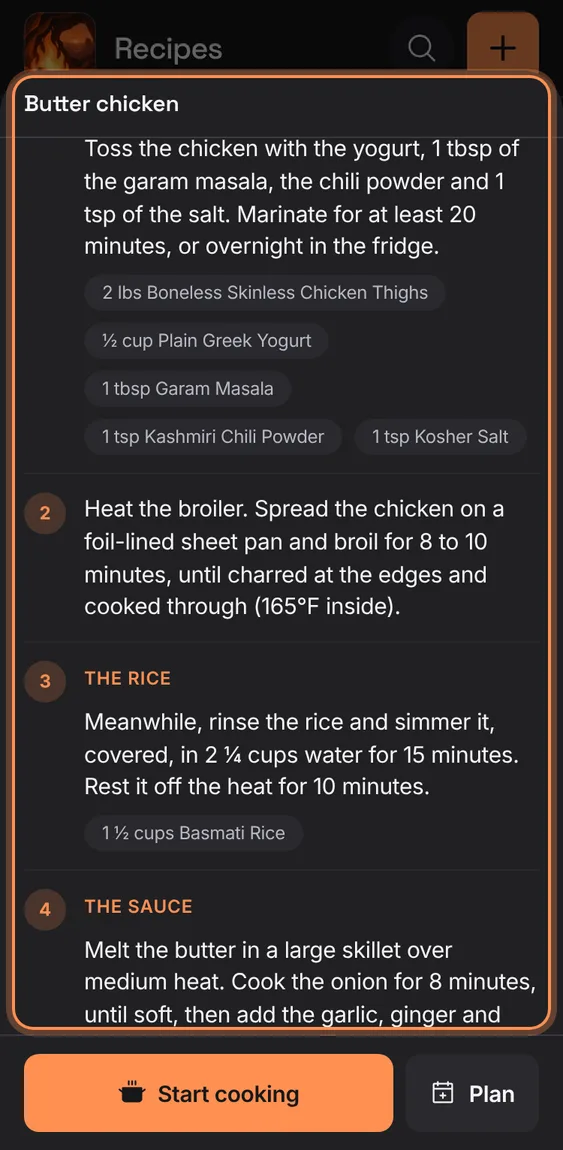
Each numbered step lists the ingredients it uses, with that step's own amount.
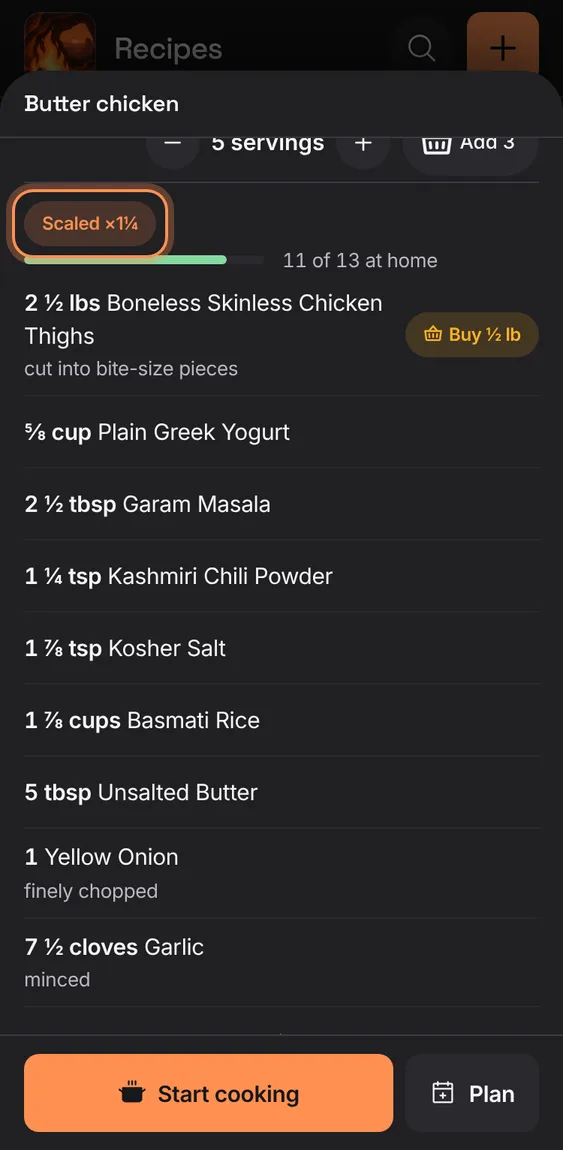
A step's amounts follow the servings you choose.
Recipe-wide totals are marked "Recipe total".
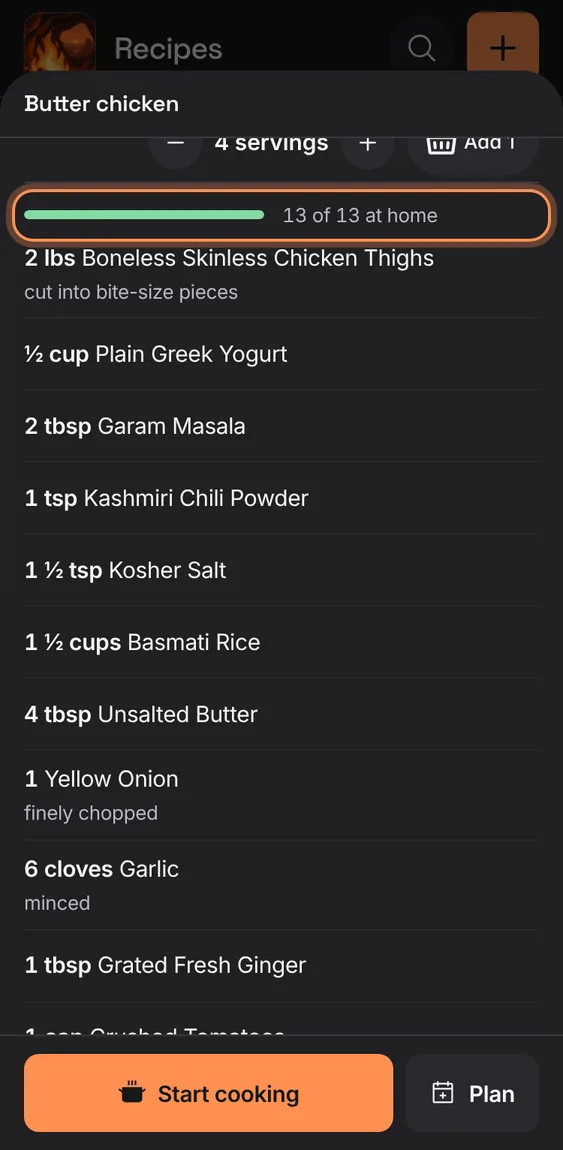
The ingredients are checked against your pantry and list: "9 of 11 at home", and each missing line says what to buy or that it's on the list.
Lines you have enough of say nothing.
"Buy 1 lb", "On list" or "Check" marks the others.
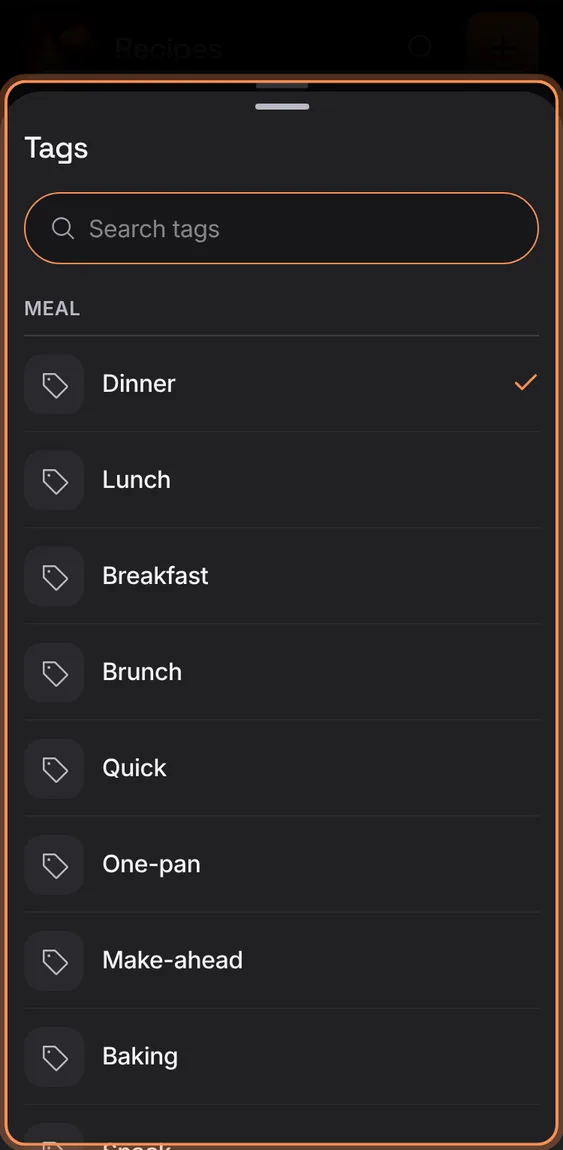
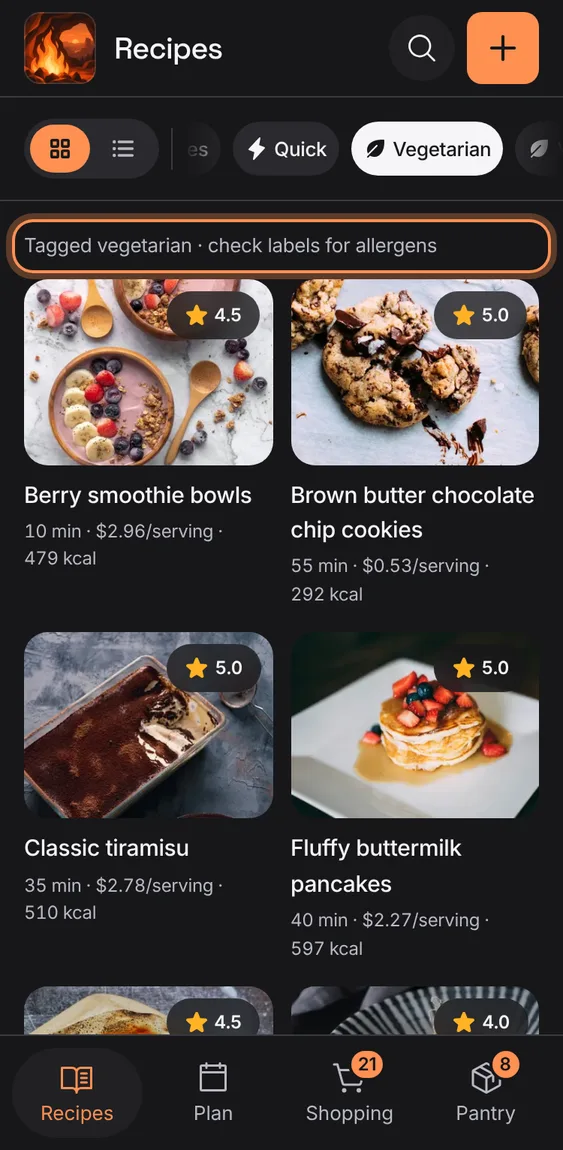
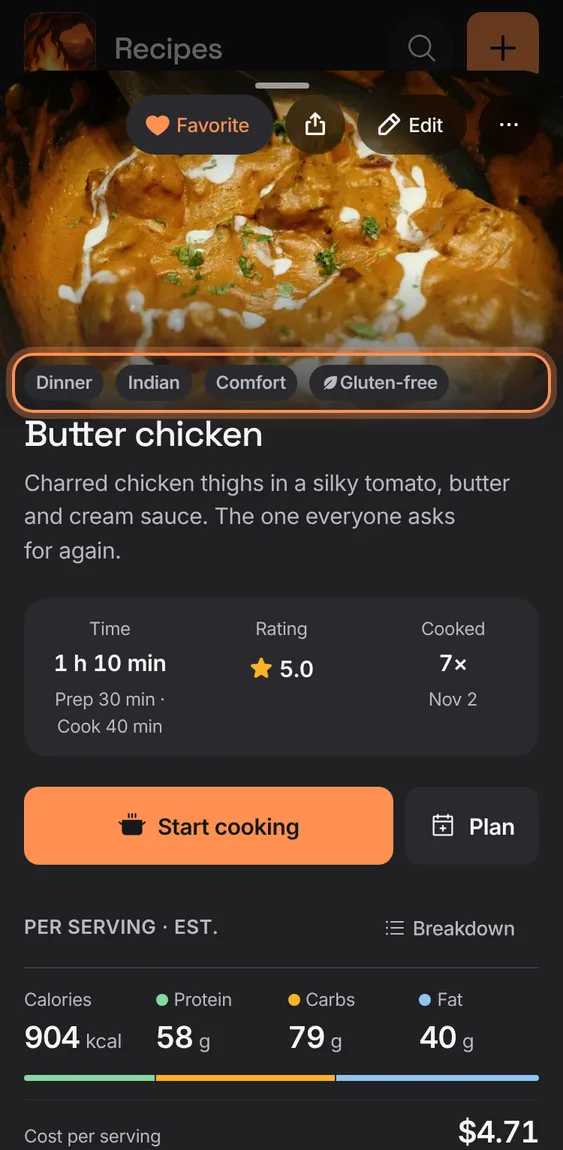
The recipe's first tags above its title; a diet shows with a leaf and reads "Tagged dairy-free" to a screen reader.
Tags come from the editor's Tags.
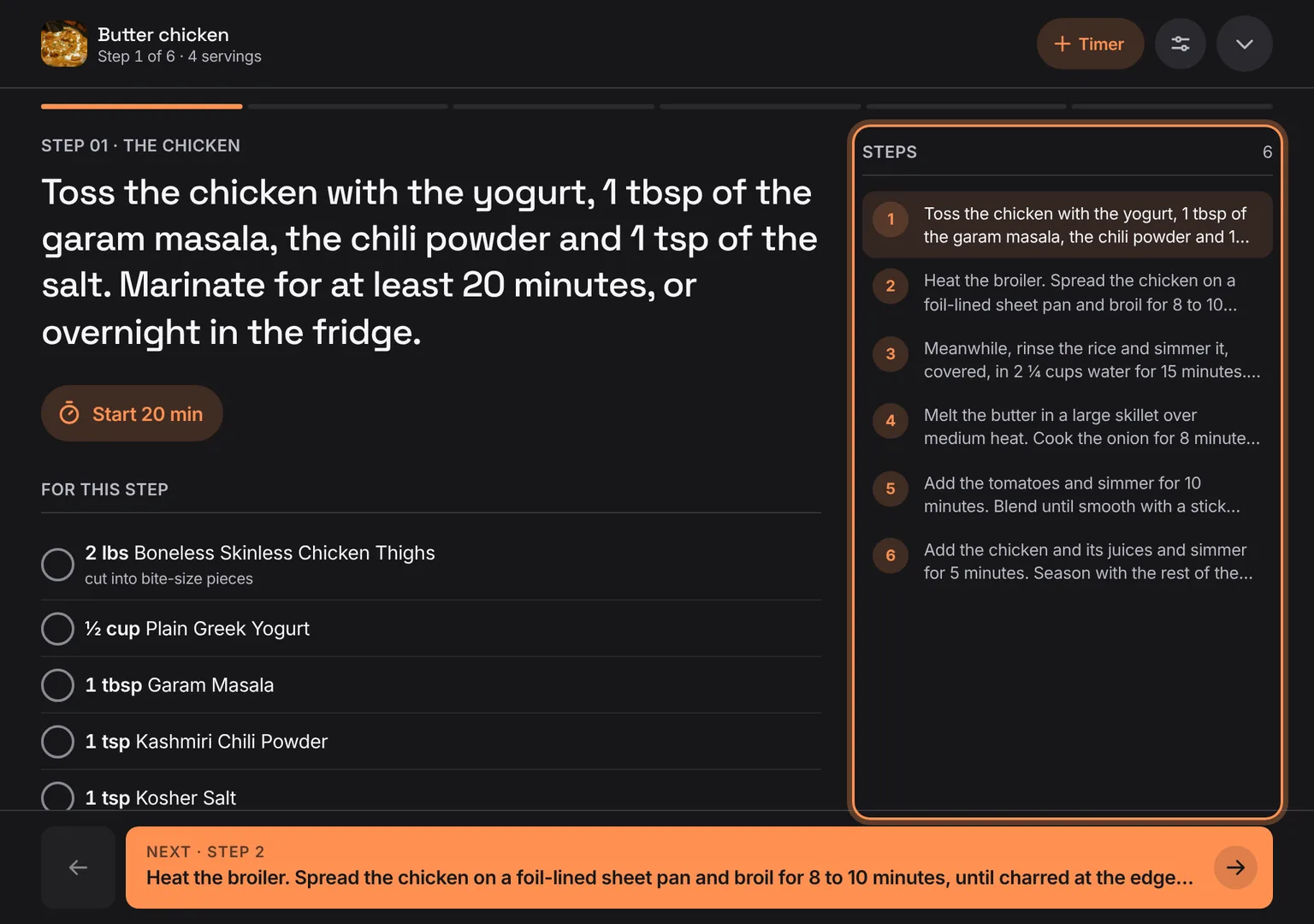
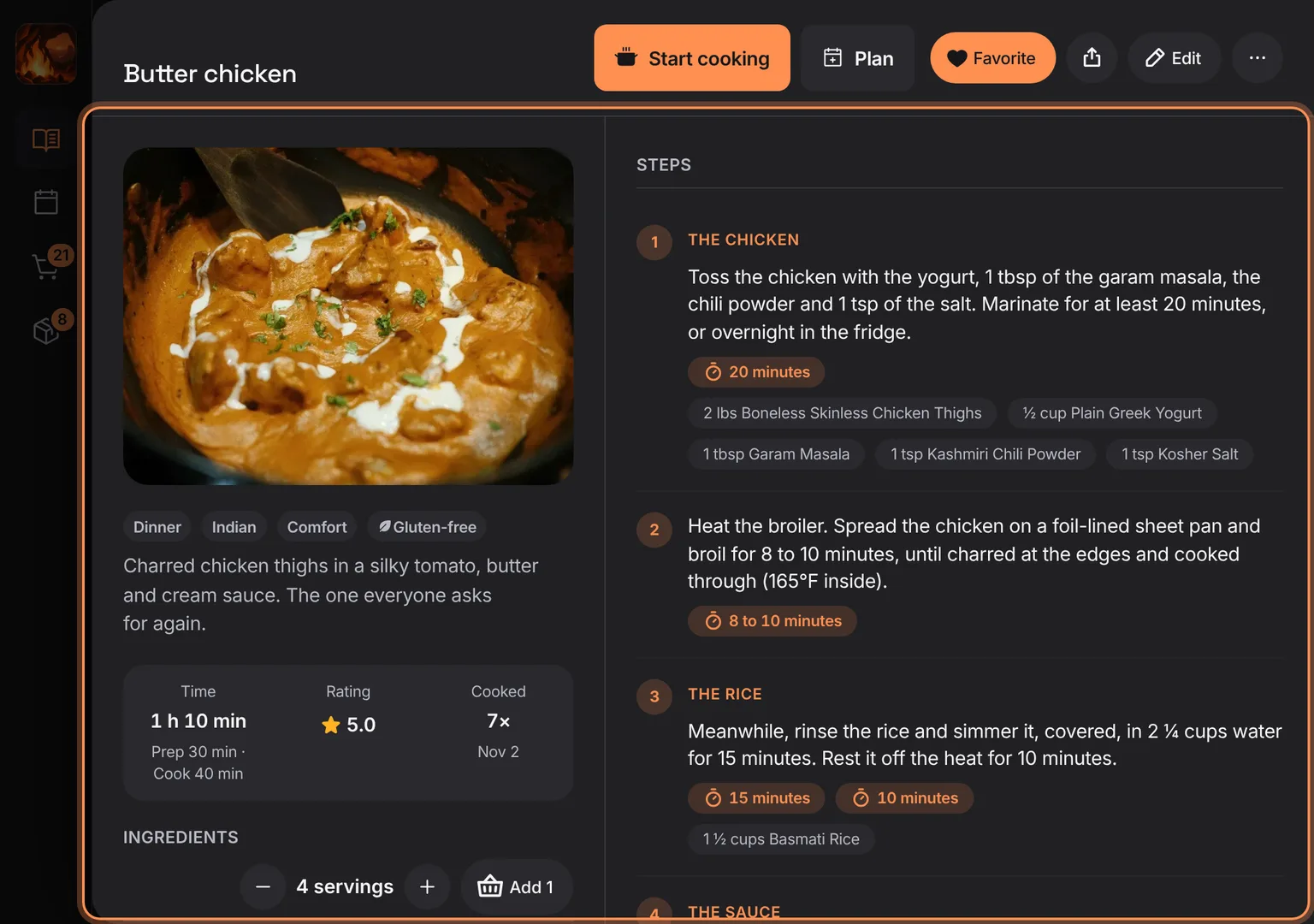
From laptop width the recipe is two columns beside the list, with Start cooking and Plan in a bar on top.
Open a recipe on a computer or a large tablet.
Shown at a computer’s width.
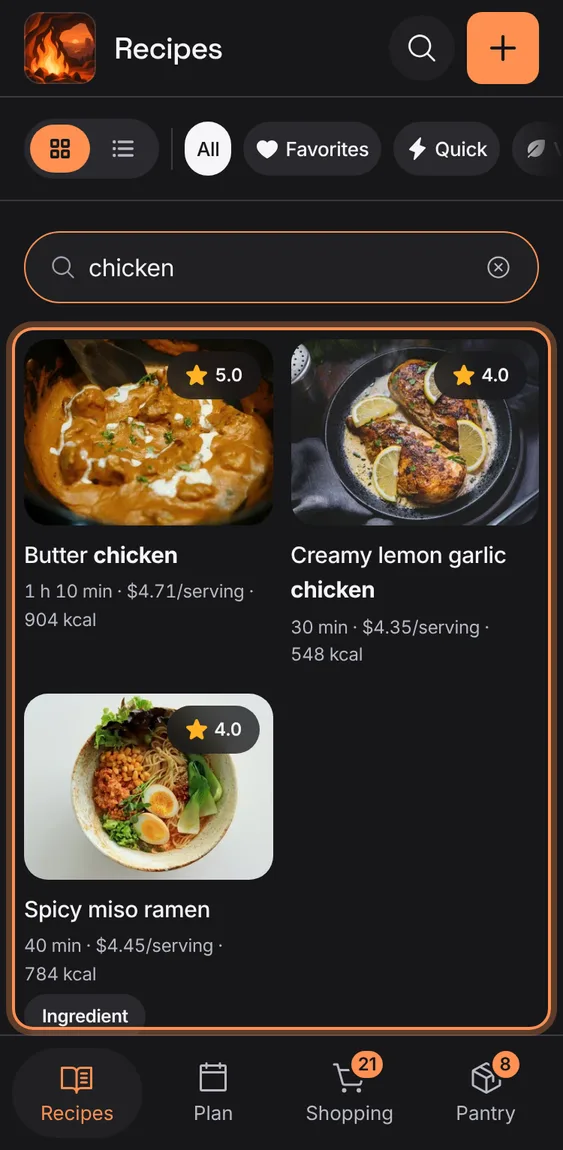
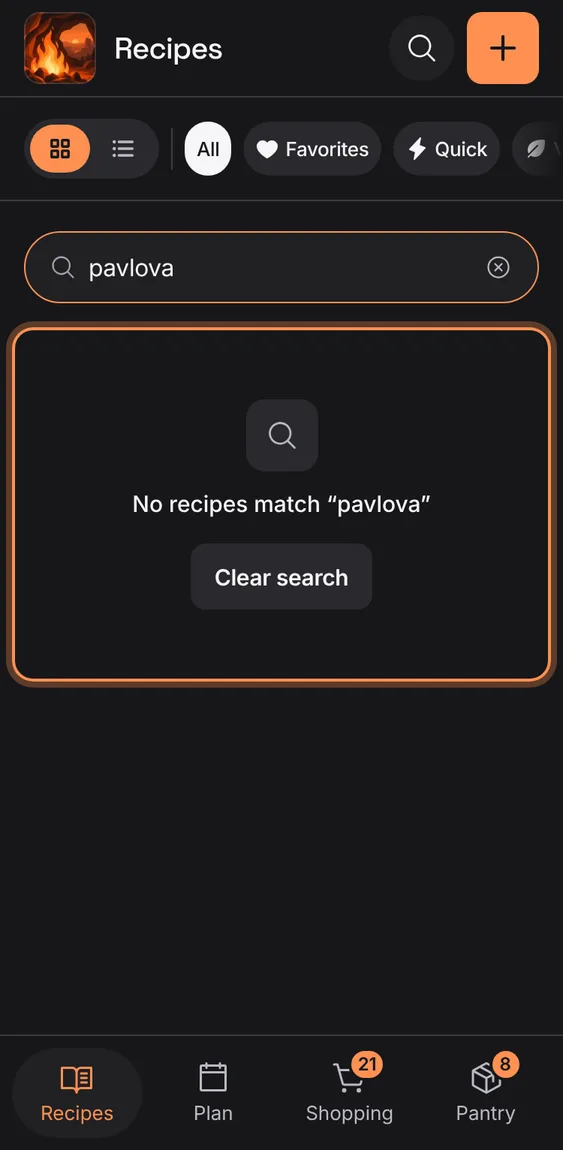
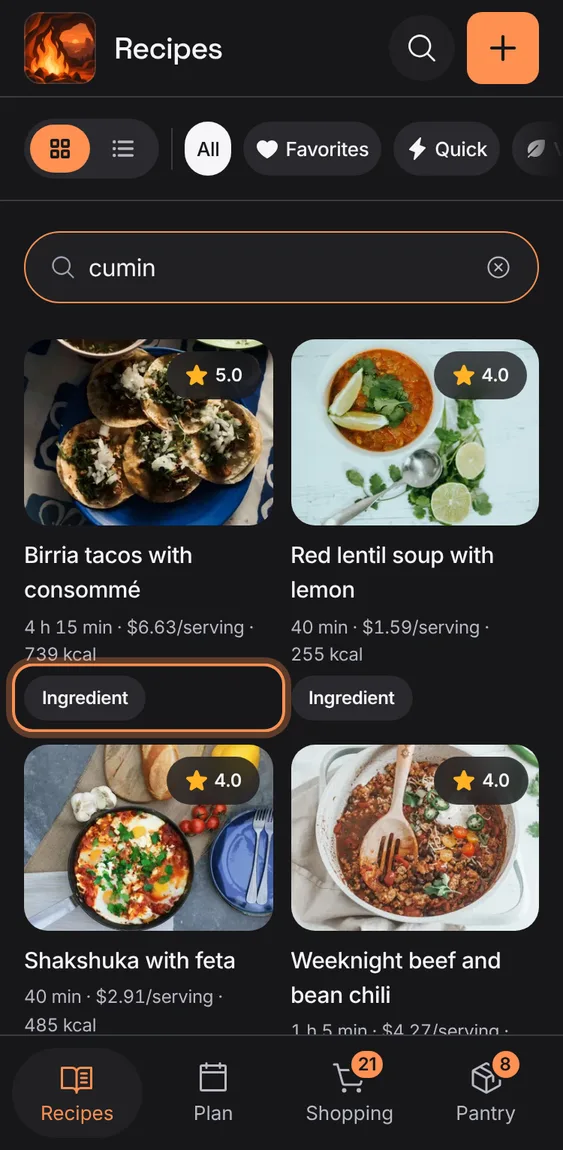
Find a recipe by its name, an ingredient, a tag or its description.
 Hearth